How Many Hours to Study for the MCAT? (Real Data)
By Dr. Sarah Johnson • Updated 9/3/2026
Short answer: budget 300 to 500 focused hours for the MCAT. The median student actually reports 475.
But that number is nearly useless on its own, and here is why: the hours you need depend almost entirely on where you are starting from and how many points you need to gain.
Every other page answering this question repeats the same figure, “300 to 350 hours,” and none of them shows you the data behind it. So we went looking.
We read 43 real posts on r/MCAT where students reported both their total study hours and their actual score. Two things came out of that which you will not find anywhere else on this question.
The 30-second answer: the middle 50% of students report between 300 and 600 hours, with a median of 475. More hours did not predict a better score. Index your plan to your score gap, not to a number you read on a blog.
In this guide
- What 43 real students reported
- Where “300 to 350 hours” came from
- How many hours you need, by starting point
- No science background, working, or retaking
- Hours per week by timeline
- The hours you cannot skip
- Why hours are the wrong unit
- Turning hours into a schedule
What 43 Real Students Actually Reported
We collected every r/MCAT post we could find where a student gave a specific hours figure alongside a specific score. That produced 43 usable data points, spanning reports from 2017 through 2026.
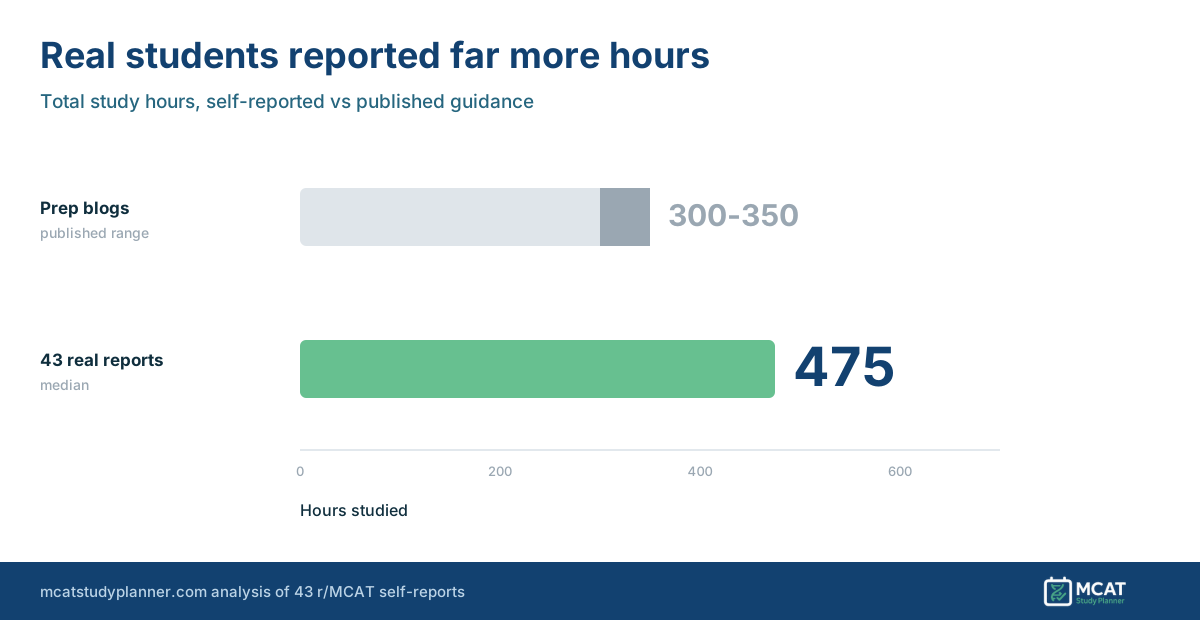
The median was 475 hours, roughly 36% to 58% higher than the 300 to 350 figure the industry publishes.
| Statistic | Hours |
|---|---|
| Lowest reported | 45 |
| 25th percentile | 300 |
| Median | 475 |
| 75th percentile | 600 |
| Highest reported | 2,625 |
Then we plotted hours against score, and the result is the more useful finding.
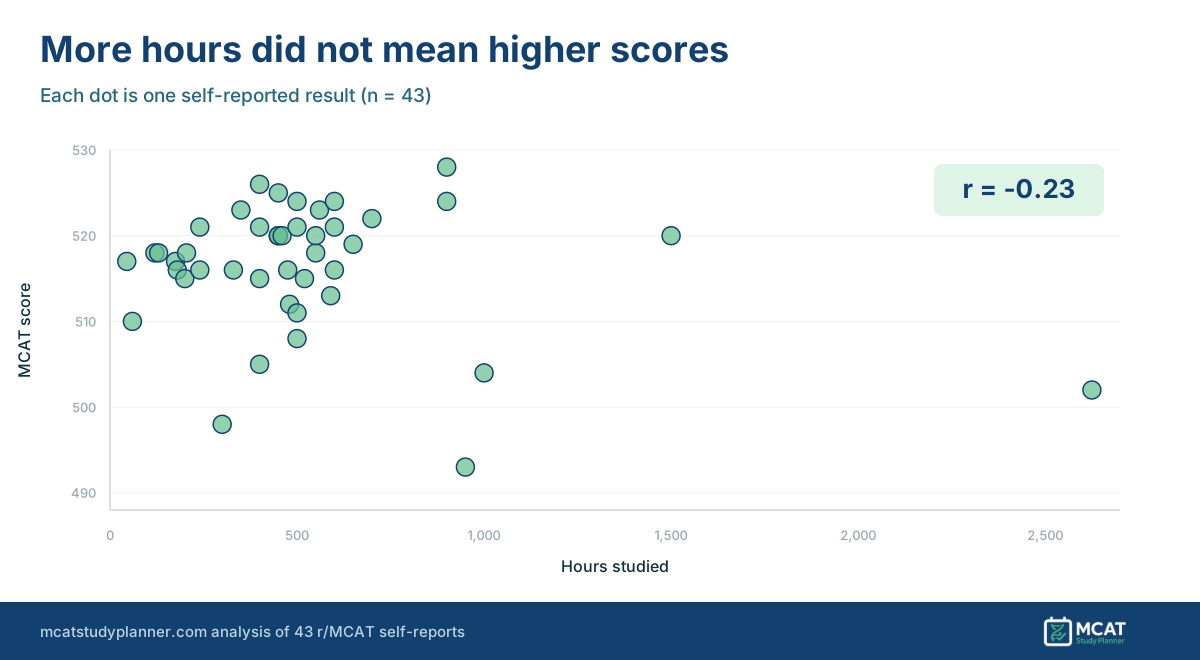
The correlation between total hours studied and final score was slightly negative (r = -0.23).
The overlap is close to total:
- Scores of 515 or higher were reported at 45, 120, 130, 175, 180 and 200 hours.
- Scores below 510 were reported at 950, 1,000 and 2,625 hours.
- Grouped into bands, median score barely moves: 517 under 200 hours, 516 from 200 to 399, 518 from 400 to 599, 522 from 600 to 999, and 504 above 1,000 hours.
Before you conclude anything from this, read the limitations, because they change the interpretation completely.
What this data is not: it is 43 self-selected, self-reported posts. The median score in our sample is 518, which sits around the 91st percentile nationally against a real mean of 500.6, so these are high scorers and not a representative sample. Only about four of the 43 tracked hours with a timer. Students who never reached their target score often stop posting. And the negative correlation is confounded: students starting at 488 study more because their gap is bigger. The honest reading is not “study less.” It is that total hours is a downstream symptom of your starting gap, not a lever you pull.
Where the “300 to 350 Hour” Number Actually Comes From
We tried to trace it to a source. It does not have one.
The figure appears to originate in Kaplan marketing copy, and the AAMC has never published an hours recommendation at all.
Here is what we could verify:
- Kaplan’s own wording cites nobody. Its guidance reads that “Experts recommend that students spend 300-350 hours studying,” with no named experts and no citation (via AMSA).
- The AAMC’s official study-plan page contains no hours, weeks, or months figure at all. It is structured as assess, then study and practice in a cycle, then take practice exams. Its emphasis is explicitly on method rather than duration: “Active learning requires more than just reading or watching a video. You must engage in the learning process through recall, practice, and reflection” (AAMC).
- The AAMC does not even collect study hours. The Post-MCAT Questionnaire, which surveyed 81,077 invited examinees and received 24,721 responses, asks about preparation strategies, resources and challenges. Hours studied is not among them (AAMC PMQ report).
- The vendor numbers do not converge. Princeton Review says 200 to 300 hours. Kaplan says 300 to 350. Blueprint says at least 300. MedSchoolCoach prefers 400 to 500. Magoosh gives no total at all. Numbers drawn from a shared dataset would agree. These do not.
One more thing worth flagging: Blueprint attributes a figure of roughly 240 hours to the AAMC without linking it, and we could not find that number on any AAMC page we were able to access. Treat any “the AAMC says X hours” claim with suspicion, including that one. We applied the same scrutiny to their pricing and guarantees in our guide to the best MCAT prep courses.
How Many Hours You Actually Need, by Starting Point
This is the table the rest of the internet is missing. Hours should be a function of your score gap, so take a diagnostic first, then budget. Our guide to what an MCAT diagnostic score predicts works the same 43 reports the other way, through the 15 that recorded a starting score as well as a final one.
The ranges below are our framework, built from the gap logic and anchored to real reports in our dataset.
| Your score gap | Budget | Real reports at this gap |
|---|---|---|
| 0 to 5 points | 120 to 250 hrs | 512 to 518 in 120 hrs; 510 to 517 in 175 hrs |
| 6 to 12 points | 300 to 500 hrs | 504 to 521 in 240 hrs; 501 to 521 in 500 hrs |
| 13 to 20 points | 500 to 700 hrs | 497 to 516 in 600 hrs; 502 to 524 in 500 hrs |
| 20+ points | 600+ hrs, staged | 485 to 498 in 300 hrs; 488 to 493 across 950 hrs |
That last row is the one to take seriously. A very large gap is the case where extra hours reliably stop working. One student in our dataset studied roughly 950 hours across three years and took more than 35 full lengths, moving from a 488 diagnostic to a 493. If you are 20 or more points away, the answer is usually a change in method, not more time on the clock.
The Three Situations Nobody Plans For
Google’s autocomplete for this question surfaces three specific variants: no science background, full-time job, and retake. Not one of the pages currently ranking segments its hours estimate by any of them.
If you have no science background
Budget 400 to 700 hours and give yourself five to six months. Learning content for the first time is slower than refreshing it, and the gap shows up almost entirely in the content-review phase rather than in practice.
One student in our dataset taught themselves the sciences from scratch with no prerequisites in about 350 hours and scored 523, tracking their time with Toggl. Another, nine years out of coursework, needed 700 hours to reach 522 from a diagnostic around 507. Plan for the second case.
If you are working full time
Your total hours do not change much. Your calendar does.
At 12 to 15 hours per week, 450 hours takes about seven to eight months. In our dataset, one student working full time reported 900 hours across 6.5 months and scored 528, and another studying during classes logged 650 hours over 6 months at 3 to 4 hours a day, six days a week, for a 519.
If you are retaking
Retake plans should be diagnostic-led, not hours-led. The most instructive case in our dataset is a student who studied roughly 400 hours at 4 hours per day across three separate attempts, scoring 505, then 511, then 521. Same hours each round, and the gains came from changing what those hours contained.
Hours per Week by Timeline
Once you have a total, the arithmetic is simple. This table assumes a 450-hour target, close to our observed median.
| Timeline | Hours per week | Realistic for |
|---|---|---|
| 6 months | 17 to 19 | Working or in classes |
| 4 months | 26 to 28 | Part-time work, light course load |
| 3 months | 35 to 38 | Full-time studying |
| 2 months | 50+ | Small gaps only, high burnout risk |
Anything under two months means cutting total hours rather than compressing them. If that is your situation, our 30-day MCAT plan sets out what to drop, and the 10-week content review schedule shows how the content phase fits into a longer runway.
At twelve weeks the division is worth doing before you commit: our 3-month MCAT study schedule multiplies 40, 25 and 15 hour weeks out to 480, 300 and 180 hours and checks each against the quartiles above.
The Hours You Cannot Skip
Some of your budget is fixed by the official material itself. It is worth knowing that floor before you pick a number.
The AAMC now offers six scored practice exams, not the four that older guides still reference: Practice Exam 1 is free, Practice Exams 2 through 6 are $35 each, and there is also a free Unscored Sample Test of 230 questions with the same look, feel and length as the real thing but no scaled score (AAMC).
Seven exams at roughly 7.5 hours of seated time plus 4 to 8 hours of review each is 80 to 105 hours before you have opened a single content resource. Add the Section Bank (two volumes, 300 questions each at $45) and the Question Packs (720 questions), and official practice alone accounts for a large share of a 450-hour plan. The full online bundle runs 2,710 unique questions for $323.70.
Time-sensitive: the AAMC is retiring the CARS Diagnostic Tool, both CARS Question Packs and the Question Pack Bundle after September 14, 2026, and launching a new CARS Question Bank on September 30, 2026. If your plan was built around the old CARS products, the question-volume math is about to change.
Why Hours Are the Wrong Unit
The students who actually measured their time are the ones most skeptical of measuring time. That is worth sitting with.
An hour on the clock is not an hour of studying, and most people overestimate by roughly half.
One student who scored 515 and is now in their third year of medical school responded to another’s claim of eight-hour days:
I highly doubt it was 8 full hours, unless you were timing them. Even using pomodoro, I never hit over 5 hrs and usually hovered around 4 hours, but I “felt” I was doing 10 hrs per day.
A separate thread on hour-tracking drew the same observation, that “It is very easy to piss away an 8 hr day, and really only get about 4-5 hours of quality studying.”
Three more reasons the metric misleads:
- Anki time is systematically under-counted. Flashcard apps do not log the thinking you do after flipping a card. One student who reported 460 hours and scored 520 flagged this about their own number.
- Practice-question hours track score better than total hours. This is the recurring observation in StudentDoctorNetwork discussions on the topic, and it matches what we saw: the highest scorers describe question volume and review quality, not hours logged.
- Past a point, more hours actively hurt. A student who compressed about 1,000 hours into 17 weeks scored 504 and named burnout directly. A commenter confirmed the pattern: “1000 hrs in 17 weeks is a ton of studying & underperforming due to burnout is real.” One 500-hour student who scored 508 described themselves as “the perfect case study for quality over quantity.”
None of this means hours are irrelevant. At the bottom of the range they clearly matter, and 50 hours will not produce a competitive score. It means hours are a budget, not a strategy.
Turning Your Hours Into an Actual Schedule
A total is only useful once it has dates attached. Four hundred and fifty hours means nothing until it becomes “Tuesday, 6pm, biochem discretes.”
That conversion is exactly what our free MCAT study schedule generator does: you give it your test date and how many hours per week you can genuinely commit, and it lays the content review, practice and full lengths across your calendar, with .ics export so it lands in the calendar you already use. If you want the full method those hours slot into, from the free Sample Test baseline to the last practice exam, our step-by-step guide to studying for the MCAT lays it out with a number on every step.
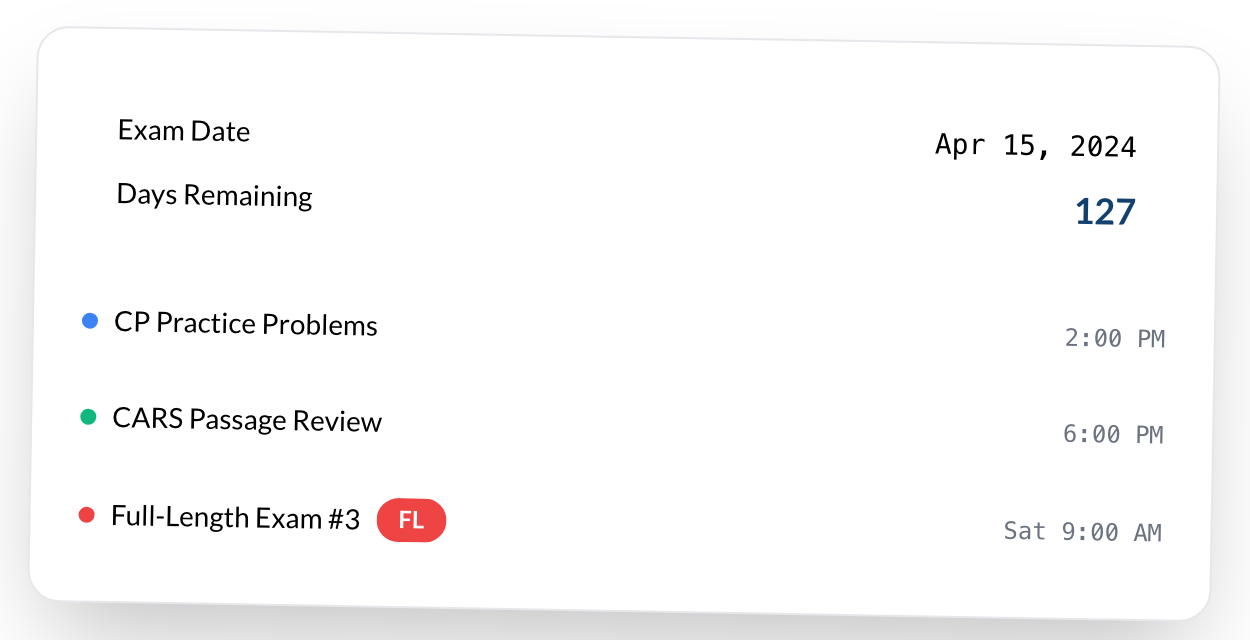
If you would rather build it yourself, our free MCAT study plan templates cover the same structure in spreadsheet form, and we have reviewed the other schedule builders if you want to compare options first.
Two habits matter more than the total you pick:
- Take a diagnostic before you budget anything. Every useful number on this page is a function of your gap, and you cannot compute a gap without a baseline.
- Track practice questions and review quality, not just hours. Your hours number is a planning tool. Your question accuracy is the feedback loop.
Frequently Asked Questions
How many hours should I study for the MCAT?
Plan for 300 to 500 focused hours. In our analysis of 43 real r/MCAT self-reports the median was 475 total hours, with the middle 50% between 300 and 600. Your own number depends mostly on your diagnostic score and how many points you need.
Is 300 hours enough?
It can be, but it sits at the 25th percentile of what students actually report. Students who scored 515 or higher on 200 hours or less almost always started with a diagnostic near their target. Starting 15 or more points below your goal, budget closer to 500.
How many hours per day?
Four to six hours of genuinely focused work is the realistic ceiling. Full-time studiers manage 25 to 40 hours per week; those working or in classes usually land at 12 to 20.
Does studying more guarantee a higher score?
No. Our data shows a slightly negative correlation (r = -0.23) between hours and score. Total hours mostly reflects how large your starting gap was.
How long before my test date should I start?
Work backward from your hours budget and weekly availability rather than picking a month count. At 450 hours, that is about three months full time or six to eight months around a job. Our MCAT time breakdown guide covers how exam-day timing should shape the final weeks, and test day tips from 520+ scorers covers the last 48 hours.
What should those hours contain?
Roughly a third content review and two thirds active practice, shifting further toward practice as you go. For section-specific approaches, see our Reddit-sourced guides to CARS and physics, and our guide to studying with Anki.
Method note: the 43 data points in this article come from public r/MCAT posts in which a student reported both a specific total-hours figure and a specific score. Ranges were converted to midpoints. The sample is self-selected and self-reported, its median score of 518 is far above the national mean of 500.6, and it should be read as the best available picture of what students say they did, not as a controlled study.
Written by
Dr. Sarah Johnson
Last updated 9/3/2026