
MCAT Diagnostic Test: Which to Take and What It Predicts
By MCAT Study Planner Team • Updated 9/12/2026
Short answer: take a free third-party full length from Blueprint, Kaplan or Princeton Review as your diagnostic. Each one gives you a scaled score, and none of them costs you one of the AAMC’s seven official sittings. Then expect to gain about 14 points from that number, which is the median across the 15 reports we have that recorded both a starting score and a final one.
Almost every page ranking for this search tells you to take a diagnostic and then stops. None of them tells you what the number means once you have it.
That is the harder half. A 493 and a 508 send you down very different calendars, and the difference is worth more than the test itself.
The 30-second answer: a diagnostic is a full-length practice exam taken before you study anything. Take a free third-party one so you keep all seven AAMC sittings for later. Sit the whole 7 hours and 30 minutes, no pausing and no lookups. Median gain from diagnostic to final in our data is 14 points, with the middle half between 7 and 17. Convert the gap you have left into hours at roughly 29 hours per point, then into weeks at your real weekly number.
In this guide
- Every free MCAT diagnostic, compared
- The free AAMC test that gives you no score
- What a diagnostic score actually predicts
- Your diagnostic score and where it realistically lands
- Turn the gap into hours, then into weeks
- Is a 500 diagnostic good? Is a 493?
- How to take it so the number means something
- When to take it
- What changes on September 14, 2026
- The whole decision on one page
Every Free MCAT Diagnostic, Compared
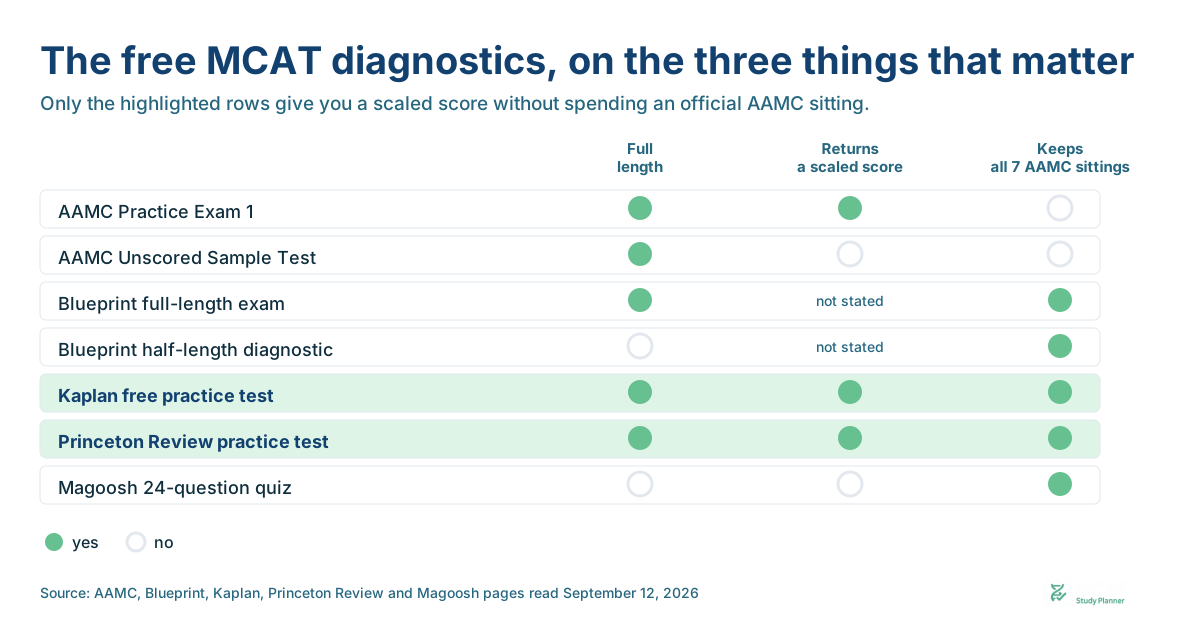
We opened each of these pages on September 12, 2026 and read what the provider says about its own product. Costs, counts and access terms are as of that date.
| Diagnostic | Cost | Length | Scaled score? | Access |
|---|---|---|---|---|
| AAMC Practice Exam 1 | Free | 230 questions, full length | Yes, scaled score and percentile rank | AAMC account |
| AAMC Unscored Sample Test | Free | 230 questions, full length | No | AAMC account |
| Blueprint half-length diagnostic | Free | Half length | Not stated on their page | Free Blueprint account |
| Blueprint full-length practice exam | Free | Full length | Not stated on their page | Free account, 14-day trial |
| Kaplan free practice test | Free | Full length | Yes, scaled score plus percentile rankings | 30-day trial, one per user |
| Princeton Review practice test | Free | Full length | Yes, “with score report” | Registration, 14-day trial |
| Magoosh “diagnostic test” | Free | 24 questions, untimed | No | None, runs in the browser |
Two rows deserve a flag.
The Magoosh row is the one to skip. It ranks ninth for this exact search under the headline “Free MCAT Diagnostic Test,” but it is a 24-question untimed browser quiz. We counted the questions on September 12, 2026. The page was published on March 2, 2021 and last modified the following day. A 24-question quiz cannot produce a baseline for a 230-question exam.
The AAMC rows are free in the sense that they cost no money. They are not free in the sense that matters, which is that you only get seven official sittings and their scaled scores are the ones that predict your real result. Our week-by-week guide to spacing your practice exams works through where those seven go. Spending one on day one, before you have learned anything, is the most expensive way to buy a number you can get elsewhere for nothing. For the rest of what is genuinely free and worth using, see our compilation of free MCAT resources. Once the diagnostic is done and you are buying exams for the rest of the plan, we priced every full length on the market per sitting in our comparison of the best MCAT practice tests.
The Free AAMC Test That Gives You No Score
This is the trap on this search, and it is worth its own section.
The AAMC publishes two free full-length practice exams. They look identical in a list. They are not.
Practice Exam 1 is 230 questions with, in the AAMC’s words on its official prep page, “the same look, feel, functionality, scaled score and percentile rank as an actual exam.”
The Unscored Sample Test is also 230 questions, with “the same look and feel and the same length and functionality as the actual MCAT exam.” Then the sentence that most pages leave out: it “does not provide a scaled score or percentile rank.” Both quotes were read directly on September 12, 2026.
So if you take the Unscored Sample Test as your diagnostic expecting a baseline number, you will finish 7 hours and 30 minutes later with a percentage correct and nothing to plan against.
There is a real case for it anyway. Our 12-week MCAT plan puts the Unscored Sample Test on day one precisely because it burns none of the six scored exams, and because on a fixed 12-week calendar the exposure matters more than the number. That tradeoff is the whole decision. If your plan is already built and you just need the rehearsal, take it. If the number is what sets your plan, take something that returns one.
One more useful detail: the Unscored Sample Test includes video walkthroughs for four CARS passage sets in its review screen. That is the best free CARS instruction the AAMC gives away, and it survives whether or not you use the test as a diagnostic.
What a Diagnostic Score Actually Predicts
Here is the part nobody publishes.
For our guide to how many hours the MCAT takes we built a dataset of 43 self-reported study logs, collected in September 2026, in which a student gave both a total hours figure and a real score. Fifteen of those reports also recorded where they started. That subset is the table below.
| Hours | Start | Final | Gain |
|---|---|---|---|
| 120 | 512 | 518 | 6 |
| 175 | 510 | 517 | 7 |
| 200 | 503 | 515 | 12 |
| 240 | 504 | 521 | 17 |
| 300 | 485 | 498 | 13 |
| 400 | 491 | 505 | 14 |
| 450 | 511 | 525 | 14 |
| 500 | 502 | 524 | 22 |
| 500 | 501 | 521 | 20 |
| 500 | 497 | 511 | 14 |
| 600 | 497 | 516 | 19 |
| 700 | 507 | 522 | 15 |
| 900 | 523 | 528 | 5 |
| 950 | 488 | 493 | 5 |
| 1000 | 491 | 504 | 13 |
Our arithmetic on those 15 rows: median gain 14 points, middle half between 7 and 17, full range 5 to 22. Thirteen of the 15 called their starting number a diagnostic; two called it their first full length.
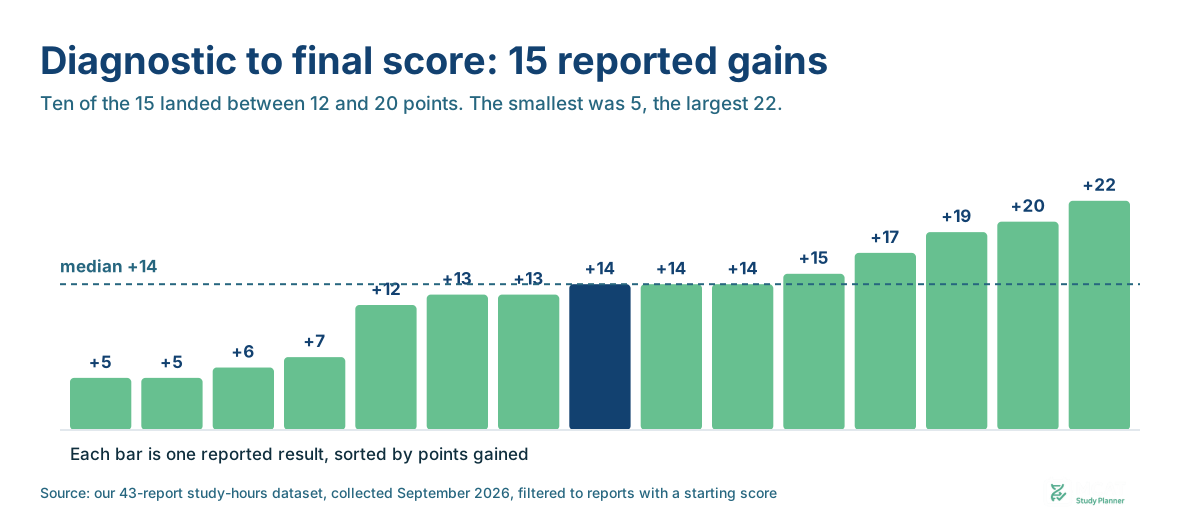
Two results in that table are worth more than the median.
Your starting score does not predict your gain. The correlation between starting score and points gained across these 15 reports is -0.26, which is flat. Reports that started under 500 gained a median of 13.5 points. Reports that started at 500 or above gained a median of 14. Starting low does not hand you a bigger jump, and starting high does not cap you.
Neither do total hours. The correlation between hours studied and points gained is -0.10. The two smallest gains in the set, both 5 points, came from the two students who logged 900 and 950 hours.
What this data is not: 15 self-selected, self-reported results whose median final score of 518 sits near the 95th percentile against a national mean of 500.6. The starting numbers are not one standardized instrument: some are AAMC exams, at least two are Blueprint diagnostics, and two are a first full length rather than a true pre-study baseline. Students who never reached their target often stop posting. Read the 14 points as a realistic middle for someone who finishes the plan, not as a floor and not as a ceiling.
Your Diagnostic Score and Where It Realistically Lands
Now cross that gain distribution with the AAMC’s own percentile table, the one in effect from May 1, 2026 to April 30, 2027, built on 305,494 scores from the 2023, 2024 and 2025 testing years.
The middle three columns are our arithmetic: your starting score plus the median gain (14), plus the third-quartile gain (17), and plus the largest gain in our set (22). The percentiles beside each one are the AAMC’s, read directly on September 12, 2026.
| Your diagnostic | Percentile now | Median outcome | Percentile | Strong outcome | Percentile | Best in our set | Percentile |
|---|---|---|---|---|---|---|---|
| 485 | 11th | 499 | 45th | 502 | 55th | 507 | 71st |
| 490 | 20th | 504 | 61st | 507 | 71st | 512 | 84th |
| 493 | 28th | 507 | 71st | 510 | 79th | 515 | 91st |
| 495 | 33rd | 509 | 76th | 512 | 84th | 517 | 94th |
| 498 | 42nd | 512 | 84th | 515 | 91st | 520 | 97th |
| 500 | 48th | 514 | 89th | 517 | 94th | 522 | 99th |
| 503 | 58th | 517 | 94th | 520 | 97th | 525 | 100th |
| 505 | 64th | 519 | 96th | 522 | 99th | 527 | 100th |
| 508 | 74th | 522 | 99th | 525 | 100th | 528 | 100th |
| 510 | 79th | 524 | 99th | 527 | 100th | 528 | 100th |
Look at what 14 points buys at the bottom of the scale. A 490 diagnostic sits at the 20th percentile. The median outcome from there, a 504, is the 61st. The same 14 points moves you 41 percentile places from 490 and only 25 from 505, because the score distribution is densest in the middle. The mean is 500.6 with a standard deviation of 11.2, so most of the country is packed into a narrow band and every point near the middle is worth more than a point at either end.
Turn the Gap Into Hours, Then Into Weeks
Take each of the 15 reports, divide total hours by points gained, and you get a per-point cost. Sorted, those 15 values run from 14.1 hours per point to 190. The median is 28.6.
We round that to 29 hours per point below. It is our arithmetic on 15 reports, not a measured coefficient, and the spread around it is enormous. Use it to size a plan, not to predict one.
| Points you need | Hours at 29 per point | At 15 hr/wk | At 20 hr/wk | At 25 hr/wk | At 30 hr/wk |
|---|---|---|---|---|---|
| 5 | 143 | 10 weeks | 7 weeks | 6 weeks | 5 weeks |
| 8 | 229 | 15 weeks | 11 weeks | 9 weeks | 8 weeks |
| 10 | 286 | 19 weeks | 14 weeks | 11 weeks | 10 weeks |
| 12 | 343 | 23 weeks | 17 weeks | 14 weeks | 11 weeks |
| 15 | 429 | 29 weeks | 21 weeks | 17 weeks | 14 weeks |
| 18 | 515 | 34 weeks | 26 weeks | 21 weeks | 17 weeks |
| 20 | 572 | 38 weeks | 29 weeks | 23 weeks | 19 weeks |
| 25 | 715 | 48 weeks | 36 weeks | 29 weeks | 24 weeks |
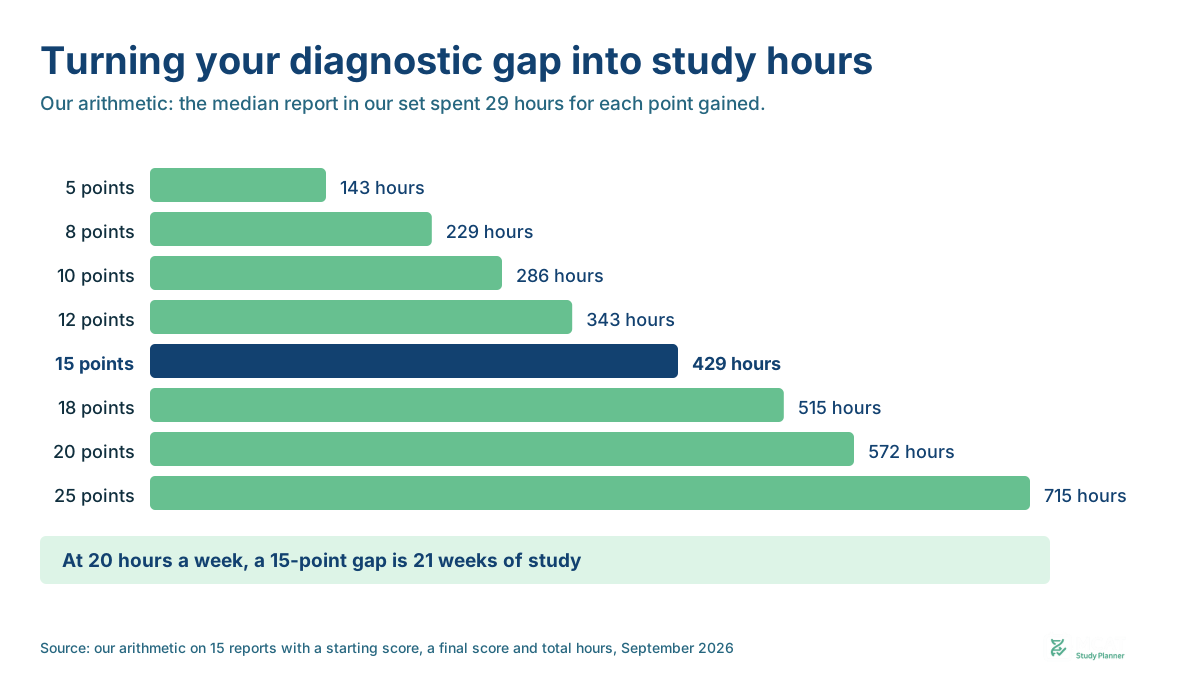
Read the bottom two rows carefully before you commit to them. A 25-point gap at 15 hours a week is 48 weeks, and nobody sustains that. If your gap is 20 points or more, the answer is usually a different method rather than a longer calendar, because the two students in our set who studied hardest gained the least.
Once you have a gap and a weekly number, that is exactly the pair of inputs a schedule is built from. Feed your test date and your real weekly hours into the free MCAT study schedule generator and it lays the blocks out day by day around everything else on your calendar.
If the weeks that fall out of this table do not fit the date you had in mind, that is a signal about the date. Our guide to when to take the MCAT works the same arithmetic in reverse, from each 2027 window back to the hours a week it demands.
Is a 500 Diagnostic Good? Is a 493?
These are the two questions people actually type, so here are the direct answers.
A 500 diagnostic is good. A 500 is the 48th percentile as a finished score. Scoring it cold, before content review, puts you in a strong position: the median outcome from 500 in our data is 514, which is the 89th percentile.
A 493 diagnostic is fine. It is the 28th percentile, and it is a completely ordinary place to start. The median outcome from there is 507, the 71st percentile, and the best result in our set from a similar start was a 515. The one thing a 493 tells you reliably is that you are early, not that you are capped.
For either number, the section breakdown is worth more than the total. A 498 built from a 130 in Psych/Soc and a 121 in Chem/Phys is a completely different study plan than a flat 498 across all four. Sort your sections by how far each sits below 125, the rough midpoint of each section’s scale, and start at the top of that list.
How to Take It So the Number Means Something
The exam is 230 questions across four sections: 59 questions in 95 minutes for Chem/Phys, 53 in 90 minutes for CARS, 59 in 95 for Bio/Biochem, and 59 in 95 for Psych/Soc, per the AAMC’s exam overview read on September 12, 2026. Total content time is 6 hours and 15 minutes. Total seated time is about 7 hours and 30 minutes.
Four rules, and they are the whole method:
- Sit all 7 hours and 30 minutes in one block, taking only the breaks the real schedule allows. The MCAT tests stamina as much as content, and a diagnostic taken in three comfortable sittings measures a test you will never take.
- No pausing, no lookups, no open book. Every minute of help inflates the number, and an inflated baseline produces a plan that is too short.
- Do not skip CARS because you have not studied it. The AAMC states the section “requires no specific content knowledge,” so your cold CARS score is already close to real. It is the most honest section on a diagnostic.
- Take it even if you have not finished your prerequisites. A low score from missing coursework is information, not failure. It tells you which content to schedule first.
When to Take It
Take it on the day you set your start date, before any content review.
That timing is not arbitrary. The diagnostic is what converts a vague plan into a specific one, and it only does that if you take it untouched. Two weeks of review first gives you a number you cannot interpret.
If you have not locked a test date, do that in the same sitting. Our list of official MCAT test dates carries all 35 dates in the 2027 calendar with the exact day a 12-week plan has to begin for each one, and registration for the whole 2027 season opens October 20 to 22, 2026. Pair that date with the weeks column above and you will know immediately whether your target is reachable or whether you need a later date.
Then spend the 48 hours after the test reviewing every missed question before the plan starts. The eight-step MCAT study method picks up from there.
What Changes on September 14, 2026
One product note, because it is two days away and every page ranking for this search still lists the product as available.
The AAMC MCAT Official Prep CARS Diagnostic Tool, $25 for a 1-year subscription covering 28 passage sets, is retired and no longer available for purchase starting September 14, 2026. Its questions move into the new CARS Question Bank. We read both the store listing and the official prep page on September 12, 2026.
The Online-Only Bundle goes off sale from September 14 to 29, 2026 and returns on September 30 with the new CARS Question Bank included. If you buy the bundle before September 14, the new question bank is not included and has to be bought separately.
None of this changes your diagnostic. It changes what you buy in the week after it, so check the AAMC store rather than a blog before you spend anything on CARS material this month.
The Whole Decision on One Page
| Question | Answer |
|---|---|
| Which test? | A free third-party full length: Blueprint, Kaplan or Princeton Review |
| Why not the AAMC’s? | You get seven official sittings and their scaled scores predict best. Save them |
| Which AAMC one if you do use it? | Practice Exam 1. The Unscored Sample Test returns no scaled score |
| Which one to skip? | Any 24-question quiz calling itself a diagnostic |
| How long? | The full 7 hours 30 minutes, breaks only where the real exam allows |
| When? | The day you set your start date, before any content review |
| What does the number mean? | Median gain in our 15 reports is 14 points, middle half 7 to 17 |
| How do I size the plan? | Roughly 29 hours per point you need, then divide by your weekly hours |
| What do I do first? | Rank your four sections by distance below 125, start at the top |
That last row is the one that gets skipped, and it is the reason to take a diagnostic at all. The total score tells you how long. The section split tells you what to do on Monday.
When you have both, turn them into a calendar: our MCAT study planner takes your test date, your weekly hours and the resources you own, and returns a day-by-day schedule you can export straight into your calendar.
Method note: the 15 data points in this article are the subset of our 43-report study-hours dataset, collected in September 2026, in which a student reported a starting score as well as a final score and a total hours figure. Ranges were converted to midpoints. The sample is self-selected and self-reported, its median final score of 518 is far above the national mean of 500.6, and the median gain, the hours-per-point figure and the outcome columns of the band table are our arithmetic on it rather than measured values. All product, timing, percentile and price figures were read from the AAMC and the named providers on September 12, 2026.
Written by
MCAT Study Planner Team
Last updated 9/12/2026