
2 Month MCAT Study Plan (8 Weeks, 25 to 40 Hours)
By MCAT Study Planner Team • Updated 9/24/2026
Short answer: 8 weeks at 25 to 40 hours a week is 200 to 320 total hours. Reaching the 300-hour first quartile of our 43-report dataset takes 37.5 hours a week, and reaching the 475-hour median takes 59.4. Two months is enough time only if your weekly number is high and you have seen the content before.
Six pages rank for this search. Every one publishes a daily or weekly hour figure. Not one multiplies it by eight weeks to say what the plan totals.
So this guide does that first. Once the multiplication is done, the question stops being “is two months enough” and becomes “what does the third month buy,” which has a specific and uncomfortable answer.
The 30-second answer: multiply your honest weekly hours by 8 before you book anything. Take the free AAMC Unscored Sample Test on day 2, then put the six scored AAMC exams on days 14, 21, 28, 35, 42 and 49 of a 56-day plan, leaving the last seven days for taper. The seven sittings cost 80.5 to 108.5 hours, which is the largest single line item in the plan, so place them before you plan anything else. If the gap between your diagnostic and your target is larger than about 11 points, move the date rather than the schedule.
In this guide
- What eight weeks actually adds up to
- The month you cut is not the month you think
- The 8-week calendar, counted back from test day
- Where the six official exams go
- What a full-length week costs you
- Go or postpone, as arithmetic instead of advice
- Weeks 1 and 2: content triage, not content review
- Weeks 3 to 8: the exam cycle
- What the ranking pages get wrong
- The whole eight weeks on one page
What Eight Weeks Actually Adds Up To
Two months is not a study budget. Hours per week times eight is a study budget.
Here is every ranking page’s own stated pace, multiplied out. This is our arithmetic, and the only assumption is the rest-day convention each page states for itself. Where a page gives a daily figure and names one rest day, we use a six-day week. Where a page gives a weekly figure, we use it as written. All six pages were read on September 24, 2026.
| Page | What it recommends | Its own 8-week total |
|---|---|---|
| Kaplan | 3 to 5 hours a day, 6 days a week | 144 to 240 hours |
| Inspira | 15 to 40 hours a week | 120 to 320 hours |
| Jack Westin | 25 to 35 hours a week | 200 to 280 hours |
| Shemmassian | 5 to 6 hours a day | 240 to 288 hours |
| Blueprint | about 6 hours a day, one rest day | 288 hours |
| MedSchoolCoach | 6 to 8 hours a day, 6 days a week | 288 to 384 hours |
The comparison comes from our own data. In our analysis of 43 real reports from students who gave both total hours and a score, the median was 475 hours and the middle half fell between 300 and 600.
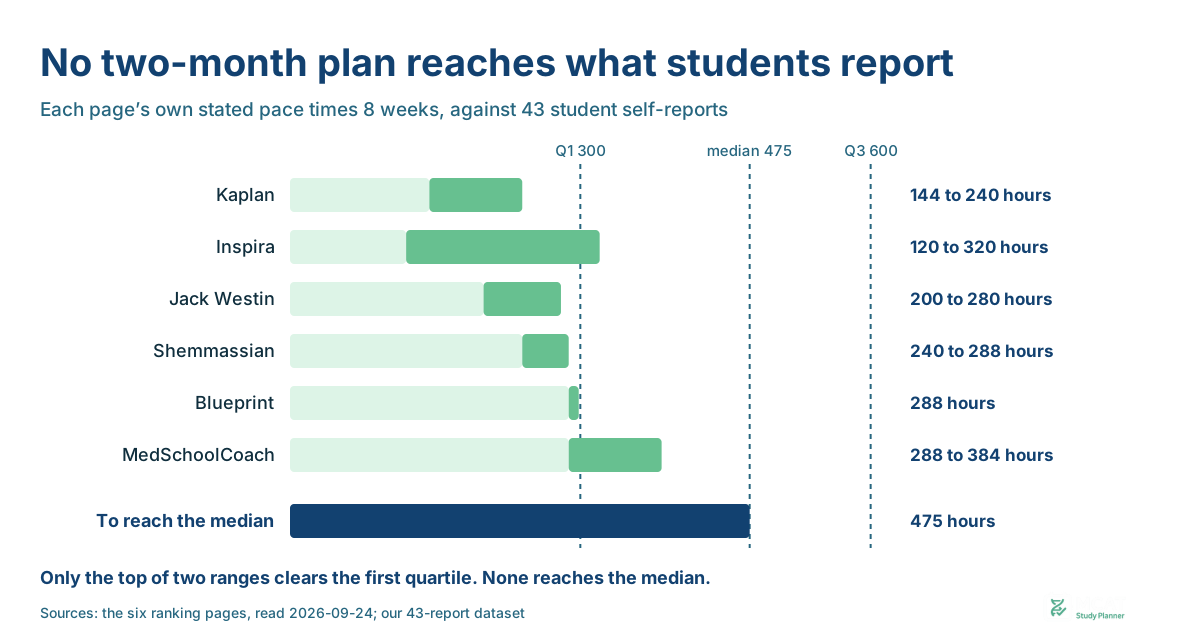
Read the right-hand edges. Only Inspira and MedSchoolCoach clear 300 hours at all, and only at the very top of their ranges. Not one plan on this search reaches 475.
To hit 300 hours in eight weeks you need 37.5 hours a week, which is 6.3 hours a day across six days. To hit 475 you need 59.4 hours a week, which is 9.9 hours a day across six days. That second number is a full-time job plus a part-time job, and it is why two months is genuinely hard rather than merely busy.
The Month You Cut Is Not the Month You Think
This is the section that should decide your timeline.
The six scored AAMC exams cost the same whether you spread them over 12 weeks or 8. One sitting is about 7.5 hours seated, per the AAMC’s own exam-length figures, plus 4 to 8 hours of review: 11.5 to 15.5 hours, or 13.5 at the midpoint. Six of them is 69 to 93 hours, about 81 at the midpoint.
Now hold your weekly hours constant at 25 and change only the number of weeks. This is our arithmetic on those two figures:
| Plan | Total hours | Exam block | Left for content and questions |
|---|---|---|---|
| 12 weeks at 25 hours | 300 | 81 | 219 |
| 8 weeks at 25 hours | 200 | 81 | 119 |
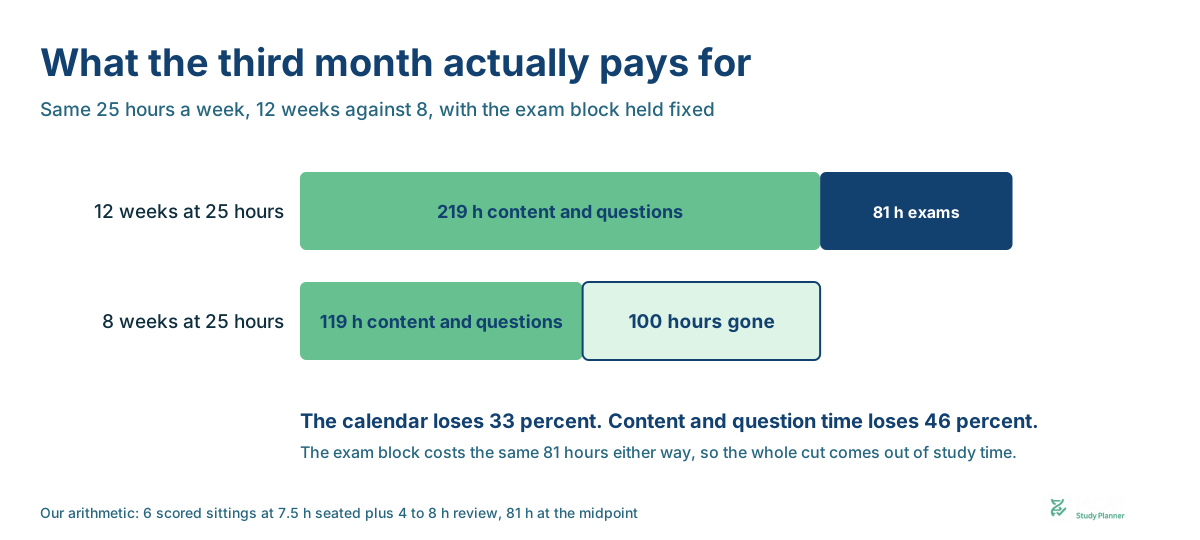
The calendar loses four weeks out of twelve, which is 33 percent. The time you actually have for learning and practicing loses 100 hours out of 219, which is 46 percent. Across the full range of exam-review costs the figure runs 43 to 48 percent.
That is the honest trade. Going from three months to two does not cost you a third of your prep. It costs you close to half of it, because the fixed cost of the official exams stays exactly where it was.
If that changes your mind, our 12-week MCAT plan runs the same calendar with room to breathe.
The 8-Week Calendar, Counted Back From Test Day
Eight weeks is 56 days. Count back from test day rather than forward from today, because the exams have to land on fixed days and everything else fills in around them.
| Days | Phase | What happens |
|---|---|---|
| 1 to 2 | Baseline | Unscored Sample Test on day 2, full seated conditions |
| 3 to 14 | Content triage | Your three weakest areas per section, nothing else |
| 15 to 49 | The exam cycle | One scored exam per week, on days 14, 21, 28, 35, 42 and 49, with two review sessions after each |
| 50 to 56 | Taper | No full lengths, reduced hours, day 56 off |
Take every exam on the same weekday as your real test date, at the same hour. The AAMC’s practice exams carry “the same look, feel, functionality, scaled score and percentile rank as an actual exam,” so the only variable left to rehearse is the clock and your own body.
Do this first: put the six exam dates in your calendar before you schedule a single content block. They are 69 to 93 hours of the plan and they cannot move. Everything else is flexible; these are not.
Where the Six Official Exams Go
Read directly from the AAMC’s practice products page on September 24, 2026: “The AAMC offers two free full-length practice exams and five low-cost practice exams.” The lineup is Practice Exam 1 (free), Practice Exams 2 through 6, and the Unscored Sample Test (free). That is six scored exams and seven sittings in total. Practice Exams 2 through 6 were $35.00 each at the September 2026 read.
Use the free Unscored Sample Test as your day 2 baseline. It is 230 questions with “the same look and feel and the same length and functionality as the actual MCAT exam but does not provide a scaled score or percentile rank,” which is exactly what a baseline needs to be: a real rehearsal that does not burn a scored exam you will want later. It also carries video walkthroughs for four CARS passage sets.
The six scored exams then go on days 14, 21, 28, 35, 42 and 49. The last sits seven days out, which leaves room to review it properly and still taper. Blueprint’s two-month page draws the same boundary tighter with “Do not take a full-length within four days of your exam.” Seven days is the safer version.
For what each exam costs and how the third-party options compare, we put every full length compared in one table.
What a Full-Length Week Costs You
An exam week is not a normal week, and this is where low weekly totals fall apart. One sitting plus its review runs 11.5 to 15.5 hours. Subtract that from your week:
| Your weekly hours | Left after the exam and its review |
|---|---|
| 40 | 24.5 to 28.5 hours |
| 30 | 14.5 to 18.5 hours |
| 25 | 9.5 to 13.5 hours |
| 20 | 4.5 to 8.5 hours |
At 20 hours a week, six of your eight weeks hold under nine hours of anything that is not a practice exam. You would be taking exams with almost no time to fix what they reveal, which is the failure mode behind “practice tests stopped helping.”
Jack Westin’s plan runs into a smaller version of this. Its weekly template gives Saturday to the exam and Sunday to the review, while the same page asks for “two deep review sessions per full-length.” One day does not hold two deep review sessions after a 7.5-hour exam. Split the review across two days and the week works.
Once you have a date and an honest weekly number, the free MCAT study schedule generator places the six exams and fills the days around your job or classes.
Go or Postpone, as Arithmetic Instead of Advice
Every page on this search tells you to take a diagnostic. None of them tells you what to do with the number.
In our 15 reports that recorded both a starting score and a final score, the median gain was 14 points and the median cost was about 28.6 hours per point. Divide your eight-week total by that figure:
| Weekly hours | 8-week total | Points that buys |
|---|---|---|
| 20 | 160 | 5.6 |
| 25 | 200 | 7.0 |
| 30 | 240 | 8.4 |
| 35 | 280 | 9.8 |
| 40 | 320 | 11.2 |
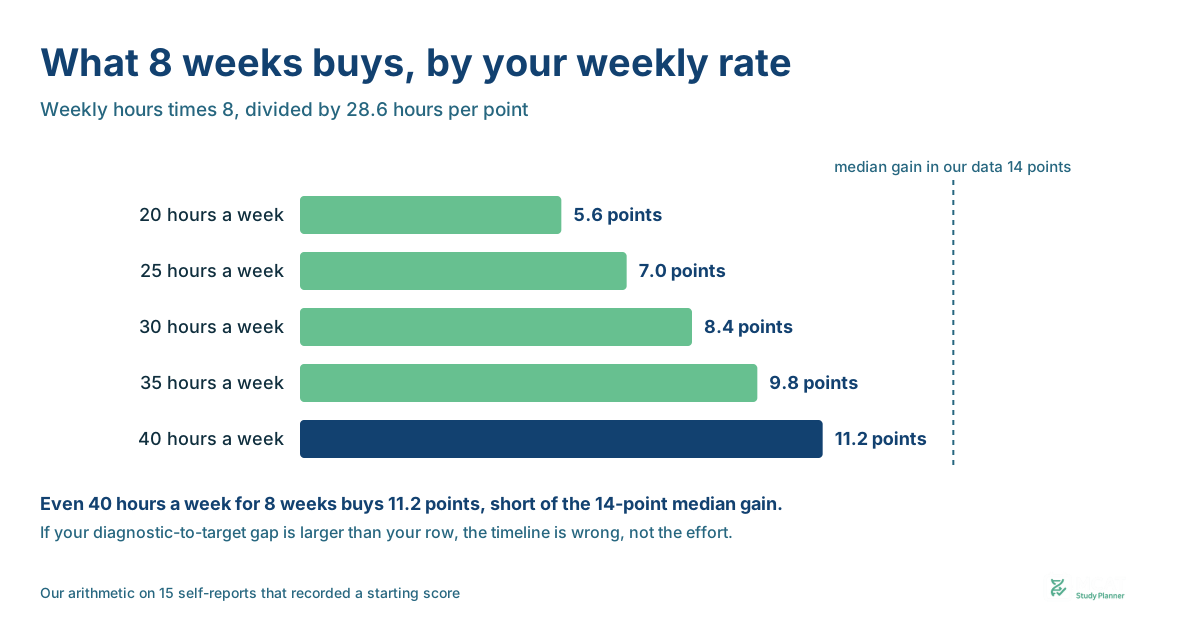
This is our arithmetic on 15 self-reports, not a measured coefficient, and the range is wide: individual reports ran from 14.1 to 190 hours per point. Those students were also high scorers, with a median final score of 518 against a national mean of 500.6, so the set is not representative. Treat it as a sanity check, not a promise.
As a sanity check it gives a clean rule. Take your diagnostic, subtract it from your target, find your weekly row. If the gap is bigger than that row, the timeline is wrong, not your effort. Shemmassian publishes a similar boundary from a different direction, saying “A gap of 3-8 points usually calls for 1-2 months of focused prep,” and our arithmetic broadly agrees with their upper bound.
Our guide to what an MCAT diagnostic score predicts has the full distribution behind these numbers, including the reports where 900 hours bought five points.
The postpone rule: if your diagnostic-to-target gap is more than about 11 points, or you cannot hold 25 hours a week, pick a later date instead of a denser plan. Moving the date is free. Underperforming is not. Our guide to how to pick an MCAT test date covers which window fits your week.
Two months also has a hard prerequisite that Jack Westin states plainly: “You have already seen most content at least once,” and “If you are starting from scratch, a 3- or 4-month timeline is a more realistic path.” Kaplan’s own two-month page agrees, in the middle of recommending one: “For most students, two months is not enough time to spend studying for the MCAT.” When two competitors selling two-month plans both say this, believe them.
Weeks 1 and 2: Content Triage, Not Content Review
You do not have time for content review in the usual sense. With 107 to 131 hours for everything that is not an exam, a full pass through six subjects is not available.
Triage instead. Take the baseline on day 2, pick the three weakest areas per section, and work only those for twelve days. Everything else waits until an exam surfaces it.
The AAMC is direct about what actually moves in this phase: “Active learning requires more than just reading or watching a video. You must engage in the learning process through recall, practice, and reflection, consistently revisiting content throughout the process and assessing your understanding of each topic.” On an eight-week plan, rereading a chapter is the single most expensive thing you can do with an hour.
If you want the general method rather than this timeline’s version, the eight-step MCAT study method lays it out.
Weeks 3 to 8: The Exam Cycle
From day 15 the plan repeats one shape, six times:
- Exam day. Same weekday and start time as your real test.
- Review session one, the day after. Every missed question, labeled by cause: content, reasoning, timing, or misread passage.
- Review session two, two days after. Turn the labels into drills and work them.
- Three days of targeted practice on whatever the exam exposed, plus daily CARS.
- One lighter day.
The rule that makes this work: the exam sets the next week’s content, not a syllabus you wrote in week one. Six exams in six weeks only helps if each one changes what you do next.
What the Ranking Pages Get Wrong
Four specific things, all checkable.
Kaplan’s plan cannot reach Kaplan’s target. The page says to plan “three to five hours per day, six days per week” and, further down, that “Kaplan experts recommend that you spend 300-350 hours studying so you can earn a good MCAT score.” Three to five hours over six days for eight weeks is 144 to 240 hours. The plan falls 60 to 206 hours short of the target on the same page.
Three pages disagree about how many official exams exist, and all three are wrong. Kaplan says “The AAMC offers four full-length practice tests to purchase online.” Blueprint says, in one bullet, “AAMC MCAT Official Prep Bundle: This tool includes four full-length exams,” and in another bullet on the same page, “You should take the six official AAMC exams (four paid and two free).” The AAMC’s own page, read September 24, 2026, says two free and five low-cost. Five are purchasable, not four.
| Source | What it says exists | Read on |
|---|---|---|
| AAMC | 2 free plus 5 low-cost, so 7 sittings and 6 scored | 2026-09-24 |
| Kaplan | 4 to purchase | 2026-09-24 |
| Blueprint, bullet one | 4 in the bundle | 2026-09-24 |
| Blueprint, bullet two | 6 total, 4 paid and 2 free | 2026-09-24 |
Blueprint’s AAMC statistic is not on any AAMC page. The page states “According to the AAMC, the average premed studies 240 hours for the MCAT.” We re-read the AAMC’s study-plan page on September 24, 2026 and it carries no hours, weeks or months figure anywhere. The Post-MCAT Questionnaire, which would be the natural source, does not collect study hours at all.
Nobody prices their own exam schedule. At Kaplan’s floor of 144 hours, the seven official sittings cost 80.5 to 108.5 hours, or 56 to 75 percent of the entire plan. The page never does that subtraction.
The Whole Eight Weeks on One Page
| Days | What you do | Hours at 30 a week |
|---|---|---|
| 1 to 2 | Unscored Sample Test as baseline, seated conditions | 9 |
| 3 to 14 | Triage: three weakest areas per section, daily CARS | 51 |
| 15 to 21 | Scored exam 1 on day 14, two review sessions, drills | 30 |
| 22 to 28 | Scored exam 2 on day 21, same shape | 30 |
| 29 to 35 | Scored exam 3 on day 28, same shape | 30 |
| 36 to 42 | Scored exam 4 on day 35, same shape | 30 |
| 43 to 49 | Scored exam 5 on day 42, same shape | 30 |
| 50 to 56 | Scored exam 6 on day 49, review, then taper to test day | 30 |
The right-hand column sums to 240 hours, which is what 30 hours a week over eight weeks comes to.
If you are counting toward a specific date: eight weeks back from January 15, 2027, the first test date of the 2027 season, is November 20, 2026. Registration for the whole 2027 season opens October 20 to 22, 2026, a month before that start line, so you can register well before you begin. The twelve-week start line for the same date is October 23, 2026.
Two ways to put this on a real calendar. The MCAT study planner takes your test date, your weekly hours and your resources and places the six exams for you, then fills in the days around everything else you do. If a month is all you have instead, our 30-day MCAT plan is the honest version of that timeline.
Written by
MCAT Study Planner Team
Last updated 9/24/2026