5 Month MCAT Study Plan: A Dated 20 Week Schedule
By MCAT Study Planner Team • Updated 10/18/2026
Short answer: a five-month MCAT plan is 20 study weeks and 300 to 480 hours, depending on which of three weekly tracks you can actually hold. Twenty weeks is the only plan length where our published 10-week content review schedule fits the content window exactly, with no compression and no padding. It is also the only one where the full content block and a two-week exam cadence cannot both fit, so your weekly hours decide which one gives. All AAMC figures here were read on October 18, 2026.
There is a problem with searching for this plan. Nobody publishes it.
We pulled the live results for “5 month mcat study plan” on October 18, 2026. Position 1 is a Reddit thread about four months. Position 3 is a three-month plan. Position 8 is Kaplan’s one-month page. Position 9 covers three months and six months. Position 13 is a Pinterest board for four months. Google is returning the neighbours of the question because the thing itself is not on page one.
The 30-second answer: 20 weeks. Track A is 15 hours a week and 300 hours total, Track B is 20 hours and 400, Track C is 24 hours and 480. Only Track C clears the 475-hour median of our 43-report dataset. Content review runs weeks 1 to 10 on Tracks B and C, which is exactly our 10-week content schedule. The six scored AAMC exams go in weeks 14 to 19, one a week, because one sitting plus review costs 11.5 to 15.5 hours and a weekly cadence needs about 20 hours a week to absorb. On Track A the exams go every second week from week 9, which costs you weeks 9 and 10 of content review. Count back 140 days from your test date to find your start line.
In this guide
- What 20 weeks actually adds up to
- Pick your track before you pick your calendar
- The content block is 10 weeks, and that is not a coincidence
- Where the seven sittings go
- The 20 week calendar
- Count back from your 2027 test date
- What the official material alone costs you
- How this differs from the 4 month and 6 month plans
- What the ranking pages get wrong
- The whole plan on one page
What 20 Weeks Actually Adds Up To
Multiply your honest weekly hours by 20. That is the whole budget, and it is the number every other decision on this page hangs off.
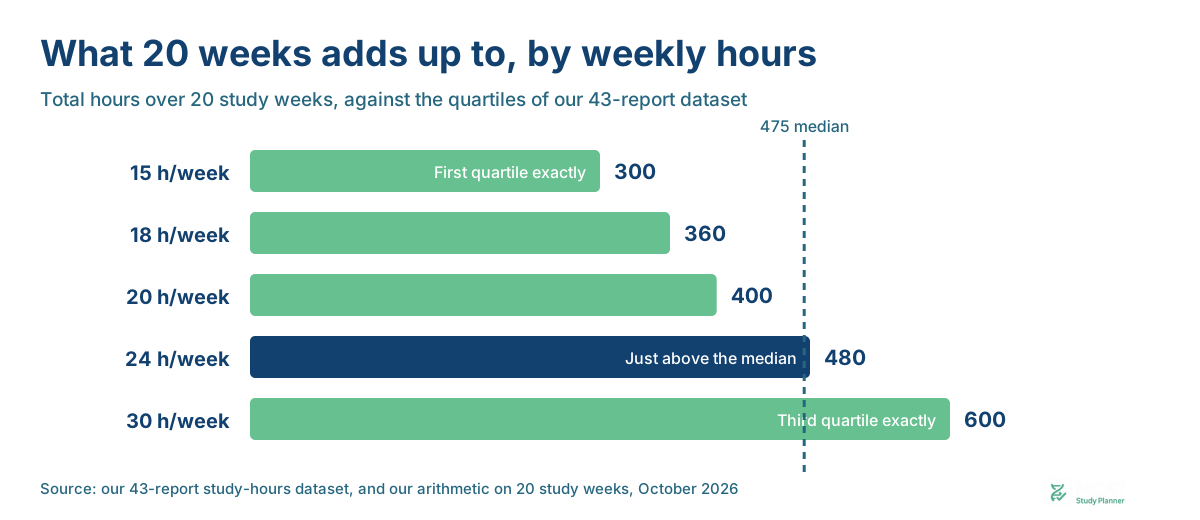
| Weekly hours | 20-week total | Where that sits in our 43-report dataset |
|---|---|---|
| 15 | 300 hours | The first quartile exactly |
| 18 | 360 hours | Between the first quartile and the median |
| 20 | 400 hours | Between the first quartile and the median |
| 24 | 480 hours | Just above the 475-hour median |
| 30 | 600 hours | The third quartile exactly |
Those quartiles come from our analysis of 43 real reports, where the median total was 475 hours and the median score was 518. The arithmetic above is ours, and the assumption is that you actually study in all 20 weeks.
Now put that beside what this search currently gets told. Google’s AI Overview opens by saying a five-month plan “gives you roughly 300 to 350 hours of preparation” at “15 to 20 hours per week”. Twenty weeks at 20 hours a week is 400 hours. Its own band produces 300 to 400, so the top of its total is 50 hours short of its own weekly figure.
The gap matters because 350 hours does not reach the median. Reaching 475 hours in 20 weeks takes 23.75 hours a week, call it 24, which is above the top of the range the AI Overview gives you.
One page on the search does name a five-month number. MedSchoolBro calls “4-5 months (400-450 hours)” the “sweet spot for most students”. Over 20 weeks that is 20 to 22.5 hours a week, higher than the AI Overview says for the same timeline, and closer to what the dataset supports.
Pick Your Track Before You Pick Your Calendar
Three tracks, because the weekly number changes the calendar underneath it. The weekly shapes for Tracks A and B are the same ones we published on the 16-week plan, so the ladder stays consistent.
| Track | Hours a week | 20-week total | What the week looks like |
|---|---|---|---|
| A | 15 | 300 | Five weekday blocks of 2 hours, one weekend block of 5 |
| B | 20 | 400 | Five weekday blocks of 3 hours, one weekend block of 5 |
| C | 24 | 480 | Five weekday blocks of 3.5 hours, one weekend day of 6.5 |
The reason the track has to come first is a single number: what one practice exam costs.
A sitting is about 7 hours 30 minutes seated, which is the AAMC’s own published exam structure, 6 hours 15 minutes of testing across four sections plus 50 minutes of breaks. Reviewing it properly takes another 4 to 8 hours. That review range is ours and it is carried from our 12-week plan. So one sitting costs 11.5 to 15.5 hours, midpoint 13.5.
| Track | Weekly hours | Cost of one sitting | Hours left that week |
|---|---|---|---|
| A | 15 | 13.5 | 1.5 |
| B | 20 | 13.5 | 6.5 |
| C | 24 | 13.5 | 10.5 |
Track A has 1.5 hours left in an exam week. That is not enough to run the error-log work the next exam depends on, which we budget at about 6 hours. 13.5 plus 6 is 19.5, so a weekly exam cadence needs about 20 hours a week. Above that line you can sit one a week. Below it you cannot, and the calendar has to change.
That is the same 20-hour threshold our 16-week plan and our 24-week plan each arrived at from their own side.
Do this first: write down the hours you held last week, not the hours you meant to hold. Multiply by 20. If that number is under 300, the fix is the weekly figure, not the timeline, because adding weeks to a 10-hour week just gets you 200 hours slowly.
The Content Block Is 10 Weeks, and That Is Not a Coincidence
Our other four plans each end systematic content review at a published point: 12 days on the 8-week plan, 42 days on the 12-week plan, 63 days on the 16-week plan and 84 days on the 24-week plan. The 12-week and 24-week plans both stop at the halfway mark.
Apply the same halfway rule to 140 days and you get 70 days. Seventy days is 10 weeks. Our 10-week content review schedule is 10 weeks.
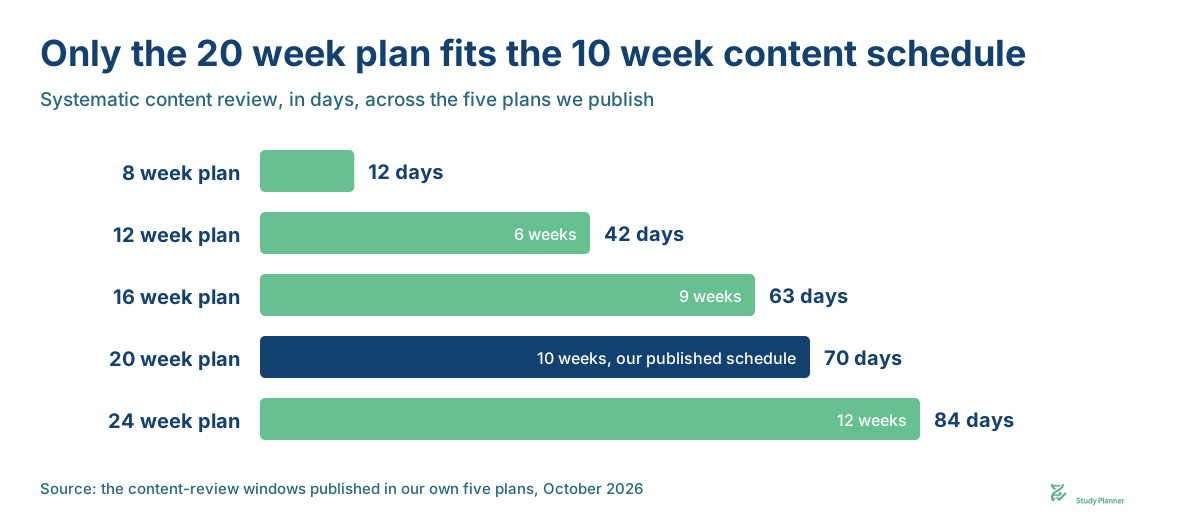
This is the one rung on the ladder where that schedule fits without being handled. The 12-week plan has to squeeze 10 weeks of sequenced content into 6. The 24-week plan has two weeks spare and has to decide what to do with them. The 20-week plan runs it week for week, from week 1 on foundations and core biochemistry through week 10 on integrated review and weakness focus.
Our subject guides each take a share of that window. Applying the same shares to 70 days, at Track B’s 2.86 hours a day and Track C’s 3.43 hours a day, gives the block lengths this plan is built from.
| Subject | Share of the window | Days | Hours, Track B to Track C |
|---|---|---|---|
| Biology | One quarter | 17.5 | 50.0 to 60.0 |
| Biochemistry | One sixth | 11.7 | 33.3 to 40.0 |
| General chemistry | 11.67 percent | 8.2 | 23.3 to 28.0 |
| Organic chemistry | One fifteenth | 4.7 | 13.3 to 16.0 |
Those shares are our arithmetic on the AAMC’s published question percentages, and the assumption, stated in each of those guides, is that content review covers the three science sections only. The remaining days go to physics, psychology and sociology, which are the other two blocks in the same sequence.
Track A’s window is shorter, for a reason that has nothing to do with content. More on that below. On 56 days the same shares give biology 14.0 days and 30.0 hours, biochemistry 9.3 days and 20.0 hours, general chemistry 6.5 days and 14.0 hours, and organic chemistry 3.7 days and 8.0 hours.
Where the Seven Sittings Go
The AAMC offers seven sittings in total. Read on October 18, 2026, its practice page says it “offers two free full-length practice exams and five low-cost practice exams”. Each is a “230-question practice exam” built from previously administered exams. Five of them carry a scaled score and percentile rank. The free Unscored Sample Test does not, which is exactly what makes it the right baseline.
Six scored exams, one unscored baseline. The question is where they land, and 20 weeks is where that question gets interesting.
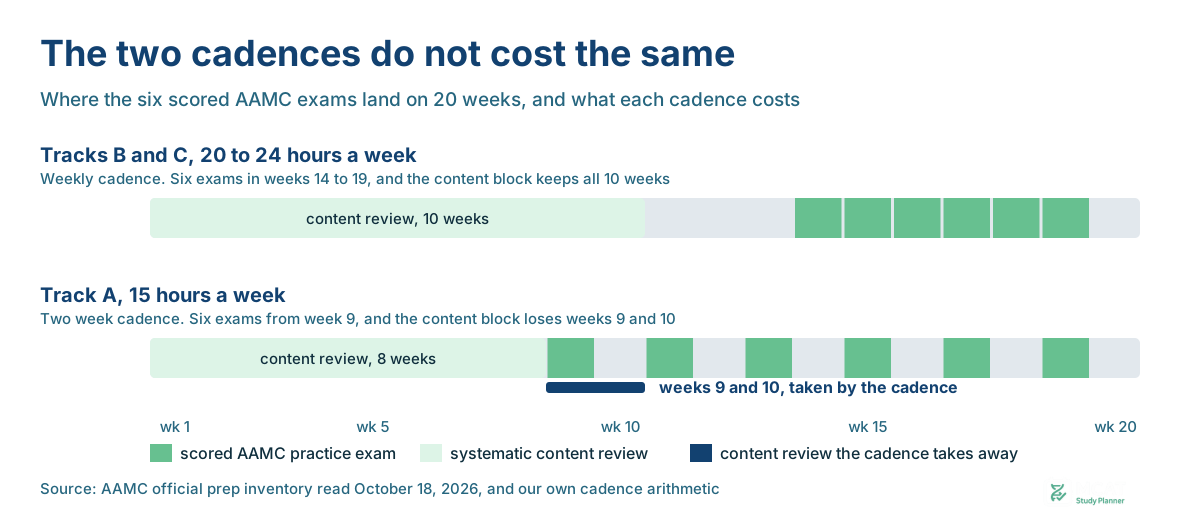
Six exams on a weekly cadence occupy 6 weeks. The last one has to land seven days out, at the end of week 19, so a weekly run starts at week 14. Content review ends at week 10 and weeks 11 to 13 become a bridge: error-log work, the AAMC Section Bank, targeted content from what the question blocks exposed.
Six exams every second week occupy 11 weeks. Working back from the same week 19, the first lands at the end of week 9. Content review has to be finished before it, which ends the block at week 8 and costs two weeks.
So on 20 weeks the full content block and a two-week cadence do not both fit, and your weekly hours pick the winner. Tracks B and C clear the 20-hour threshold, take the weekly cadence and keep all 10 content weeks. Track A does not clear it, takes the two-week cadence and pays for it with weeks 9 and 10.
That trade is the real content of a five-month plan, and no page on this search states it. Our full-length calendar has the spacing rules in full, and which diagnostic to take covers why the unscored exam belongs in week 1 rather than a scored one.
The 20 Week Calendar
Tracks B and C, 20 to 24 hours a week.
| Week | What runs | Sitting at the end of the week |
|---|---|---|
| 1 | Free Unscored Sample Test on day 1, then content review begins | Baseline, day 1 |
| 2 to 9 | Content review in sequence, daily CARS, timed question blocks, Anki new cards | none |
| 10 | Content review ends, new Anki cards go to zero | none |
| 11 | Error-log work begins, targeted content from the question blocks | none |
| 12 | AAMC Section Bank starts, targeted content | none |
| 13 | Section Bank continues, timed section blocks | none |
| 14 | Error log and targeted content | Practice Exam 1 |
| 15 | Error log from Exam 1 | Practice Exam 2 |
| 16 | Error log from Exam 2 | Practice Exam 3 |
| 17 | Error log from Exam 3 | Practice Exam 4 |
| 18 | Error log from Exam 4 | Practice Exam 5 |
| 19 | Error log from Exam 5, then timed section blocks | Practice Exam 6, seven days out |
| 20 | Taper: error-log review, light section blocks, sleep schedule | Test day |
Track A, 15 hours a week.
| Week | What runs | Sitting at the end of the week |
|---|---|---|
| 1 | Free Unscored Sample Test on day 1, then content review begins | Baseline, day 1 |
| 2 to 7 | Content review in sequence, daily CARS, timed question blocks, Anki new cards | none |
| 8 | Content review ends, new Anki cards go to zero | none |
| 9 | Error-log work begins | Practice Exam 1 |
| 10, 12, 14, 16, 18 | Error log from the exam before, targeted content, Section Bank | none |
| 11 | Error log and targeted content | Practice Exam 2 |
| 13 | Error log and targeted content | Practice Exam 3 |
| 15 | Error log and targeted content | Practice Exam 4 |
| 17 | Error log and targeted content | Practice Exam 5 |
| 19 | Error log, then timed section blocks | Practice Exam 6, seven days out |
| 20 | Taper: error-log review, light section blocks, sleep schedule | Test day |
Anki runs underneath both. At 20 new cards a day on a 10 to 1 steady state, that is 200 reviews a day, about 35 minutes, 4.1 hours a week. We use the 10 to 1 ratio here rather than the 6 to 1 we derived for a 90-day window, because 140 days is long enough for early cards to finish their review sequences. That is 27 percent of Track A’s week, 21 percent of Track B’s and 17 percent of Track C’s, which is why your Anki settings are a scheduling decision and not a preference.
Those two inputs, a test date and your honest weekly hours, are all the free MCAT study schedule generator needs. It puts the content block, the Section Bank and all seven sittings on actual dates, so you get this calendar with real days on it instead of week numbers.
Count Back From Your 2027 Test Date
Twenty weeks is 140 days. Here is that counted back from the 2027 dates, using the calendar in our 2027 test dates guide.
| 2027 test date | Start a 20-week plan on | Still startable on October 18, 2026? |
|---|---|---|
| Jan 15 | Aug 28, 2026 | No |
| Feb 12 | Sep 25, 2026 | No |
| Mar 6 | Oct 17, 2026 | No, by one day |
| Mar 19 | Oct 30, 2026 | Yes |
| Apr 9 | Nov 20, 2026 | Yes |
| Apr 16 | Nov 27, 2026 | Yes |
| May 1 | Dec 12, 2026 | Yes |
| May 21 | Jan 1, 2027 | Yes |
| Jun 11 | Jan 22, 2027 | Yes |
| Jun 25 | Feb 5, 2027 | Yes |
| Jul 23 | Mar 5, 2027 | Yes |
| Aug 14 | Mar 27, 2027 | Yes |
| Sep 11 | Apr 24, 2027 | Yes |
Look at the March 6 row next to the AAMC’s own banner, read the same day: “Registration for the entire 2027 MCAT testing season (Jan. - Sept.) will open Oct. 20-22, 2026, by testing center location.”
The start line for March 6 was October 17, 2026. Registration for that date opens on October 20 at the earliest. So the first morning you can register for the March 6 exam, a full 20-week run-up to it is already three to five days out of reach. A plan started today, October 18, ends March 7, one day after that exam.
That is not a reason to panic about March 6. It is a reason to pick March 19 instead, whose start line is October 30, and to notice that registration opening is not the same thing as a timeline being available.
What the Official Material Alone Costs You
Seven sittings cost 80.5 to 108.5 hours. The official question inventory outside the full lengths is 1,230 questions: 600 in the two Section Bank volumes, 240 in the two biology packs, 120 in chemistry, 120 in physics and 150 in the Independent Question Bank. Working those at the AAMC’s own timed pace plus 3 minutes a question of review is about 95 hours, and that 3 minutes is our assumption.
| Track | Total hours | Official material | Share of the plan |
|---|---|---|---|
| A | 300 | 175.5 to 203.5 | 59 to 68 percent |
| B | 400 | 175.5 to 203.5 | 44 to 51 percent |
| C | 480 | 175.5 to 203.5 | 37 to 42 percent |
Track A is the row to read twice. Two thirds of a 300-hour plan goes to official material before you have opened a third-party question bank, which means Track A should not plan to finish one. Our question bank comparison has the per-bank hour costs if you want to check that against whatever you already own.
On price, the five paid practice exams are $35.00 each and the Online-Only Bundle was $336.15 against a $405.00 list price, both read on the AAMC store on October 18, 2026. Those are unchanged from our September 20, 2026 reading.
How This Differs From the 4 Month and 6 Month Plans
Three differences, each of them a number.
The content block grows, the exam block does not. The 16-week plan ends content review at 63 days and starts its weekly exam run in week 10, back to back for six weeks. The 20-week plan ends content review at 70 days and still fits the same six weekly exams, with three bridge weeks in between for the Section Bank. The four extra weeks buy content and breathing room, not more exams, because there are only seven official sittings either way.
The hours per week fall, but not as far as six months. The 24-week plan runs at 12 to 15 hours a week and reaches 288 to 360 hours. Twenty weeks at the same hours would reach 240 to 300, which is why the five-month tracks start at 15 and not at 12.
The cadence becomes a choice. On 16 weeks the exams have to be weekly, because a two-week cadence does not fit. On 24 weeks they have to be every second week, because the weeks are too small to absorb a sitting. Twenty weeks is the only rung where both fit on paper, and your weekly hours, not the calendar, are what decides it.
What the Ranking Pages Get Wrong
We read four of the ten results in full on October 18, 2026.
The Princeton Review ranks at 10 for this search with a page called “Your Ideal MCAT Study Schedule” that contains two sample single days and nothing else. No week, no month, no total-hour figure, no multi-week calendar anywhere on the page.
mcat.tools ranks at 7 with a 14-week template and one paragraph on adapting it, which tells a five-month student to stretch the content-review block to 6 to 8 weeks and the practice block to 8 to 10. Its closing full-length block stays four weeks, so at the top of its own ranges the stretched plan runs 22 weeks, two weeks longer than five months. Its table also says “5-6 months (20-24 weeks) 10-18 hrs/week 250-350 hrs”, and 20 weeks at 12 hours a week, which it recommends in the next paragraph, is 240 hours, under its own floor.
MedSchoolBro ranks at 9 and is the only page that names a five-month total, “4-5 months (400-450 hours)“. It then publishes a three-month calendar and a six-month calendar and no five-month one.
tikonote ranks at 14 with a three-month plan and no five-month variant at all.
What none of them does is count back from a dated test date, state what one sitting costs against a week of a given size, or notice that on 20 weeks the content block and the exam cadence are competing for the same two weeks.
The Whole Plan on One Page
| Track A | Track B | Track C | |
|---|---|---|---|
| Hours a week | 15 | 20 | 24 |
| 20-week total | 300 | 400 | 480 |
| Against our 475-hour median | First quartile | Below | Just above |
| Content review | Weeks 1 to 8, 56 days | Weeks 1 to 10, 70 days | Weeks 1 to 10, 70 days |
| Exam cadence | Every second week | Weekly | Weekly |
| Scored exams in | Weeks 9, 11, 13, 15, 17, 19 | Weeks 14 to 19 | Weeks 14 to 19 |
| Baseline | Unscored Sample Test, day 1 | Unscored Sample Test, day 1 | Unscored Sample Test, day 1 |
| Hours left in an exam week | 1.5 | 6.5 | 10.5 |
| Official material as a share | 59 to 68 percent | 44 to 51 percent | 37 to 42 percent |
Pick the track you can hold, count back 140 days from your date, and the rest of the plan is already decided. If you would rather not do that on paper, build your MCAT schedule from your test date and your weekly hours and it lays all 20 weeks out with the sittings placed.
Written by
MCAT Study Planner Team
Last updated 10/18/2026