
6 Month MCAT Study Schedule (12 to 15 Hours a Week)
By MCAT Study Planner Team • Updated 9/16/2026
Short answer: 24 weeks at 12 to 15 hours a week is 288 to 360 total hours. That is the first quartile of what students actually report, not the middle. Six months does not buy you more studying. It buys you the same studying at a weekly rate you can survive.
Every page ranking for this search gives you a weekly hour range and a month-by-month outline. Not one of them multiplies the two together. Google’s AI Overview opens with “about 12 to 15 hours per week for a total of 300 to 350 study hours” and credits the Kaplan MCAT Study Guide. Kaplan’s own 6-month page, read on September 16, 2026, tells you to study “at least three hours per day, six days per week,” which is 18 hours a week, or 432 hours over 24 weeks. The plan and the total on that single page do not agree.
So this guide runs the arithmetic first. Every number below either comes from a source we name or is labeled as ours, with the assumption written next to it.
The 30-second answer: multiply your honest weekly hours by 24 before you pick a date. Take the free AAMC Unscored Sample Test in week 1. Run content review through week 12. Put the six scored AAMC exams at the end of weeks 13, 15, 17, 19, 21 and 23, two weeks apart, because one exam plus its review costs about 13.5 hours and that is more than a 12-hour week holds. Stop adding new Anki cards in week 13. Plan two or three light weeks into the 24 now, because six months of life will take them whether you plan them or not.
In this guide
- What 24 weeks at 12 to 15 hours actually buys
- Six months is the same plan at a lower weekly rate
- The 24-week calendar, counted back from test day
- Why the six exams go two weeks apart, not one
- The problem a six-month plan has to solve
- The Anki cadence that keeps month one alive
- The working-student track at 12 hours a week
- Plan the light weeks before life plans them
- Book the date before you start, or as close as you can
- What the ranking pages get wrong
- The whole 24 weeks on one page
What 24 Weeks at 12 to 15 Hours Actually Buys
Six months is not a study budget. Hours per week times 24 is a study budget.
This is our arithmetic, and the only assumption is that you study in all 24 of the weeks:
| Weekly hours | 24-week total | Where that sits in our 43-report dataset |
|---|---|---|
| 12 | 288 hours | Below the first quartile |
| 13 | 312 hours | Just above the first quartile |
| 15 | 360 hours | Between the first quartile and the median |
| 20 | 480 hours | Just above the 475-hour median |
The comparison column comes from our own data. In our analysis of 43 students who reported both total hours and score, the median was 475 hours, the middle half fell between 300 and 600, and the range ran from 45 to 2,625.
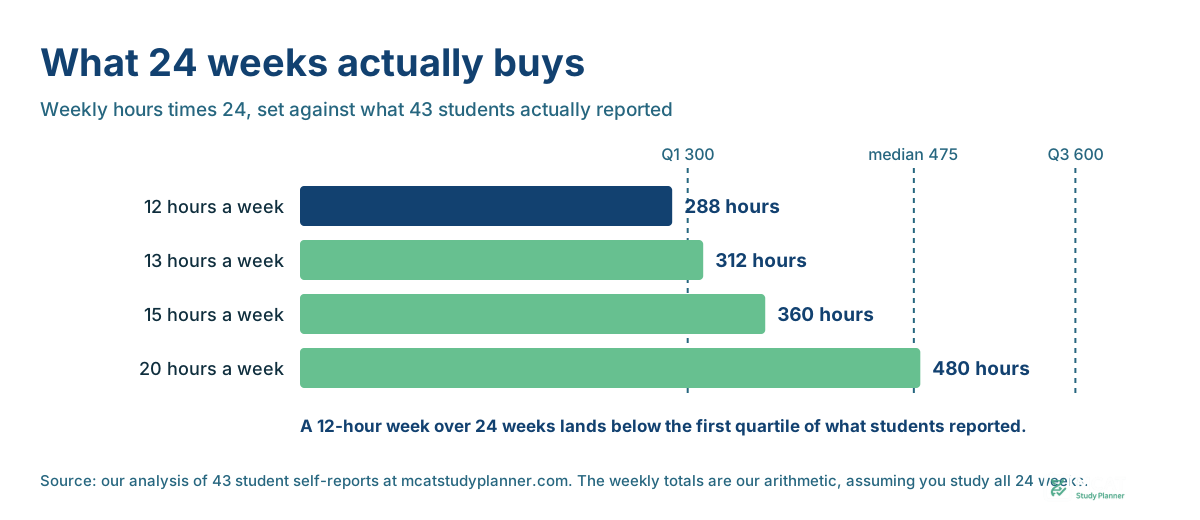
That is the first thing nobody tells you about a six-month plan. The weekly number that makes six months sound relaxed is also the number that puts your total near the bottom of the reported range. If your baseline is far from your target, 12 hours a week is not a gentler plan. It is a smaller one.
One note on a number you may have seen on our own site. Our study hours guide gives 17 to 19 hours a week for “6 months” because it divides the 475-hour median across 26 calendar weeks. This page counts 24 study weeks, so the same median comes out at about 20 hours a week. Both are the same division with a different denominator.
Six Months Is the Same Plan at a Lower Weekly Rate
Here is the equivalence nobody on this search puts in writing.
Twelve weeks at 25 hours a week is 300 hours. Twenty-four weeks at 12.5 hours a week is also 300 hours. The budgets are identical. Doubling the calendar did not add a single hour of studying.
What the extra 12 weeks actually buy you is a week you can live in. Our 3-month MCAT study schedule asks for 25 hours a week to hit that same 300 hours, and 25 hours a week is not compatible with a full course load or a full-time job. Six months is the timeline that makes the same total survivable.
What the extra 12 weeks cost you is retention, and that is the trade this whole guide is built around. Choose six months because your week is small, not because you think six months is more preparation.
The 24-Week Calendar, Counted Back From Test Day
Here is the whole plan as 24 weeks, counted backward from test day. Week 24 ends on your exam. The numbering is ours and it works for any date: find your test date, count back 24 weeks, and that is the start of week 1.
Every exam day lands on the same weekday as your real test date. You want the rehearsal to match the performance.
| Week | What runs | Sitting at the end of the week |
|---|---|---|
| 1 | Free Unscored Sample Test on day 1, then content review | Baseline, day 1 |
| 2 to 11 | Content review, daily CARS, timed question blocks, Anki new cards | none |
| 12 | Systematic content review ends | none |
| 13 | New Anki cards go to zero, error-log work begins | Practice Exam 1 |
| 14 | Targeted content from the error log | none |
| 15 | Targeted content from the error log | Practice Exam 2 |
| 16 | Targeted content from the error log | none |
| 17 | Targeted content from the error log | Practice Exam 3 |
| 18 | Targeted content from the error log | none |
| 19 | Targeted content from the error log | Practice Exam 4 |
| 20 | Targeted content from the error log | none |
| 21 | Targeted content from the error log | Practice Exam 5 |
| 22 | Targeted content from the error log | none |
| 23 | Review day, then timed section blocks | Practice Exam 6, seven days out |
| 24 | Taper: error-log review, timed section blocks, sleep schedule | Test day |
The official lineup is the constraint the calendar is built around. The AAMC’s prep page, read September 16, 2026, states that it “offers two free full-length practice exams and five low-cost practice exams.” In practice that is Practice Exam 1 free, Practice Exams 2 through 6 at $35.00 each on the AAMC store as of September 16, 2026, plus a separate free Unscored Sample Test that has, in the AAMC’s words, “the same look and feel and the same length and functionality as the actual MCAT exam but does not provide a scaled score or percentile rank.”
That gives you seven sittings and two jobs for them. The free Sample Test is your baseline in week 1, because it costs nothing and burns none of the six scored exams. The six scored exams are your diagnostics, spaced through the back half. Our week-by-week full-length calendar works through the placement rules across other timelines.
For the order to march through in weeks 1 to 12, our 10-week content review schedule sequences the topics by yield.
Why the Six Exams Go Two Weeks Apart, Not One
This is the section that makes a six-month plan different from a stretched three-month plan, and it is a straight collision between two numbers.
Per the AAMC, the exam is 230 questions, 6 hours 15 minutes of testing and about 7 hours 30 minutes of seated time. Reviewing a full length properly takes another 4 to 8 hours, which is our figure. So one sitting plus its review costs 11.5 to 15.5 hours, or about 13.5 at the midpoint.
Now set that against the week you just chose. This is our arithmetic, using the 13.5-hour midpoint:
| Weekly hours | Cost of one sitting | Hours left that week |
|---|---|---|
| 12 | 13.5 | 1.5 hours over budget |
| 15 | 13.5 | 1.5 |
| 25 | 13.5 | 11.5 |
| 40 | 13.5 | 26.5 |
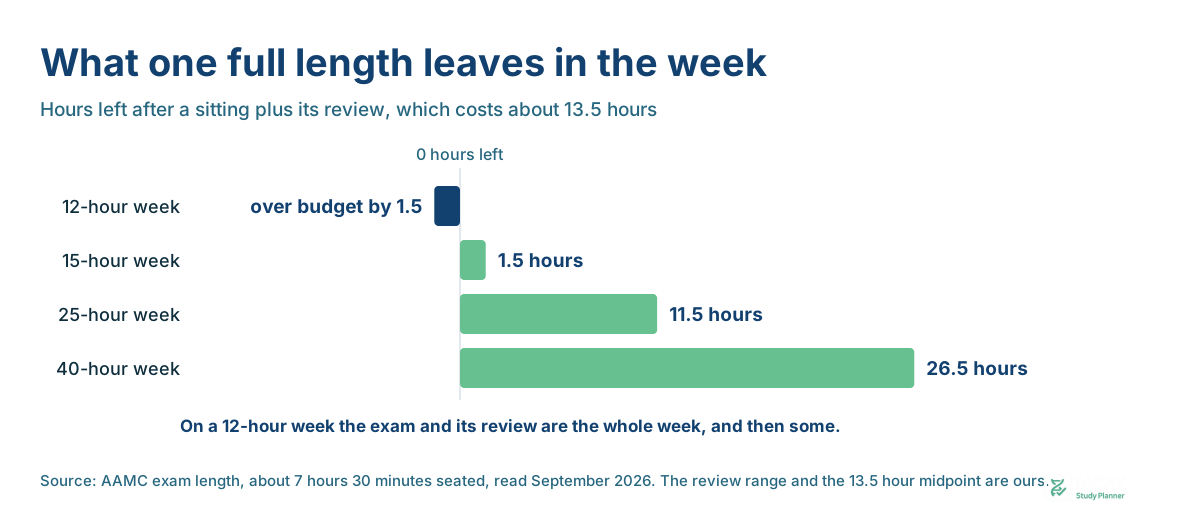
Read the top row again. On a 12-hour week the exam and its review do not fit. Six of those weeks in a row, which is what a one-exam-per-week practice block asks for, means six consecutive weeks with no content review, no error-log follow-up and no CARS, in the stretch where those matter most.
So the exams go two weeks apart: end of weeks 13, 15, 17, 19, 21 and 23. The exam week is the exam. The week after it is the error log, which is the part that actually moves the score. The last exam still lands seven days before test day.
This is a deliberate departure from our own advice elsewhere. Our guide to how to study for the MCAT puts the six exams in the final six weeks on every timeline of 12 weeks or more, including 24. That split holds at 20 hours a week and above, where one sitting leaves 6.5 hours behind. Below about 20 hours a week it does not survive the table above, so this page spaces the exams instead. If your 24 weeks run at 20 hours or more, use the six-week practice block from that guide. The same 20-hour line decides the calendar on a 16-week timeline too, which is why our 4-month MCAT study plan ships two versions of it.
The whole exam block is worth pricing once. Seven sittings at 11.5 to 15.5 hours is 80.5 to 108.5 hours, which on a 312-hour plan is 26 to 35 percent of everything you have. On the 480-hour full-time 12-week plan it was 17 to 23 percent. The longer, lighter plan spends a bigger share of itself on the same seven exams.
Do this before you book anything: multiply your honest weekly hours by 24, subtract 100 for the seven sittings, and look at what is left. If the remainder is under 200 hours and you are learning the sciences rather than refreshing them, raise the weekly number rather than accepting the total. Twenty-four weeks at 12 hours leaves about 188 hours for all content review and question practice combined.
The Problem a Six-Month Plan Has to Solve
A three-month plan does not have this problem. A six-month plan lives or dies on it.
Material you learn in week 1 has to still be there in week 24. That is 23 weeks of decay on your earliest content, against 11 weeks on a 12-week plan. Double the calendar, double the forgetting.
Exactly one page on this search names it. The Brem Method’s schedule guide, read September 16, 2026, says “Material you learn in month one needs to stay with you through month six, so regular review of earlier topics becomes part of the routine,” and recommends revisiting older subjects “on a rolling basis.” That is correct and it is where the page stops. No cadence, no card count, no hours.
The cadence has a cost, and the cost is the reason nobody publishes it.
The Anki Cadence That Keeps Month One Alive
Anki’s manual publishes a steady-state ratio: “If you are consistently learning 20 new cards a day, you can expect your daily reviews to be roughly about 200 cards/day.” Ten reviews for every new card.
That ratio is the open-ended equilibrium, and which number you should plan with depends on your timeline. A 12-week plan ends before the earliest cards finish their review sequence, so our Anki settings guide works from about 6 reviews per card over a 90-day horizon. A 24-week plan runs for 168 days, which is long enough for those sequences to complete. On this timeline, plan with the manual’s published 10 to 1.
Here is what that costs, assuming 8 seconds per review card and 25 seconds per new card, seven days a week. Both of those assumptions are ours, and Anki’s built-in simulator will give you the real figure for your own deck:
| New cards a day | Reviews a day | Minutes a day | Hours a week | Share of a 12-hour week |
|---|---|---|---|---|
| 15 | 150 | 26 | 3.1 | 26 percent |
| 20 | 200 | 35 | 4.1 | 34 percent |
| 30 | 300 | 53 | 6.1 | 51 percent |
| 50 | 500 | 88 | 10.2 | 85 percent |
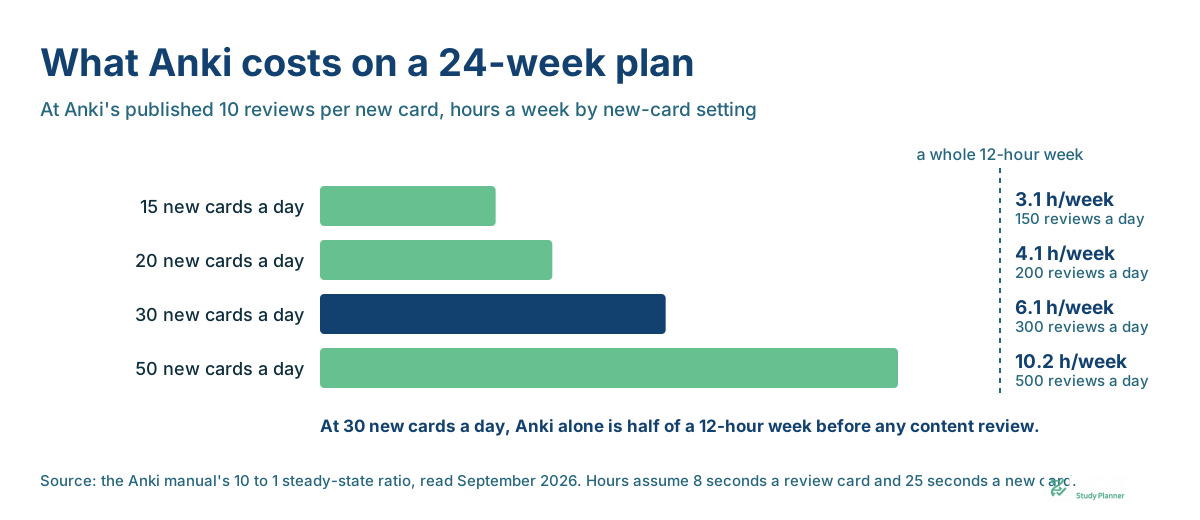
Three rules follow from that table, and together they are the rolling review the Brem Method page describes but does not specify.
Cap new cards at 20 a day during weeks 1 to 12. Twelve weeks at 20 a day is 1,680 cards, which is a real MCAT deck. At 30 a day you get 2,520 cards and Anki takes half your week. The cards you never review are worth nothing, so the cap is not a compromise.
Set new cards to zero in week 13. This is the setting almost nobody changes, and on a 24-week plan it is the one that matters most. When the practice block starts, every hour belongs to the error log. If you keep adding 20 cards a day through week 24, your review queue keeps climbing right through the weeks when your full lengths need the time. Set new cards to zero and the queue starts to shrink on its own as intervals lengthen.
Set maximum interval so nothing sleeps through test day. Anki’s default is 100 years, and the manual says to “decrease this to a smaller number if you’re willing to trade extra study time for higher retention.” Our Anki guide’s rule is about half the days left until your test, which is 90 at the six-month mark. Lower it again as the date approaches.
The Working-Student Track at 12 Hours a Week
Twelve hours a week is the point of this timeline, so it is worth laying out as a real week rather than a number. This shape is ours:
| Day | Block | Hours |
|---|---|---|
| Monday to Friday | Evening: Anki, then one content topic or a timed question block | 1.5 each, 7.5 total |
| Saturday or Sunday | Long block: content review, CARS, and the week’s question practice | 4.5 |
| The other weekend day | Off | 0 |
Daily CARS runs inside the weekday evening, not as an extra. One or two passages, timed, from week 1. CARS does not respond to cramming, and 24 weeks of daily contact is the single biggest advantage this timeline has over a 12-week one.
Exam weeks change shape. The weekend long block becomes the full sitting, which needs about 7.5 hours, so it takes the whole day. The five weekday evenings that follow carry the 4 to 8 hours of review. That is the entire week, which is exactly why the next exam is two weeks out and not one.
Once you have a date and a weekly number, the free MCAT study schedule generator lays these blocks out day by day around whatever else is already on your calendar, with the six exams placed.
Plan the Light Weeks Before Life Plans Them
Twenty-four weeks is most of a semester. In that span you will have a midterm week, a holiday, a wedding, a bad cold, or all four. No ranking page on this search builds a single light week into a six-month plan, which is why so many six-month plans quietly become five-month plans.
Build them in instead. A light week is 4 hours, not zero: Anki keeps running and CARS keeps running, because those are the two things that punish a gap. Here is what that does to the weeks around it, which is our arithmetic:
| Light weeks planned | Hours needed in each working week, 312-hour target | Hours needed in each working week, 360-hour target |
|---|---|---|
| 0 | 13.0 | 15.0 |
| 2 | 13.8 | 16.0 |
| 3 | 14.3 | 16.6 |
| 4 | 14.8 | 17.2 |
Three light weeks on a 312-hour target means your real working week is 14.3 hours, not 13. That is the honest version of the plan, and it is better to know it in week 1 than to discover it in week 18.
Book the Date Before You Start, or as Close as You Can
A 24-week plan started today runs into a scheduling quirk that a 12-week plan never sees.
The AAMC’s site, read September 16, 2026, carries this notice: “Registration for the entire 2027 MCAT testing season (Jan. - Sept.) will open Oct. 20-22, 2026, by testing center location.” So if you start a 24-week plan in the second half of September 2026, you will be about five weeks into studying before you can book the exam you are studying for.
That is worth planning around rather than worrying about. Our list of official MCAT test dates gives all 35 dates in the 2027 calendar with the exact day a 24-week plan has to start for each one. Counting back 24 weeks, the March 6, 2027 exam starts on September 19, 2026, and the March 19, 2027 exam starts on October 2, 2026. Both start lines fall before registration opens, so pick the date first and treat the booking as a calendar item for October 20.
One product note if you are buying AAMC material this month. The same prep page states that the Online-Only Bundle “will be unavailable for purchase from Sept. 14-29, 2026, and will return on Sept. 30 with the new CARS Question Bank included.” The CARS Question Packs and the CARS Diagnostic Tool are no longer listed at all, as of that September 16, 2026 read. If you are in week 1 right now, wait for September 30 rather than buying the pieces separately.
What the Ranking Pages Get Wrong
Four errors repeat across the pages that currently rank for this search, and each one changes what you would do.
Kaplan’s page contradicts itself by about 100 hours. Its Step 3 tells you to plan on “at least three hours per day, six days per week,” and its own FAQ says “Kaplan recommends studying for the MCAT over a period of four to six months for a total of 300 to 350 hours.” Both read September 16, 2026. Three hours over six days is 18 hours a week, which is 432 hours across 24 weeks. Follow the weekly instruction and you will study 82 hours past the top of the range the same page recommends.
The 12 to 15 hour figure rests on nobody in particular. Jack Westin’s 6-month page, read September 16, 2026, is where it comes from: “many experts recommend a total of 300 to 350 hours of study time… If you’re following a 6-month study schedule, this equates to approximately 12-15 hours per week.” The experts are unnamed and uncited. When we read the AAMC’s own study-plan page directly, it contained no prep-hours recommendation at all. Treat any hours figure without a dataset behind it as somebody’s guess, ours included, which is why ours ships with its 43 reports and their limitations attached.
There are six scored official exams, not five. Shemmassian’s schedule guide, read September 16, 2026, says “At an absolute minimum, you should take the five AAMC full-length practice exams.” The AAMC’s own page lists Practice Exams 1 through 6. A 24-week plan has room for all six, so planning around five leaves a scored data point unused. That same page’s 6-month section is three sentences and a PDF download, with no weeks, no hours and no exam placement in it.
One of the top 6-month schedules is 31 weeks long. Jack Westin’s “6-Month MCAT Study Schedule” table, read September 16, 2026, runs its own Week column from 1 to 31, which is just over seven months, and places four full lengths rather than six. Its CARS practice does not start until week 11, which contradicts the daily-CARS advice on nearly every other page ranking for this search, that page’s own included.
The Whole 24 Weeks on One Page
| Decision | The number |
|---|---|
| Plan length | 24 weeks, ending on test day |
| Budget at 12 hours a week | 288 hours, below the first quartile of 43 reports |
| Budget at 13 hours a week | 312 hours |
| Budget at 15 hours a week | 360 hours |
| Budget for the 475-hour median | About 20 hours a week |
| Baseline | Free AAMC Unscored Sample Test, week 1 |
| Content review | Weeks 1 to 12, with daily CARS and timed blocks throughout |
| Scored exams | End of weeks 13, 15, 17, 19, 21 and 23, same weekday as test day |
| Cost per sitting | 7.5 hours seated plus 4 to 8 hours of review |
| Cost of all seven sittings | 80.5 to 108.5 hours, or 26 to 35 percent of a 312-hour plan |
| Anki new cards | 20 a day in weeks 1 to 12, zero from week 13 |
| Anki review load | About 200 a day, roughly 4.1 hours a week |
| Anki maximum interval | About 90 days at the start, lowered as the date nears |
| Light weeks | Plan 2 to 4 at 4 hours each, and raise the working week to match |
| Last full length | End of week 23, seven days out |
| Final week | Week 24, taper, no full length |
Two ways to put this on a real calendar. The MCAT study planner takes your test date, your weekly hours and your resources and builds exactly this structure, with the six exams already placed and the days filled in around your job or your classes. If you would rather do it by hand, copy the 24-week table above into a spreadsheet and fill in the topic for each week from our content review schedule.
Whichever you choose, do the multiplication before you book the date. Six months is a generous calendar and a modest budget at the same time, and only one of those two facts is on the other pages you will read today.
Written by
MCAT Study Planner Team
Last updated 9/16/2026