
3 Month MCAT Study Schedule (Week-by-Week, 2026)
By MCAT Study Planner Team • Updated 9/8/2026
Short answer: three months is enough at 40 hours a week, workable at 25, and not enough at 15. Twelve weeks buys you 480, 300 or 180 total hours, and the seven official practice sittings alone cost 80 to 108 of them.
Almost every 3-month schedule you will find gives you daily hours and a week-by-week outline. Very few multiply their own advice out. Google’s AI Overview for this search tells you to study 6 to 8 hours a day, 5 to 6 days a week, “to hit the recommended 300 total study hours.” That pace over 12 weeks is 360 to 576 hours. The plan and the total do not agree.
So this guide does the arithmetic first and the calendar second. Every number is either from a source we name or labeled as ours, with the assumption written down next to it.
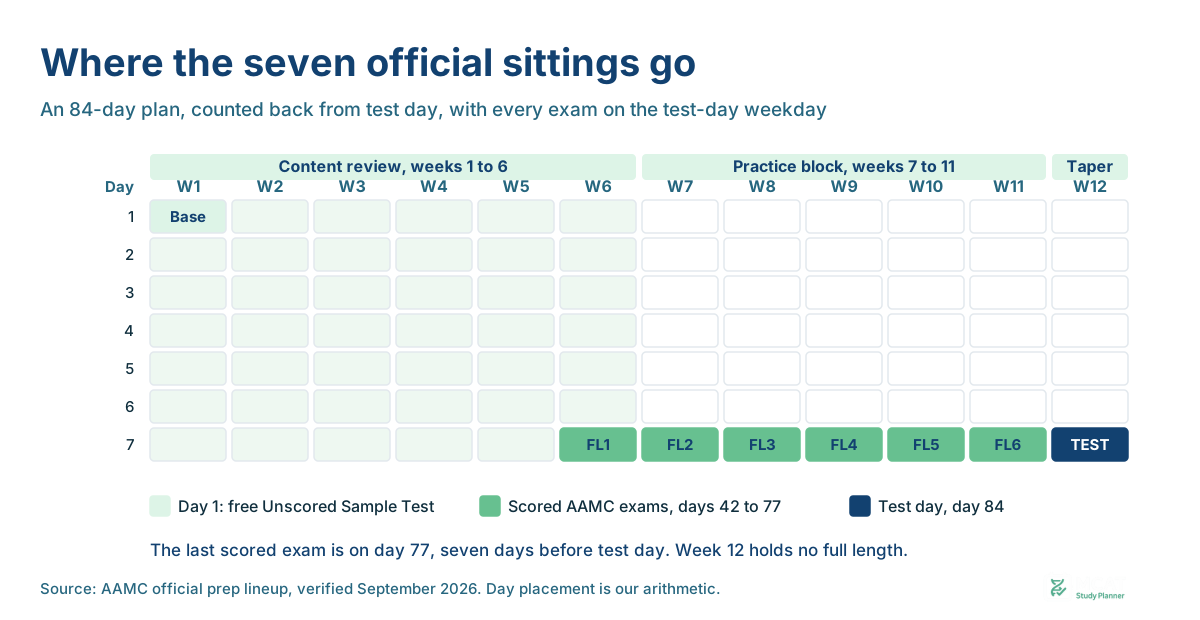
The 30-second answer: pick your weekly hours, not your daily ones. Multiply by 12 to get your real budget. Take the free AAMC Unscored Sample Test on day 1. Run content review through day 42, then put the six scored AAMC practice exams on days 42, 49, 56, 63, 70 and 77, each on the same weekday as your real test date. Week 12 holds no full length. If your budget lands at 180 hours, add weeks instead of cutting exams.
In this guide
- What 12 weeks of studying actually adds up to
- Pick your track before you pick your calendar
- The 12-week calendar, counted back from test day
- Where the six official exams go
- What a full-length week actually costs
- Weeks 1 to 6: the content block
- Weeks 7 to 11: the practice block
- Week 12: taper, not another exam
- Is three months actually enough?
- What the ranking pages get wrong
- The whole 12 weeks on one page
What 12 Weeks of Studying Actually Adds Up To
Twelve weeks is not a study budget. Hours per week times twelve is a study budget, and the difference between the three common answers is enormous.
This is our arithmetic, and the only assumption is that you study every one of the 12 weeks:
| Weekly hours | 12-week total | Where that sits in our 43-report dataset |
|---|---|---|
| 40 (full time) | 480 hours | Just above the 475-hour median |
| 25 (part time) | 300 hours | Exactly the first quartile |
| 15 (working or in class) | 180 hours | Below all but 6 of the 43 reports |
The comparison column comes from our own data. In our analysis of 43 students who reported both their total hours and their score, the median was 475 hours, the middle half fell between 300 and 600, and the range ran from 45 to 2,625.
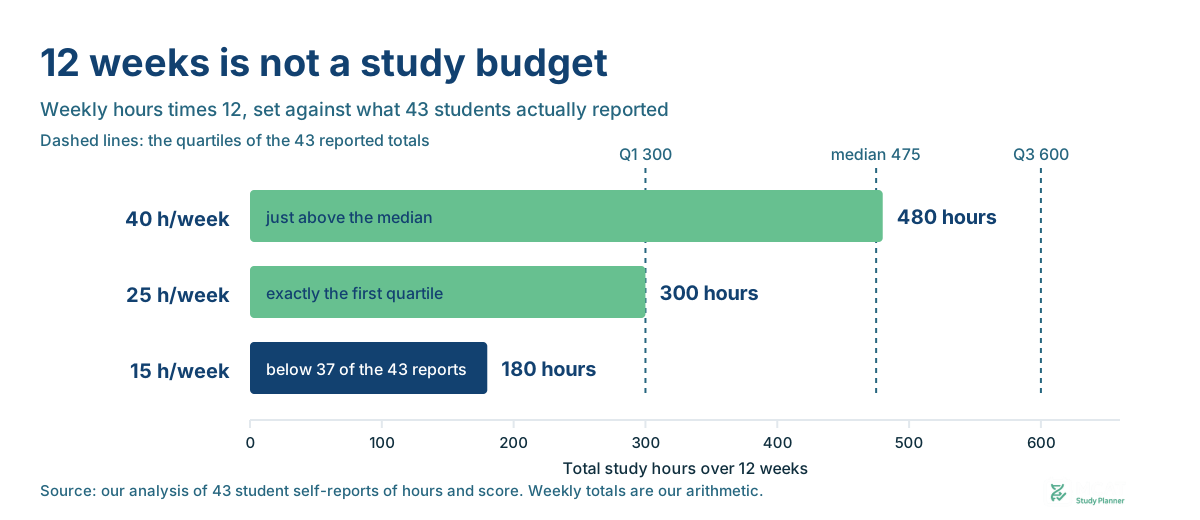
The 180-hour cell deserves a second look before you commit to it. Six of the 43 reports came in under 200 total hours. Their median score was 517, the lowest was 510, and where a starting score was given it was already at or above 510. Those are people who were nearly there when they started. If your baseline is not, 180 hours is not the same plan for you that it was for them.
Pick Your Track Before You Pick Your Calendar
The calendar below is the same for everyone. What changes is the size of each day inside it. Three tracks cover almost everyone, and the daily shapes are ours:
| Track | Weekly hours | A typical week | Best for |
|---|---|---|---|
| Full time | 40 | About 7 hours on 6 days | A gap semester or post-bacc with nothing else booked |
| Part time | 25 | 4 hours on 5 weekdays plus one 5-hour weekend day | Classes, part-time work, or family commitments |
| Limited | 15 | 2 hours on 5 weekdays plus one 5-hour day | A full-time job, and see the warning below |
For reference on the ends of that range, read September 8, 2026: Leah4Sci’s 3-month plan assumes about 8 hours Monday through Friday, Jack Westin’s 12-week page works from 20 to 30 hours a week, and Student Doctor Network’s part-time plan lands at 20 to 25.
Pick the row you can actually live in for 12 straight weeks, not the row you admire. Then feed the test date and that weekly number into the free MCAT study schedule generator, which lays the blocks out day by day around whatever else is on your calendar.
The 12-Week Calendar, Counted Back From Test Day
Here is the whole plan as 84 days, counted backward from test day. Day 84 is your exam. This numbering is ours, and it works for any test date: find your date, count back 84 days, and that is day 1.
If you have not locked a date yet, our list of official MCAT test dates gives all 35 dates in the 2027 calendar with the exact day a 12-week plan has to start for each one.
Every exam day lands on the same weekday as your real test date, which is deliberate. You want the rehearsal to match the performance.
| Week | Days | What runs | Sitting on the last day |
|---|---|---|---|
| 1 | 1 to 7 | Free Unscored Sample Test on day 1, then content review | Baseline, day 1 |
| 2 | 8 to 14 | Content review, daily CARS, timed question blocks | none |
| 3 | 15 to 21 | Content review, daily CARS, timed question blocks | none |
| 4 | 22 to 28 | Content review, daily CARS, timed question blocks | none |
| 5 | 29 to 35 | Content review, daily CARS, timed question blocks | none |
| 6 | 36 to 42 | Content review ends | Practice Exam 1, day 42 |
| 7 | 43 to 49 | Review day, then targeted content from the error log | Practice Exam 2, day 49 |
| 8 | 50 to 56 | Review day, then targeted content from the error log | Practice Exam 3, day 56 |
| 9 | 57 to 63 | Review day, then targeted content from the error log | Practice Exam 4, day 63 |
| 10 | 64 to 70 | Review day, then targeted content from the error log | Practice Exam 5, day 70 |
| 11 | 71 to 77 | Review day, then targeted content from the error log | Practice Exam 6, day 77 |
| 12 | 78 to 84 | Taper: error-log review and timed section blocks | Test day, day 84 |
Where the Six Official Exams Go
The official lineup is six scored practice exams plus one free unscored one. That is the constraint the whole calendar is built around.
When we last read the AAMC’s official prep page directly, on September 3, 2026, it listed Practice Exam 1 as free, Practice Exams 2 through 6 at $35 each, and a separate free Unscored Sample Test. The Sample Test is 230 questions with, in the AAMC’s words, “the same look and feel and the same length and functionality as the actual MCAT exam but does not provide a scaled score or percentile rank.”
That gives you seven sittings and two jobs for them:
- The free Sample Test is your baseline, on day 1. It has no scaled score, which is exactly why it makes a good baseline. It costs you nothing and it burns none of the six scored exams, whose scaled scores are the ones that predict anything.
- The six scored exams go one per week, on days 42, 49, 56, 63, 70 and 77. Same weekday as your real test, seven days apart, last one exactly a week out.
Our week-by-week full-length calendar works through the placement rules across other timelines, including what to cut on 8 weeks. On 12 weeks you cut nothing: the six exams fit.
One product note if you are starting a 12-week plan right now. The same AAMC page, read September 3, 2026, said the CARS Diagnostic Tool and both CARS Question Packs “will be retired and no longer available for purchase starting Sept. 14, 2026,” and that a new CARS Question Bank would be added to the Online-Only Bundle on Sept. 30, 2026. Check the current AAMC store before you buy CARS material, because that changeover falls inside week 1 of a plan started in September 2026.
What a Full-Length Week Actually Costs
This is the table that decides whether your track survives contact with the calendar, and it is the one no ranking page runs.
A sitting is about 7 hours 30 minutes seated, per the AAMC’s description of the exam. Reviewing it properly takes another 4 to 8 hours. So an exam plus its review costs 11.5 to 15.5 hours. Our arithmetic, with that as the only assumption:
| Track | Weekly hours | Exam plus review | Hours left that week |
|---|---|---|---|
| Full time | 40 | 11.5 to 15.5 | 24.5 to 28.5 |
| Part time | 25 | 11.5 to 15.5 | 9.5 to 13.5 |
| Limited | 15 | 11.5 to 15.5 | 0 to 3.5 |
Read the bottom row again. On a 15-hour week, weeks 7 through 11 have nothing left in them, and at the top of the review range the week is already over budget. The exam and its review are the whole week, five weeks running, which leaves no content review and no error-log follow-up in the stretch where those matter most.
The same thing shows up across the full budget. Seven sittings at 11.5 to 15.5 hours each is 80 to 108 hours:
| Track | 12-week total | Seven sittings | Left for content and questions |
|---|---|---|---|
| Full time | 480 | 80 to 108 (17 to 23 percent) | 372 to 400 hours |
| Part time | 300 | 80 to 108 (27 to 36 percent) | 192 to 220 hours |
| Limited | 180 | 80 to 108 (45 to 60 percent) | 72 to 100 hours |
Do this before you book anything: multiply your honest weekly hours by 12, subtract 100 for the practice exams, and look at what is left. If the remainder is under 150 hours and you are learning material rather than refreshing it, move the test date out rather than cutting the exam block. Sixteen weeks at 15 hours a week is 240 hours, which is a real plan; 12 weeks at 15 is not.
Weeks 1 to 6: The Content Block
Content review runs from day 1 to day 42 and ends the moment the first scored exam starts. Six weeks is all you get, so the order matters more than the coverage.
Three things run every week in this block, alongside the content itself.
Daily CARS. One or two passages a day, timed, from day 1. CARS does not respond to cramming, and six weeks of daily contact beats six days of panic.
Timed question blocks from week 1. Not after content review, during it. The AAMC’s own framing is that “active learning requires more than just reading or watching a video. You must engage in the learning process through recall, practice, and reflection” (read on their study-plan page, September 3, 2026). Reading a chapter is not studying it.
Spaced repetition, capped. Anki quietly eats schedules. Twenty to thirty new cards a day settles into roughly 120 to 180 daily reviews, which is 16 to 24 minutes. Push new cards to 75 or 100 a day and Anki alone becomes a 1.5 to 2 hour daily commitment you did not budget for. Our Anki settings guide works through that arithmetic.
For the order to march through the outline in, our 10-week content review schedule sequences the topics by yield, and the method behind the daily block is in our guide to how to study for the MCAT.
Weeks 7 to 11: The Practice Block
Every week in this block has the same shape: exam on the last day, review the next day, then four days of targeted work driven by what the review turned up.
The review day is the part people skip, and it is the part that pays. Budget the full 4 to 8 hours and go through every wrong answer and every question you flagged, including the flagged ones you got right. Write down why the wrong choice was attractive, not what the right answer was. That list is your error log.
Then actually use it. The error log from day 49 sets days 50 through 53. If it does not, you are taking five stamina drills instead of five diagnostics.
Resource choice matters less here than most people think. In the AAMC’s Post-MCAT Questionnaire, read September 3, 2026, with 24,721 responses out of 81,077 invited, 89.2 percent of examinees used the official practice exams and 69.9 percent used commercial prep books. Official exams plus one book set is what almost everyone’s preparation is made of.
Week 12: Taper, Not Another Exam
Days 78 through 84 hold no full length. That is the point of putting the last exam on day 77.
What fills the week instead: targeted review from the error log, one or two timed section blocks to keep pacing sharp, and sleep moved onto the schedule the exam will demand. Per the AAMC, the exam is 230 questions, 6 hours 15 minutes of testing and about 7 hours 30 minutes seated. This week is when you shift your day to match it, not the night before.
Is Three Months Actually Enough?
For most people at 25 hours a week or more, yes. The budget is half the answer; your starting point is the other half. The AAMC’s percentile table (N = 305,494, 2023 to 2025 testing years) puts 500 at the 48th percentile, 508 at the 74th, 510 at the 79th, 515 at the 91st and 520 at the 97th. The distance between your Sample Test result and your target sets your hours. Twelve weeks only fixes the divisor.
Three situations change the answer:
No recent science coursework. You are learning, not refreshing. The budget moves toward 600 hours, which 12 weeks only supports at 50 hours a week. Sixteen or 24 weeks is the better call, and both now have a week-by-week version: our 4-month MCAT study plan for 16 weeks and our 6-month MCAT study schedule for 24.
A full-time job. At 15 hours a week the exam block alone consumes the back half of the plan. Move the date rather than the exam count.
A retake. You already have a real score and a real section breakdown, so day 1 does not need a baseline test. That frees a sitting and lets the content block start from your actual weak sections.
If you have less than three months, the arithmetic gets tighter but not impossible; our 1-month MCAT study schedule is the compressed version, with the exam count cut rather than the review.
What the Ranking Pages Get Wrong
Two errors are repeated across the pages that currently rank for this search, and both change what you would do.
The AAMC does not publish an hours figure. Student Doctor Network’s 3-month page states that “AAMC guidance stresses setting realistic study hours and spreading prep over 300-500 hours” and that its part-time plan “fits AAMC’s guidance of at least 300 hours of study spread across three months” (read September 8, 2026). When we read the AAMC’s study-plan page and the Post-MCAT Questionnaire directly on September 3, 2026, neither contained an hours recommendation. The study-plan page gives three steps and no prep-time number at all, and the questionnaire asks examinees about strategies, resources and challenges, not hours. Treat any hours figure attributed to the AAMC as unsourced, ours included, which is why ours comes with its dataset and its limitations attached.
There are six scored official exams, not five. Shemmassian’s schedule guide, updated March 24, 2026 and read September 8, 2026, says “at an absolute minimum, you should take the five AAMC full-length practice exams.” Student Doctor Network’s plans call for “at least 5 official AAMC Full Length Exams.” Our own read of the AAMC prep page on September 3, 2026 found six scored Practice Exams, numbered 1 through 6, plus the free Unscored Sample Test. A 12-week plan has room for all six, so planning around five leaves a data point unused.
A third gap is quieter. Brem Method’s schedule guide, read September 8, 2026, splits every plan into thirds at 70/30, 50/50 and 30/70 content to practice, and never mentions hours or exam counts. Percentages of an unspecified budget are not a plan.
The Whole 12 Weeks on One Page
| Decision | The number |
|---|---|
| Plan length | 84 days, ending on test day |
| Budget, full time | 40 h/week, 480 hours total |
| Budget, part time | 25 h/week, 300 hours total |
| Budget, limited | 15 h/week, 180 hours, not enough for the standard exam block |
| Baseline | Free AAMC Unscored Sample Test, day 1 |
| Content review | Days 1 to 42, with daily CARS and timed blocks throughout |
| Scored exams | Days 42, 49, 56, 63, 70, 77, same weekday as test day |
| Cost per sitting | 7.5 hours seated plus 4 to 8 hours of review |
| Cost of all seven sittings | 80 to 108 hours |
| Review | The day after each exam, error log drives the next four days |
| Last full length | Day 77, seven days out |
| Final week | Days 78 to 84, taper, no full length |
Two ways to put this on a real calendar. The MCAT study planner takes your test date, your weekly hours and your resources and produces exactly this structure with the exams already placed and the days filled in around your commitments. If you would rather build it by hand, our free MCAT study plan templates are the spreadsheet version of the same 84 days.
Written by
MCAT Study Planner Team
Last updated 9/8/2026