
How to Study for the MCAT: A Step-by-Step Plan
By MCAT Study Planner Team • Updated 9/7/2026
Short answer: take the free AAMC Sample Test first, set your hours from the score gap it shows you, end content review six weeks before test day, and put one scored AAMC practice exam in each of those last six weeks.
That is the whole method. Everything else is detail on how to execute those four decisions.
The problem with most “how to study for the MCAT” advice is that it stops at phases. Content review, then practice, then full lengths. The AAMC’s own study-plan page gives you three steps and not a single number: no hours, no weeks, no months. Prep companies fill that gap with “300 to 350 hours,” a figure that, when we traced it, came from marketing copy citing unnamed experts.
So this guide attaches a number to every step. Where the number comes from the AAMC, we say so. Where it comes from our own dataset of 43 students who reported both their hours and their score, we say that too. And where it is our arithmetic, it is labeled as ours.
The 30-second answer: pick a test date and count the weeks. Take the free Unscored Sample Test in week one. Budget 300 to 600 hours depending on your gap (the median student reports 475). Divide by your weeks to get hours per week. Finish content review six weeks out. Take the six scored AAMC exams one per week after that, and review each one the next day. Taper in the final week.
In this guide
- Step 1: Pick the date and count the weeks
- Step 2: Take the free Sample Test before you study anything
- Step 3: Set your hours from your gap, not from a blog
- Step 4: Decide when content review ends
- Step 5: Build the daily block
- Step 6: Put the six full lengths on the calendar
- Step 7: Review every test the day after
- Step 8: Taper, then test day
- What to study with
- The three situations that change the plan
- The whole plan on one page
Step 1: Pick the Date and Count the Weeks
Every other decision depends on one number: how many weeks you have. So the plan starts with a test date, not with a book. Our MCAT test dates page lists every official 2027 date with its registration deadlines, so you can pick one before you buy anything. If you are still deciding which date, our guide to when to take the MCAT prices each 2027 window in retake room, coursework and hours a week.
The exam itself is fixed. Per the AAMC’s description of the exam, it is 230 questions across four sections, 6 hours 15 minutes of testing time, and about 7 hours 30 minutes seated. That does not change with your timeline. What changes is how many weeks of preparation sit in front of it.
Count the weeks between today and your date. If the answer is under 8, read our 1-month MCAT study schedule and decide honestly whether the date is realistic. If it is 12 or more, the rest of this guide applies without modification. If it is between 8 and 12, you will be cutting practice sittings, and Step 6 tells you which ones.
If you land on exactly 12, our 3-month MCAT study schedule runs these eight steps out as an 84-day calendar, with the six scored exams already placed and the hours worked out for 40, 25 and 15 hour weeks.
Write the number down. It is the divisor for every calculation that follows.
Step 2: Take the Free Sample Test Before You Study Anything
This is the AAMC’s step one, and almost everyone skips it.
The AAMC study-plan page says to take the free Unscored Sample Test, open the Content and Skills Breakdown in the score report, and mark every content area low, medium or high confidence. Then, in its words, “your baseline assessment will determine the time it takes to complete each step.”
Two reasons this matters more than it sounds.
First, it tells you where your hours should go. A student whose report shows high confidence across biology and low confidence in physics does not need the same plan as the reverse. Content review that ignores the baseline spends weeks re-learning material you already have.
Second, it preserves your scored exams. The AAMC sells six scored practice exams (Exam 1 is free, Exams 2 through 6 are $35 each as of September 2026), and each one is a data point you cannot get back. Using the free Unscored Sample Test as the baseline keeps all six for the final stretch, where their scaled scores actually predict something.
The tradeoff is that the Sample Test returns no scaled score, so if you want a baseline number rather than a content map, compare it against the free third-party options in our guide to which MCAT diagnostic test to take, which also shows what a given baseline typically turns into.
Do this in week one: sit the Unscored Sample Test under real timing (95, 90, 95, 95 minutes with the breaks), export the Content and Skills Breakdown, and mark each area low, medium or high. That marked list is your content-review syllabus. Do not open a review book before you have it.
Step 3: Set Your Hours From Your Gap, Not From a Blog
Now the number everyone asks for. Here is what the sources actually say.
The AAMC publishes no hours recommendation anywhere. Its Post-MCAT Questionnaire asks examinees about strategies and resources but never about hours. The “300 to 350 hours” figure that appears on most ranking pages traces to Kaplan copy citing unnamed experts, with no source behind it.
What we have instead is our own dataset. In our analysis of 43 students who reported both their total hours and their score, the median was 475 hours, the middle half fell between 300 and 600, and the correlation between hours and score was slightly negative (r = -0.23). Hours are a symptom of how big your starting gap is, not a lever that raises your score on its own.
So the honest way to set your budget is from the gap between your Sample Test baseline and your target. The AAMC’s percentile table (N = 305,494, 2023 to 2025) puts 500 at the 48th percentile, 508 at the 74th, 510 at the 79th, 515 at the 91st and 520 at the 97th. A small gap from a strong baseline sits near the 300-hour end. A large gap, or material you are learning for the first time, sits near 600 or beyond.
Then divide by your weeks. This is our arithmetic on the dataset’s quartiles:
| Total hours | 8 weeks | 12 weeks | 16 weeks | 24 weeks |
|---|---|---|---|---|
| 300 (first quartile) | 38 h/week | 25 h/week | 19 h/week | 13 h/week |
| 475 (median) | 59 h/week | 40 h/week | 30 h/week | 20 h/week |
| 600 (third quartile) | 75 h/week | 50 h/week | 38 h/week | 25 h/week |
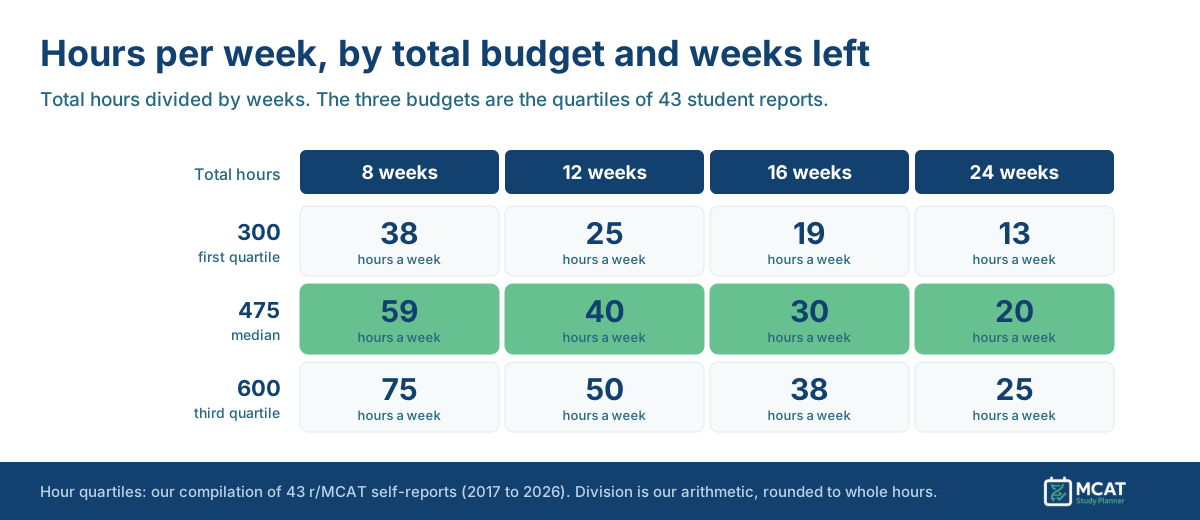
Read the table against your life. Forty hours a week is a full-time job. Twenty is what a student with classes or a working adult can usually sustain. If your budget and your weeks put you in a cell you cannot live in, the fix is more weeks, not fewer hours. This is exactly the calculation our free MCAT study schedule generator does when you enter a test date and your hours per week.
Step 4: Decide When Content Review Ends
Most guides tell you to spend “half to two-thirds” of your time on content. That is a guess dressed as a rule. There is a better way to get the split, and it comes from a constraint you cannot negotiate with.
The AAMC sells six scored practice exams. Their scaled scores are the only ones that predict your real score, and each one needs a full day plus a review day. Our full-length calendar puts one in each of the final six weeks, with the last one 7 to 10 days before test day.
That fixes the end of content review. On any timeline of 12 weeks or more, dedicated content review ends six weeks out. The split follows from that, and it is ours:
| Timeline | Content-heavy weeks | Practice and exam weeks | Scored AAMC sittings |
|---|---|---|---|
| 24 weeks | 18 | 6 | 6 |
| 16 weeks | 10 | 6 | 6 |
| 12 weeks | 6 | 6 | 6 |
| 8 weeks | 3 | 5 | 5 (Exams 5 and 6 unopened) |
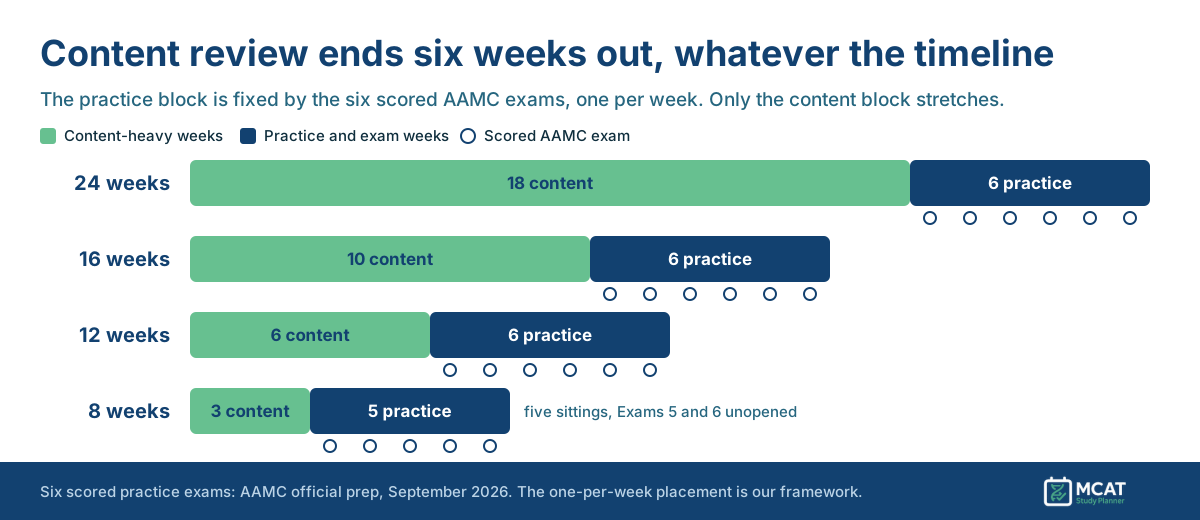
One exception sits in the 24-week row. A six-week practice block assumes you can absorb one full length plus 4 to 8 hours of review every week, and below about 20 hours a week you cannot. Our 6-month MCAT study schedule spaces the six exams two weeks apart for exactly that reason.
The 16-week row is where that same threshold starts to bite, because 19 hours a week sits right on the edge of it. Our 4-month MCAT study plan splits the timeline into two calendars for that reason, one with weekly exams above 20 hours a week and one with the exams every other week below it.
”Content-heavy” does not mean questions stop. The AAMC describes the whole method as a “study and practice cycle,” and its exact words on active learning are worth keeping in front of you: “Active learning requires more than just reading or watching a video. You must engage in the learning process through recall, practice, and reflection.” Practice questions live in every week. What ends six weeks out is the systematic march through the content outline.
For what that march looks like week by week, our 10-week content review schedule orders the topics by yield.
Step 5: Build the Daily Block
Hours per week only work if they turn into a repeatable day. Here is a four-hour block, which is our template for a 25 to 30 hour week. Scale it, do not restructure it.
| Block | Minutes | What it is |
|---|---|---|
| Anki reviews | 25 | Due cards only, first thing, before new material |
| Content with recall | 120 | One outline section: read, close the book, write what you remember, reopen and fix |
| Timed questions | 60 | A passage set or question block under section pacing |
| Review and error log | 35 | Every wrong and flagged answer, with the reason it was wrong, not the right answer |
The Anki line deserves its own number, because it is the one that quietly eats schedules. Per Anki’s own manual, learning about 20 new cards a day produces roughly 200 reviews a day at steady state. Over an MCAT horizon each card gets about six touches, so 20 to 30 new cards a day settles around 120 to 180 reviews, about 16 to 24 minutes at 8 seconds a card. Push new cards to 75 or 100 a day and Anki alone becomes a 1.5 to 2 hour daily commitment. Our Anki settings guide works through that arithmetic and the settings that keep it in check.
The recall step in the content block is the AAMC’s “recall, practice, and reflection” made literal. Reading a chapter is not studying it. Closing it and reproducing it is.
Step 6: Put the Six Full Lengths on the Calendar
You have seven sittings to place: the free Unscored Sample Test and the six scored exams. Each sitting is about 7.5 hours seated plus 4 to 8 hours of review, so budget 1.5 to 2 days per exam and roughly 80 to 105 hours for the whole set. That is 15 to 20 percent of a 475-hour plan, which is why it has to be on the calendar from day one rather than squeezed in at the end.
The placement rules, from our week-by-week full-length calendar:
- Baseline on the free Unscored Sample Test in week one (or by weeks 3 to 5 at the latest if you need a short content refresher first).
- One scored AAMC exam per week in the final six weeks. Exam 1 is free; 2 through 6 are $35 each.
- Last exam 7 to 10 days before test day. The final week is taper and targeted review, not another full sitting.
- On an 8-week plan, cut to five sittings and leave Exams 5 and 6 unopened. Five real data points beat six rushed ones.
The AAMC’s own instruction for these is to take Practice Exam One “under test-day timing” and to complete full lengths between content work, reviewing all incorrect and flagged questions. Test-day timing means the real section clocks and the real breaks, in the morning, on a day you did not study first.
Step 7: Review Every Test the Day After
A full length you do not review is a 7.5-hour stamina drill. The score comes from the review.
Do it the next day, while the reasoning is still in memory, and budget the full 4 to 8 hours. Go through every wrong answer and every flagged one, including the flagged questions you got right, and write down why the wrong choice was attractive. That “why” is the error log, and it is the only document that tells you what the next week’s content hours should contain.
Then feed it back. The AAMC’s step three is to “spend time between exams reviewing content areas where mistakes occurred.” In practice that means the error log from Sunday’s exam sets Monday through Friday’s content list. This is the loop that makes the final six weeks worth more than the first six.
Step 8: Taper, Then Test Day
The last exam is 7 to 10 days out. What fills the final week is targeted review from the error log, one or two timed section blocks to keep pacing sharp, and sleep on the schedule the exam will demand. The MCAT starts in the morning and runs about 7.5 hours seated, so the week before is when you move your day to match it.
Two of our other guides cover this stretch in detail: the section-by-section time breakdown for pacing, and our test day tips for the logistics, breaks and what to bring.
What to Study With
The AAMC’s Post-MCAT Questionnaire is the closest thing to ground truth on resources, because it asks actual examinees. In the most recent report, 24,721 examinees responded out of 81,077 invited (30.5 percent). Of those, 89.2 percent used the official AAMC practice exams and 69.9 percent used commercial prep books.
That tells you the core of almost everyone’s preparation: the official exams plus one book set. Everything else is layered on top.
- Official exams and question packs: non-negotiable, and the free ones are listed in our free MCAT resources compilation.
- One content review set: books or a video course, chosen for your baseline. Do not buy two sets.
- Anki: a pre-made deck saves weeks of card writing. Our ranking of the MCAT Anki decks covers the main options.
- A course: optional. If you want a comparison of what they actually deliver, we compared the MCAT prep courses with verified pricing.
The Three Situations That Change the Plan
The eight steps hold for everyone. Three situations change the numbers you plug into them.
No recent science coursework. Content review is learning, not refreshing, so the budget moves toward 600 hours or more and the timeline toward 24 weeks. The content-heavy block in Step 4 grows; the practice block does not shrink.
Working full time. The total hours stay the same and the calendar stretches. At 12 to 15 hours a week, 475 hours is 32 to 40 weeks. Our study-hours analysis has the working-student and no-science-background cases worked through separately.
Retaking. You already have a real score and a real breakdown, so Step 2 is done. The plan starts at Step 3 with a precise gap, and the content block should be built from your section scores rather than from a fresh Sample Test.
The Whole Plan on One Page
| Step | Decision | The number |
|---|---|---|
| 1 | Test date | Weeks remaining, written down |
| 2 | Baseline | Free Unscored Sample Test, week one |
| 3 | Hours budget | 300 to 600 by gap; median 475; divide by weeks |
| 4 | Content review ends | Six weeks before test day (12-week plans and longer) |
| 5 | Daily block | 25 min Anki, 2 h content with recall, 1 h timed questions, 35 min review |
| 6 | Full lengths | Six scored AAMC exams, one per week, last one 7 to 10 days out |
| 7 | Review | The next day, 4 to 8 hours, error log feeds the next week |
| 8 | Taper | Final week: error-log review, pacing blocks, morning schedule |
If you would rather not build the calendar by hand, the MCAT study planner takes your test date, hours per week and resources and lays out exactly this plan, week by week, with the full lengths already placed. Our free study plan templates are the spreadsheet version of the same structure.
Written by
MCAT Study Planner Team
Last updated 9/7/2026