
When to Take MCAT Full Lengths: A Week-by-Week Plan
By Dr. Sarah Johnson • Updated 9/3/2026
Take your baseline in the first three to five weeks, then run the six scored AAMC exams one per week through your final six weeks, finishing seven to ten days before test day.
That is the whole answer, and almost nobody publishes it.
We read the pages currently ranking for this question. The top result tells you when to take your first full length and then stops. Another explains how to review one but never says how many to take. The most detailed of them states that six AAMC exams exist, then hands you a schedule that uses four.
So here is the version with the whole calendar in it, built on what the AAMC actually sells today.
The rule that matters most: use the free Unscored Sample Test for your baseline. It is a full 230-question exam with no scaled score, which makes it the perfect diagnostic and means you keep all six scored exams for the weeks when the number actually predicts something.
In this guide
- What the AAMC actually offers now
- The four scheduling rules
- The week-by-week calendar
- What a full length really costs you
- Which order to take them in
- Where the standard advice goes wrong
What the AAMC Actually Offers Now
Start here, because a lot of published advice is built on an older product lineup.
The AAMC currently sells six scored practice exams, not four. Practice Exam 1 is free, and Practice Exams 2 through 6 are $35 each. Separately there is a free Unscored Sample Test: 230 questions with, in the AAMC’s own description, the same look and feel and the same length and functionality as the real exam, but no scaled score or percentile. It also includes video walkthroughs for four CARS passage sets (AAMC).
That means seven full-length sittings are available to you, and two of them are free.
| Exam | Scored? | Price | Best used as |
|---|---|---|---|
| Unscored Sample Test | No | Free | Your baseline and stamina test |
| Practice Exam 1 | Yes | Free | First scored checkpoint |
| Practice Exams 2 to 5 | Yes | $35 each | The weekly run-in |
| Practice Exam 6 | Yes | $35 | Final dress rehearsal |
Time-sensitive: the AAMC states that “The CARS Diagnostic Tool and the CARS Questions Packs, Volumes 1 and 2, will be retired and no longer available for purchase starting Sept. 14, 2026,” along with the Question Pack Bundle. A new CARS Question Bank arrives in the Online-Only Bundle on Sept. 30, 2026. If you are buying CARS material, that window matters.
The Four Rules That Decide Your Calendar
Everything below follows from these.
- Baseline early, and baseline free. Take a full length in weeks three to five, before content review is finished. You want the endurance exposure and the gap map. Use the Unscored Sample Test so the score, which will be low and is meant to be, costs you nothing.
- Six scored exams, six final weeks. One per week through the run-in. The arithmetic is deliberate: six exams map exactly onto six weeks.
- Every full length is a 1.5 to 2 day commitment. Not an afternoon. See the next section.
- Last full length seven to ten days out. Close enough to be predictive, far enough that you can still act on it and then taper.
The Week-by-Week Full-Length Calendar
Counting backward from test day. This is the piece missing from every page we read.
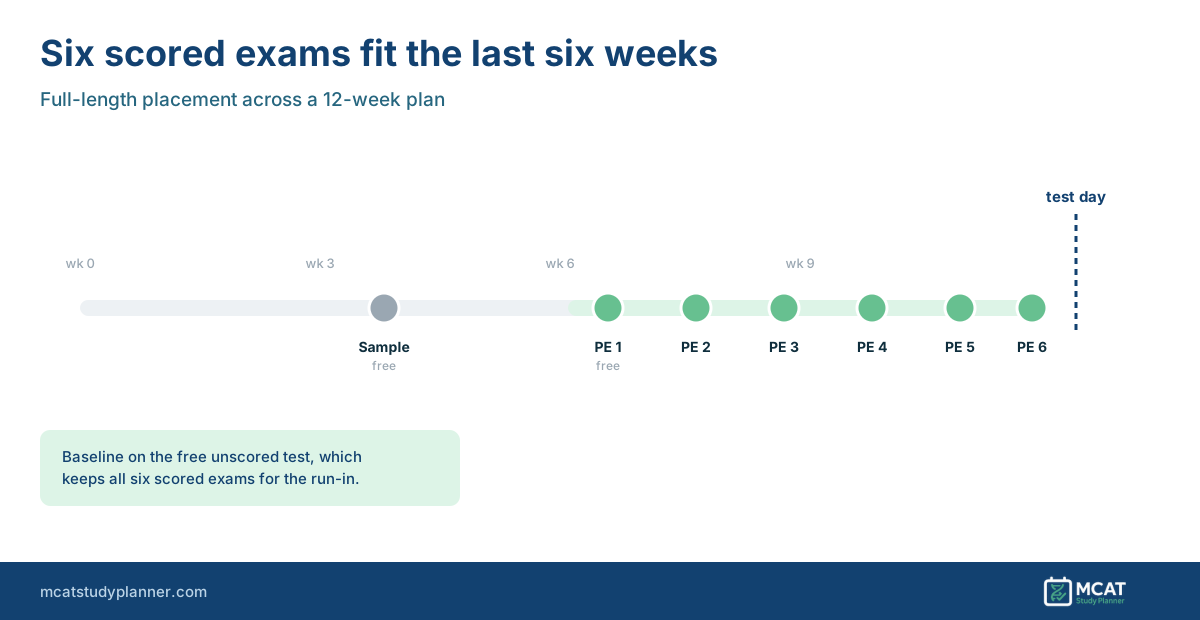
12-week plan (the standard three months)
| Week | Full length | Why here |
|---|---|---|
| Week 4 | Unscored Sample Test | Baseline and first exposure to 7.5 hours |
| Week 7 | Practice Exam 1 | First real scaled score, content mostly covered |
| Week 8 | Practice Exam 2 | Weekly cadence begins |
| Week 9 | Practice Exam 3 | Patterns in your error log become visible |
| Week 10 | Practice Exam 4 | Mid-run-in checkpoint |
| Week 11 | Practice Exam 5 | Last chance for a real strategy change |
| Week 12, day 1 to 3 | Practice Exam 6 | Dress rehearsal, 7 to 10 days out |
| Final 7 days | None | Targeted review and taper |
8-week plan (compressed)
You cannot fit seven sittings into eight weeks without wrecking your review time. Cut to five and protect the review.
- Week 2: Unscored Sample Test as baseline.
- Week 5: Practice Exam 1.
- Week 6: Practice Exam 2.
- Week 7: Practice Exam 3.
- Week 8, early: Practice Exam 4, then stop.
Save Practice Exams 5 and 6 unopened. If you end up rescheduling or retaking, you will want two untouched scored exams, and that is worth more than a fifth data point now.
24-week plan (six months, working or in classes)
The long runway changes spacing, not order.
- Week 4: Unscored Sample Test.
- Weeks 10 and 14: Practice Exams 1 and 2, spaced fortnightly as content wraps.
- Weeks 19 to 24: Practice Exams 3, 4, 5 and 6, one per week, last one 7 to 10 days out.
This is the pattern that fits around a job. If you are building around work hours, our guide to how many hours to study for the MCAT covers the weekly arithmetic, and the 10-week content review schedule shows how the content phase should land before the run-in starts.
What a Full Length Really Costs You
This is the reason full-length scheduling goes wrong. People book the exam and forget the review.
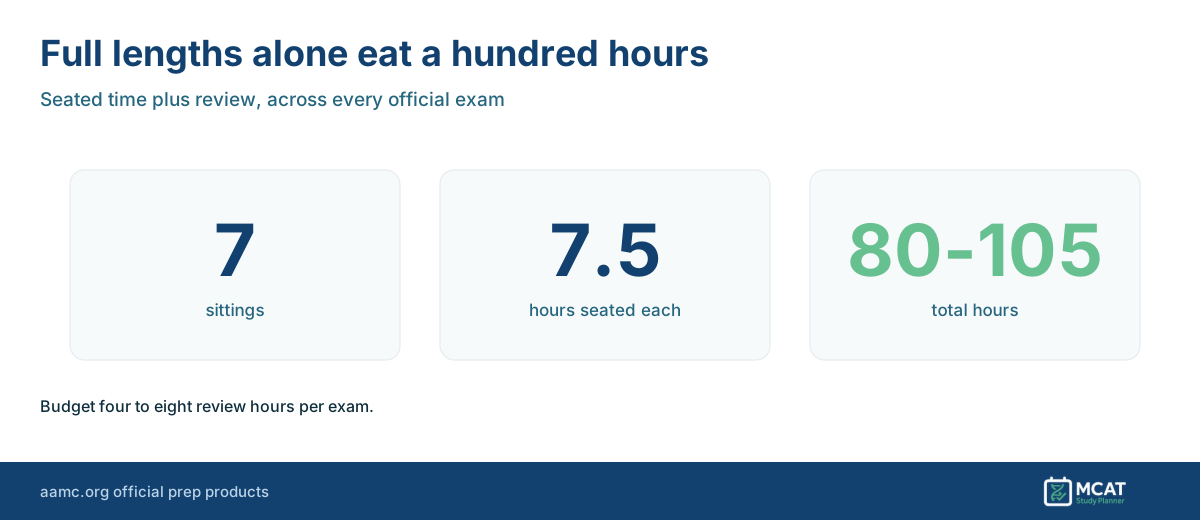
The real exam runs 6 hours 15 minutes of testing time inside about 7 hours 30 minutes of seated time, and the practice exams mirror it (AAMC). Add four to eight hours of genuine review and each full length is 1.5 to 2 days of your week, gone.
Across all seven sittings that is roughly 80 to 105 hours before you open a single content resource.
Review the day after you take it. Sketchy puts the deadline well: review “the day after you take them, or two days after at the absolute most.” Wait longer and you no longer remember why you picked the wrong answer, which is the only information a full length really contains.
Two things that make review worth the hours:
- Log every miss by reason, not by topic. “Knew the content, misread the question stem” is a different problem from “never learned this.” A topic list tells you to reread; a reason list tells you what to change.
- Review the questions you got right but guessed on. They are the same defect as a miss, just with luckier arithmetic.
For the timing mechanics inside the exam itself, our MCAT time breakdown guide covers per-passage pacing, which is the thing most people discover they need after full length two.
Which Order to Take Them In
The AAMC exams are not interchangeable, and the standard advice to “save the newest for last” needs a caveat.
Take them in numerical order, and stop worrying about which is hardest.
- Practice Exam 1 first among the scored ones. It is free, so a rusty performance costs nothing.
- Then 2 through 6 in order. Their scaled scores are the closest thing you have to a real prediction, and taking them in sequence keeps your score trend readable. A trend across five exams taken in a scrambled order is much harder to interpret.
- Practice Exam 6 as the dress rehearsal. Same wake-up time, same start time, same snacks, no phone. You are testing your day, not just your content.
Third-party full lengths from Blueprint, Kaplan, Princeton Review or Altius are genuinely useful earlier, when what you need is volume and stamina. Their scores tend to run harsher or softer than the real thing, so treat them as training loads and not predictions. Keep the official exams for the final six weeks.
Where the Standard Advice Goes Wrong
Four failure modes, and the first is the most common.
Burning scored exams for a baseline
If your first ever full length is Practice Exam 3, you have spent a $35 scored exam to learn something a free unscored one would have told you. Worse, you have spent it at the point in your prep when the number is least meaningful and most demoralising.
Taking full lengths without reviewing them
Six exams poorly reviewed is worth less than three reviewed properly. If your calendar does not have review blocks attached to each exam, you are collecting scores rather than improving.
Reading too much into one score
A single full length has real noise in it: sleep, the specific passages you drew, whether you ate. The trend across several exams taken under similar conditions is the signal. One exam is an anecdote.
Cramming a full length into the final week
The last week is for consolidation and sleep. A full length inside seven days of test day mostly buys you fatigue and a number you cannot act on.
Worth knowing before test day: you decide whether to score or void at the end of the exam, and the AAMC is explicit that “Once you make your decision to score or void your exam, you cannot change it.” If you make no selection before time expires, the exam is scored. A voided exam is not reported to schools, but it “does count toward your testing limits regardless of the reason.”
Putting the Calendar Into Your Schedule
A full-length plan only works if it is on actual dates, with the review blocks attached. Six exams and their review add up to roughly two working weeks of your calendar, and that has to be planned around rather than squeezed in.
Our free MCAT study schedule generator does this placement automatically: enter your test date and weekly hours and it drops the full lengths and their review days into the calendar, then exports to Google or Apple Calendar.
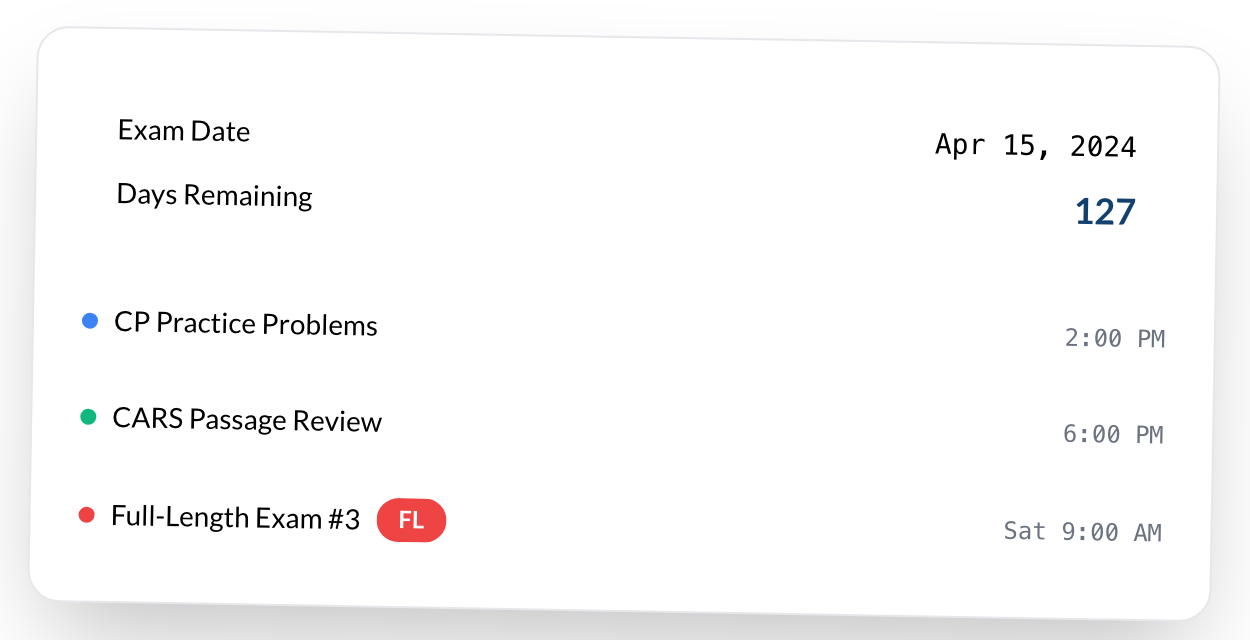
If you would rather lay it out by hand, our free MCAT study plan templates include the weekly grid, and we have compared the schedule builders if you want to see the options.
Frequently Asked Questions
When should I take my first full length?
Weeks three to five, using the free Unscored Sample Test. Early enough to build endurance and find your gaps, and free so the low score costs you nothing.
How many AAMC full lengths are there?
Six scored practice exams, plus a free Unscored Sample Test. Practice Exam 1 is free and 2 through 6 are $35 each. Guides referring to four AAMC full lengths are out of date.
How far apart should full lengths be?
One per week through the final six weeks. Each needs about 7.5 hours seated plus four to eight hours of review, so a tighter cadence eats the review time that makes them useful.
How close to test day should the last one be?
Seven to ten days. Near enough to be predictive, far enough to act on and then taper.
Do third-party full lengths count?
They are good for early volume and stamina, but their scaled scores drift from the real exam. Use official AAMC exams for the run-in. We priced every provider’s exams per sitting and audited what each one publishes about accuracy in our comparison of the best MCAT practice tests.
What if I run out of full lengths?
That is a scheduling failure worth avoiding, which is why the 8-week plan above deliberately leaves two exams unopened. If it happens, switch to section-level practice using the Section Bank rather than retaking an exam you have already seen.
How long until I get my real score?
The AAMC publishes an exact score release date for every test date in its official calendar. In practice it lands roughly a month after you sit, so factor it into application timing.
Written by
Dr. Sarah Johnson
Last updated 9/3/2026