Best MCAT Practice Tests: Every Full Length Compared (2026)
By MCAT Study Planner Team • Updated 9/14/2026
Short answer: the AAMC’s six scored exams are the only practice tests that predict your score, and all six cost $175 because Practice Exam 1 is free. Everything else is volume. On price per exam that volume runs from $19.90 at Altius to $92.79 at Kaplan, which is our arithmetic on the prices we read off each vendor’s checkout on September 14, 2026.
Every comparison page ranking for this search lists bundle prices. None of them divides.
That one piece of arithmetic reorders the market, because a $199 package of 10 exams and a $299 subscription that gets you six are not in the order the sticker prices suggest.
The 30-second answer: buy the AAMC’s Practice Exams 2 through 6 at $35 each and take the free Practice Exam 1, six scored exams for $175. Add four to six third-party full lengths in front of them for reps. Cheapest per exam on September 14, 2026 was Altius at $19.90, then Princeton Review at $24.83. The AAMC lands third at $29.17 and is still the one to buy first. Budget about 7 hours 30 minutes of seating plus 4 to 8 hours of review per sitting.
In this guide
- Every MCAT practice test, compared
- What one full length actually costs
- Who actually writes the exams you are buying
- Which accuracy claim survives its own footnote
- The prices on the comparison pages are out of date
- What changes at the AAMC today
- Where each exam goes in your calendar
- How many you actually need
- Every exam on one page
Every MCAT Practice Test, Compared
We opened each provider’s own product or checkout page on September 14, 2026 and read the counts, prices and access terms off it. Nothing here is copied from another comparison.
| Provider | Full lengths you get | Price | Access window | Free full length? |
|---|---|---|---|---|
| AAMC | 6 scored plus 1 unscored | Exam 1 free, Exams 2 to 6 at $35 each | 1 year per exam | Yes, two |
| Blueprint | 6 (Exams 2 to 6, plus one from a free account) | $99 per month, or $299 for 6 months | While subscribed | Yes, one |
| Kaplan | 21 inside a course, 14 of them written by Kaplan | Courses from $1,299 | Course access period | Yes, one on a 30-day trial |
| Princeton Review | 6 or 10 | $149 for 6, $249 for 10 | 180 days | Yes, one by registration |
| Altius | 10 | $40 for 1, $169 for 5, $199 for 10 | 1 year, unlimited attempts | Yes, one |
| MedSchoolCoach | 3 | $49 for 1, $109 for all 3 | 1 year | Half length only |
| UWorld | 2 | Inside courses from $599 | Course access period | Not listed |
| Magoosh | 1 | Free with an email address | Not stated | Yes |
| Jack Westin | Count not published | $29.99 per month | While subscribed | 7-day trial |
Two rows carry a catch worth naming.
Kaplan advertises 21 full-length practice tests as the most available anywhere, and its own page says 7 of those come from the AAMC. Fourteen of the 21 are Kaplan’s. The other seven are the same exams you can buy from the AAMC for $175 without enrolling in anything.
Princeton Review’s practice-test packages expire after 180 days. That is shorter than a six-month study plan, so if you buy on day one of a 24-week calendar, the exams you saved for the end are gone before you reach it. The larger Practice Packs run 365 days.
Examkrackers is missing from the table on purpose. Its site blocked our checks on September 14, 2026, and we do not publish a price or a count we could not read at the source.
What One Full Length Actually Costs
Here is the division nobody does. Take each package price above, divide by the exams inside it, and the ranking changes.
This table is our arithmetic on the verified prices, not a figure any provider publishes.
| What you buy | Price | Full lengths | Cost per full length |
|---|---|---|---|
| Altius, 10-pack | $199 | 10 | $19.90 |
| Princeton Review, 6-pack | $149 | 6 | $24.83 |
| Princeton Review, 10-pack | $249 | 10 | $24.90 |
| AAMC, all six scored exams | $175 | 6 | $29.17 |
| Blueprint, two months at $99 | $198 | 6 | $33.00 |
| Altius, 5-pack | $169 | 5 | $33.80 |
| MedSchoolCoach, 3-pack | $109 | 3 | $36.33 |
| Blueprint, 6-month plan | $299 | 6 | $49.83 |
| Kaplan On Demand course | $1,299 | 14 Kaplan-written | $92.79 |
| UWorld Core Prep Course | $599 | 2 UWorld-written | $299.50 |
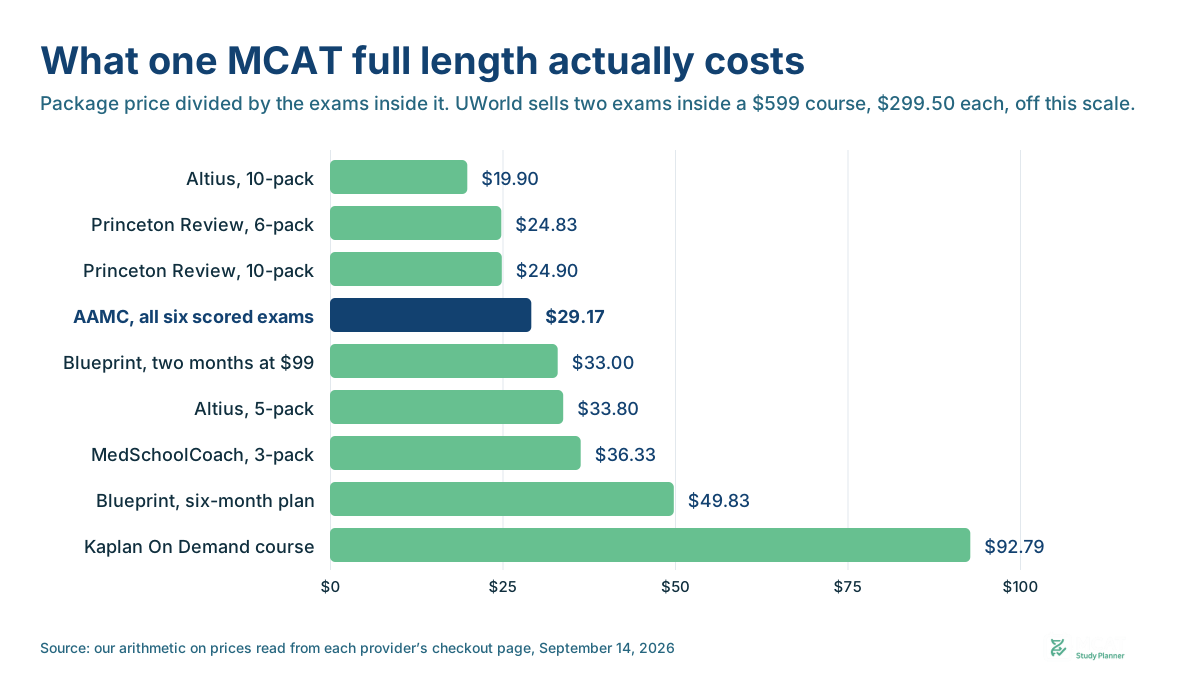
Read the last two rows as a cost of access, not a verdict on the product. Kaplan and UWorld do not sell their full lengths separately, so those figures are the course price divided by its exams. A UWorld course buys a 3,000-question bank, video lessons and the AAMC materials as well, and the same is true of Kaplan. If you want their exams and nothing else, you cannot have them.
The row that matters most is the AAMC’s. Six scored exams for $175 is the single highest-value purchase in MCAT prep, and it sits in the middle of this table rather than at the top of it.
Who Actually Writes the Exams You Are Buying
Counting exams is how the marketing works, so count them by author instead.
The AAMC’s six scored exams are built from questions used on previously administered MCAT exams. That is the sentence on its own product page, and it is the reason its numbers mean something. All six return a scaled score and a percentile rank on the official scale. The Unscored Sample Test, in the AAMC’s own words, “does not provide a scaled score or percentile rank,” which is the detail most lists leave out.
Every other exam on this page is written from scratch by a prep company and scored on that company’s own scale. Blueprint says so plainly on its practice-test page: its exams are not reviewed or endorsed by the AAMC, and neither is anyone else’s.
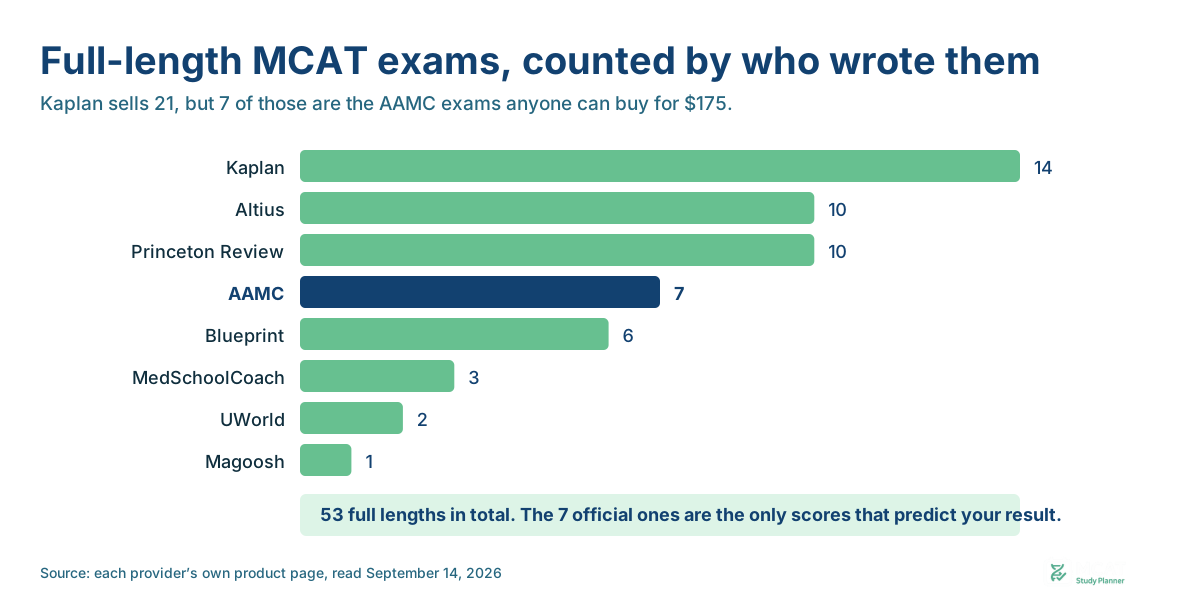
Add the authored counts together and there are 53 full-length MCAT exams available as of September 14, 2026. Seven are the AAMC’s. That ratio is the whole argument for how you should spend: third-party exams buy you reps and stamina, and official exams buy you a number.
For the record of what each official exam contains, our guide to which MCAT diagnostic test to take works through the two free AAMC exams and why only one of them gives you something to plan against.
Which Accuracy Claim Survives Its Own Footnote
”Most realistic” is on every one of these pages. Exactly one provider attaches a number and a sample size to it.
Blueprint’s claim is that its diagnostic is “statistically equivalent to the real MCAT, with an average difference of just 0.3 point.” The asterisk, at the bottom of the same page, says it is “based on analysis of 91 students who took an official AAMC exam within 18 months before our diagnostic.” So the figure covers the diagnostic, not the five other exams in the subscription, and it rests on 91 people. That is still more evidence than anyone else offers.
Altius says “our students score within 1-2 points of their last practice exam on their actual MCAT,” with no sample size given. The same page describes its exams as matching “MCAT-2015” materials, which is how the exam was branded after the 2015 revision.
Kaplan publishes an average score increase of 15 or more points, and a money-back guarantee of a 515 or a 15-point gain on its top courses. Both are worth reading, and neither is an accuracy measurement. A guarantee is a refund policy, and an average increase measures students rather than exams. Princeton Review’s practice-test page carries no accuracy figure at all.
| Provider | What it claims about accuracy | Sample published |
|---|---|---|
| AAMC | Questions from previously administered exams, official scaled score and percentile | Not a claim, the source |
| Blueprint | Mean difference of 0.3 points on its diagnostic | Yes, 91 students |
| Altius | Students score within 1 to 2 points of their last practice exam | No |
| Kaplan | Average score increase of 15 or more points | Score increase, not accuracy |
| Princeton Review | No accuracy figure on its practice-test page | None published |
| UWorld, MedSchoolCoach, Magoosh, Jack Westin | No deviation figure on the pages we read | No |
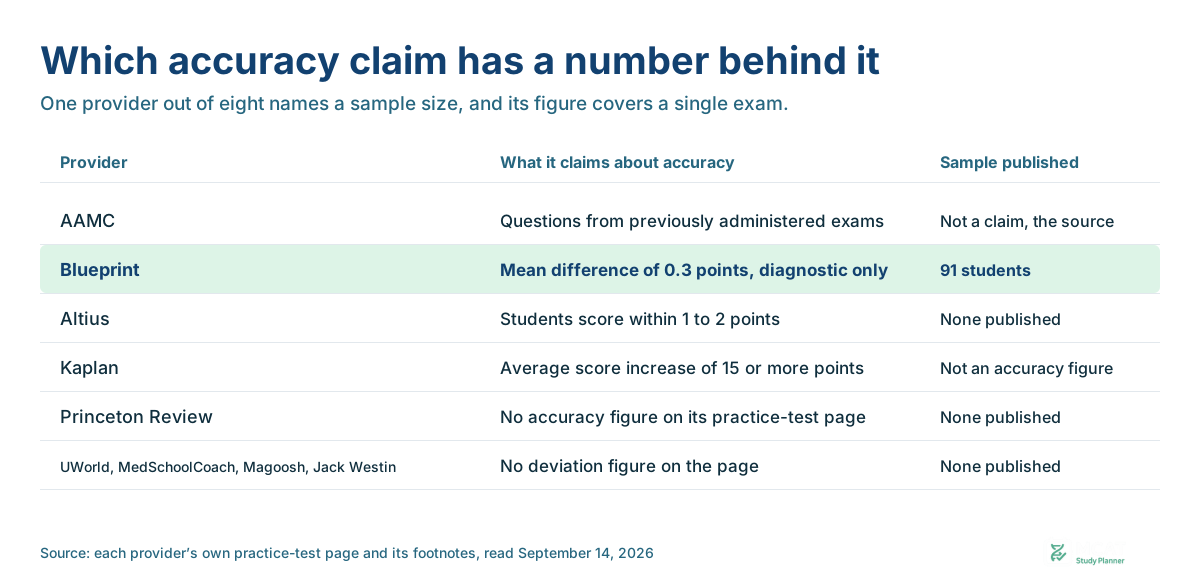
The practical rule falls out of the table. Use third-party scores to track whether you are improving, and use AAMC scores to predict where you will land.
The Prices on the Comparison Pages Are Out of Date
The one editorial comparison in the top 10 for “best mcat practice tests” is on medschoolcoach.com, which also ranks its own exams second on its own list. We checked its numbers against the vendors on September 14, 2026.
| What that page says | What the vendor’s page says today |
|---|---|
| ”$35.00 Official MCAT Practice Exams 1-4” | Practice Exam 1 is free; Exams 2 through 6 are $35 each |
| ”$310.25 Online-Only Bundle” | $323.70, marked down from $390.00 |
| Blueprint: “$159 for 4 exams, $209 for 6 exams, or $319 for 10 exams” | $99 per month or $299 for six months, with no 4, 6 or 10 exam packages listed |
| ”AAMC exams (6 total, including the free practice test and sample test)“ | Six scored exams plus the Unscored Sample Test is seven |
None of this is unusual. Prep pricing moves constantly, and a comparison whose prices were right when it was written still reads as current, because nothing on the page says when they were checked. That is why every number in this article carries the date we read it.
Do this before you buy anything: open the vendor’s own checkout page and confirm the price and the access window yourself. Access windows are the term that bites, because 180 days at Princeton Review and one year at Altius are very different purchases on a six-month plan.
What Changes at the AAMC Today
One timing note, because it lands on the day this went up and no ranking page carries it.
As of today, September 14, 2026, the AAMC has retired the CARS Question Packs, Volumes 1 and 2, the CARS Diagnostic Tool and the Question Pack Bundle. They are no longer available for purchase. The questions from the CARS products move into a new CARS Question Bank.
The Online-Only Bundle, $323.70 against a $390.00 list price, is off sale from September 14 to 29 and returns on September 30 with that new CARS Question Bank included. If you bought the bundle before today, the new question bank is not included and has to be bought separately.
None of this touches the full-length exams. Practice Exams 2 through 6 stayed at $35 each through the change, and Practice Exam 1 and the Unscored Sample Test are still free. If you were planning to buy CARS material this month, check the store rather than a blog post.
Where Each Exam Goes in Your Calendar
Buying the exams is the easy half. Spacing them is where plans fall apart, because six scored exams and a fixed test date leave less room than people expect.
The order that works, and the reason for it:
- A free third-party full length as your diagnostic, before any content review. It costs nothing and it spends none of your seven official sittings.
- Third-party exams through the middle of your plan, roughly one a week once content review is past the halfway mark. This is what the Altius, Princeton Review and Blueprint packages are for.
- The six AAMC scored exams across your final six weeks, one per week, in numerical order. They are the most accurate predictors you own, so they belong where the prediction still has time to change something.
- The last full length 7 to 10 days out. The final week is taper and targeted review, not another seven-hour sitting.
Our week-by-week guide to spacing your practice exams counts that calendar backward from test day for 12-week, 8-week and 24-week timelines. If you are on the standard timeline, the 12-week MCAT plan already has the six scored exams placed in it.
How Many You Actually Need
Ten to 12 full lengths total, of which six are the AAMC’s.
That is a bigger commitment than the number suggests. The AAMC puts total content time at 6 hours and 15 minutes and total seated time at about 7 hours and 30 minutes, which is 59 questions in 95 minutes for Chem/Phys, 53 in 90 minutes for CARS, then 59 in 95 minutes each for Bio/Biochem and Psych/Soc. Add 4 to 8 hours of review per exam, which is where the score actually moves.
Our arithmetic on those figures: the six scored AAMC exams alone are 69 to 93 hours. Ten sittings is roughly 115 to 155 hours. Set against the total time budget most students need, full lengths are a quarter to a third of everything you will do.
That is the number to plan against, and it is exactly the input a schedule is built from. Feed your test date and your real weekly hours into the free MCAT study schedule generator and it places the sittings and the review days for you, around classes and work.
A last practical note: sit them the way you will sit the real one. Same start time, same breaks, no pausing. Our MCAT test day tips cover the rehearsal details that make the seventh hour survivable, and free options for the reps are in our compilation of free MCAT resources.
Every Exam on One Page
| Question | Answer |
|---|---|
| Which exams first? | The AAMC’s six scored ones. $175 for all six, since Exam 1 is free |
| Cheapest per exam? | Altius at $19.90, then Princeton Review at $24.83, then the AAMC at $29.17 |
| Most expensive? | Kaplan at $92.79 per Kaplan-written exam, because they come only inside a course |
| Which is most accurate? | The AAMC’s. Among third parties, only Blueprint publishes a number, and on 91 students |
| Free full lengths? | Six, from the AAMC (two), Blueprint, Kaplan, Princeton Review, Altius and Magoosh |
| How many total? | 10 to 12, with the six official ones in your last six weeks |
| What does that cost in time? | About 7 hours 30 minutes seated plus 4 to 8 hours of review, per sitting |
| Watch out for? | Access windows. Princeton Review’s practice-test packs run 180 days |
The exams are the cheap part. The 115 to 155 hours they consume are not, and that is the half worth planning.
Once you know your test date and how many hours a week you really have, our MCAT study planner turns both into a day-by-day calendar with the full lengths and their review days already in place.
Method note: every price, exam count and access term above was read directly from the named provider’s own product or checkout page on September 14, 2026. Exam structure, timing and the official product definitions come from the AAMC’s exam overview and MCAT Official Prep pages, read the same day. The cost-per-exam figures, the 53-exam total and the 69 to 155 hour ranges are our arithmetic on those verified numbers, with each assumption stated where it appears. Examkrackers is excluded because its site refuses automated reads, and no price or count is asserted for it.
Written by
MCAT Study Planner Team
Last updated 9/14/2026