
MCAT Test Day Tips: 15 Proven Tips From 520+ Scorers (Reddit-Approved)
By Dr. Sarah Johnson • Updated 2/16/2026
You’ve spent months studying — hundreds of hours buried in Anki decks, practice tests, and Khan Academy videos.
But here’s what nobody tells you: test day itself can make or break your score.
The difference between a 510 and a 520 often isn’t more content knowledge. It’s knowing how to manage your energy, your breaks, your anxiety, and your pacing across 7+ grueling hours.
We crowdsourced the best advice from Reddit’s r/MCAT community — specifically from verified 520+ scorers — and combined it with official AAMC guidelines to create the only MCAT test day guide you’ll ever need.
Here are 15 battle-tested tips that separate good scores from great ones.
What to Expect on MCAT Test Day
Before we dive into the tips, let’s get the lay of the land. If you’ve never been to a Pearson VUE testing center, the process can feel intimidating — fingerprint scans, regulated locker procedures, and strict check-in protocols.
Knowing exactly what happens removes one more source of anxiety.
MCAT Test Day Timeline & Schedule
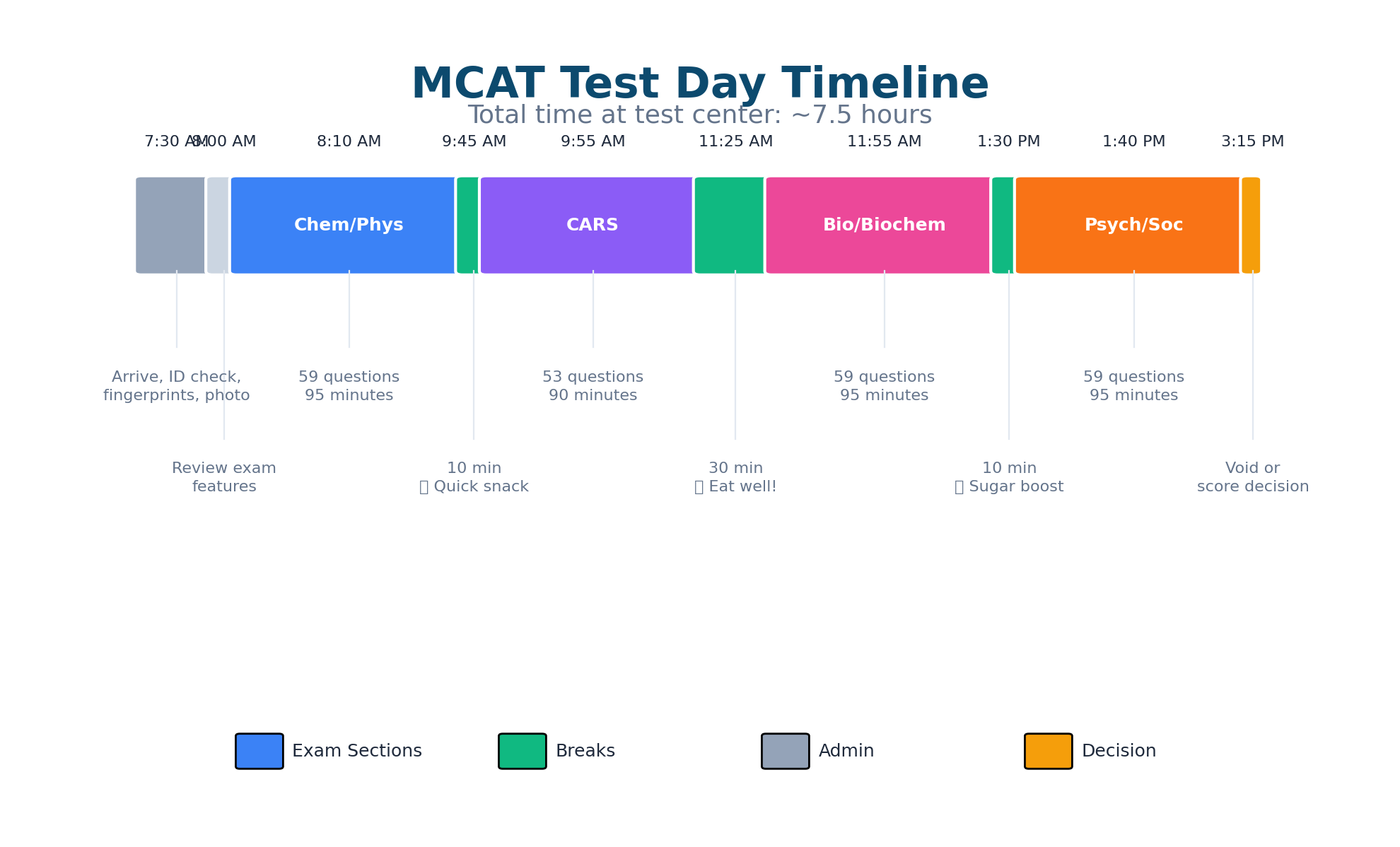
The MCAT is a 7-hour and 30-minute marathon from the moment you walk in to when you walk out. Here’s how it breaks down:
| Time | Section | Questions | Duration |
|---|---|---|---|
| 7:30 AM | Check-in & Tutorial | — | 40 min |
| 8:10 AM | Chem/Phys (C/P) | 59 | 95 min |
| 9:45 AM | Break 1 | — | 10 min |
| 9:55 AM | CARS | 53 | 90 min |
| 11:25 AM | Lunch Break | — | 30 min |
| 11:55 AM | Bio/Biochem (B/B) | 59 | 95 min |
| 1:30 PM | Break 3 | — | 10 min |
| 1:40 PM | Psych/Soc (P/S) | 59 | 95 min |
| 3:15 PM | Void/Score Decision | — | 5 min |
That’s 230 questions across 4 sections, plus 6 hours and 15 minutes of actual testing time, and approximately 50 minutes of breaks. Total time at the center: about 7.5 hours.
The Check-In Process
When you arrive at the Pearson VUE testing center, here’s what to expect:
- ID verification — Your government-issued photo ID must exactly match the name on your MCAT registration. This is the #1 reason people get turned away.
- Digital palm scan — Your palms are scanned at entry and re-scanned after every break.
- Test-day photo — A photo is taken for identity verification.
- Locker assignment — You’ll store all personal belongings (phone, wallet, keys, food) in a locker.
- Noteboard & marker — You’ll receive a laminated noteboard booklet and a fine-point marker for scratchwork inside the testing room.
Important: You cannot tour the testing center before test day, and you cannot leave the building during breaks. All food must be stored in your locker.
Before Test Day — The Week-Of Preparation
The best test-day performances start days before the exam. Here’s how 520+ scorers set themselves up for success.
Tip #1 — Do a Test Center Dry Run
Drive or commute to your Pearson VUE testing center at least once before test day. Time the trip during the same time of day you’d be traveling.
Know exactly where the building is, where to park, and which entrance to use. On test day, you want zero surprises about logistics.
”I drove to my test center the Saturday before. Turns out the parking lot entrance was on a weird side street. Would have panicked on test day if I hadn’t checked.” — r/MCAT
Tip #2 — Taper Your Studying (Don’t Cram)
The last 2–3 days before your MCAT should be a taper, not a sprint. Think of it like a marathon runner resting before race day.
- 3 days out: Light content review — skim your high-yield notes, not full chapters
- 2 days out: One light practice session (maybe 1-2 CARS passages), review your cheat sheet
- 1 day out: Do nothing MCAT-related. Watch a movie, go for a walk, hang out with friends.
Your brain needs time to consolidate what you’ve already learned. Cramming new material the night before will only increase anxiety and interfere with sleep.
”I stopped studying 2 full days before my exam. Best decision I made. I walked in feeling refreshed instead of burnt out.” — r/MCAT, 524 scorer
If you need a structured approach to your final weeks, check out our MCAT Content Review Schedule for a 10-week plan that includes a proper taper.
Tip #3 — Simulate Test Day Conditions
Starting 3–4 days before your exam, shift your daily routine to match test-day timing:
- Wake up at whatever time you’ll wake up on test day (likely 6:00–6:30 AM)
- Eat the same breakfast you plan to eat on test day
- Wear similar clothes — comfortable layers
- If possible, do a practice section at 8:00 AM to train your brain to peak at the right time
Your body performs best when it knows what to expect. If you’ve been waking up at 10 AM for months and suddenly set an alarm for 6 AM on test day, your cognitive performance will suffer.
The Night Before the MCAT
Tip #4 — Pack Your Test Day Bag (With This Checklist)
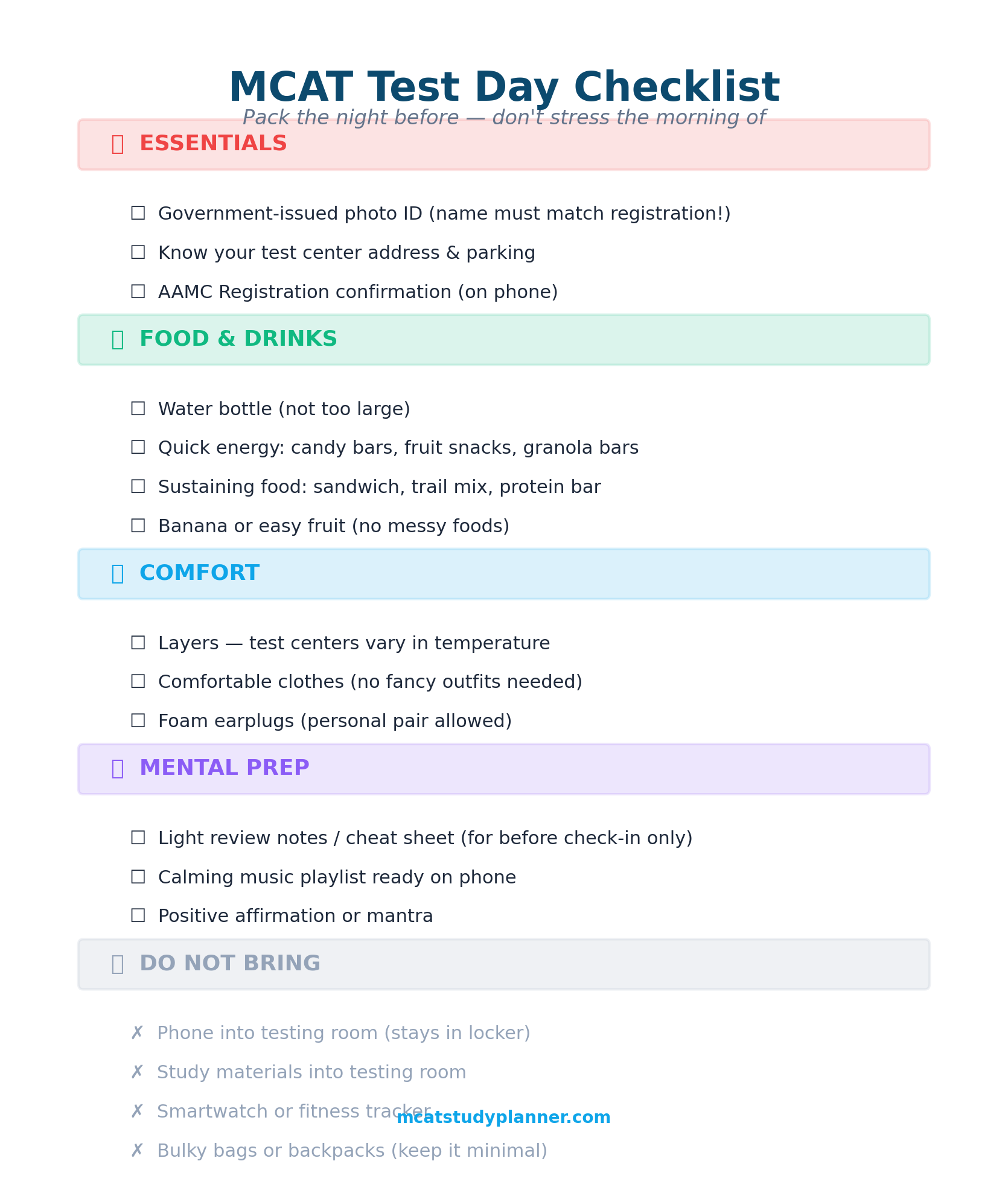
Pack your bag the night before — never the morning of. Here’s your complete checklist:
Fix a name mismatch early. The AAMC’s 10 Day Deadline is the last date you can edit your registration details at all, and our MCAT test dates page lists that deadline for every 2027 exam.
Essentials (non-negotiable):
- ✅ Government-issued photo ID (name must match MCAT registration exactly)
- ✅ Know your test center address, parking, and building entrance
- ✅ AAMC registration confirmation saved on your phone
Food & Drinks:
- ✅ Water bottle (not too large — you don’t want bathroom pressure)
- ✅ Quick energy: candy bars, fruit snacks, granola bars
- ✅ Sustaining food: sandwich, trail mix, protein bar
- ✅ Banana or easy fruit (nothing messy)
Comfort:
- ✅ Layers — test centers vary wildly in temperature
- ✅ Comfortable clothes (nobody cares what you look like)
- ✅ Foam earplugs (your own pair is allowed)
Do NOT bring into the testing room:
- ❌ Your phone (stays in the locker)
- ❌ Study materials
- ❌ Smartwatch or fitness tracker
- ❌ Food or drinks (locker only)
Tip #5 — Get 7–8 Hours of Sleep (But Don’t Panic If You Can’t)
Aim for a normal night of sleep. Set two alarms on two different devices. Keep your room cool and dark. Avoid screens for at least 30 minutes before bed.
But here’s the thing — if you toss and turn all night, don’t panic. Your body will run on adrenaline, and one night of poor sleep won’t wreck your score.
”I slept maybe 4 hours the night before. Was convinced I’d bomb it. Got a 523. Adrenaline is a hell of a drug.” — r/MCAT
What actually hurts you isn’t one bad night — it’s the anxiety spiral of thinking “I’m not sleeping, so I’ll do badly.” Trust your preparation.
MCAT Morning-Of Tips
Tip #6 — Eat a Solid, Familiar Breakfast
Your brain is a glucose-burning machine. You need fuel, but not anything experimental.
The 520+ scorer breakfast formula:
- Protein: Eggs, Greek yogurt, or peanut butter
- Complex carbs: Oatmeal, whole wheat toast, or a bagel
- Fruit: Banana (potassium helps with stress)
- Caffeine: Only if you drink it daily — this is not the day to try a new energy drink
Avoid anything greasy, spicy, or that might cause stomach issues. The goal is sustained energy, not a sugar crash at 10 AM.
”My test day breakfast: scrambled eggs, toast with PB, banana, and my usual one cup of coffee. Nothing fancy. It worked.” — r/MCAT, 521 scorer
Tip #7 — Arrive 30 Minutes Early (At Least)
The AAMC requires you to arrive 30 minutes before your scheduled start time. The test center administrators begin check-in at that point.
Pro tip from 520+ scorers: Arrive 40–45 minutes early. Sit in your car for the extra 10–15 minutes. Listen to music, do a breathing exercise, or just sit in silence. Walk into the center feeling calm and in control, not rushed and frantic.
”I got there 45 min early. Listened to my favorite playlist in the car. Walked into that center like I owned the place. Mindset matters.” — r/MCAT
If you arrive late (even by 1 minute past the cut-off), you will not be allowed to test and you forfeit your registration fee. Don’t risk it.
During the MCAT — Section-by-Section Strategy
This is where 520+ scorers separate themselves. It’s not just about knowing the content — it’s about managing your time, energy, and mental state across four brutal sections.
Tip #8 — Use the First 30 Seconds of Each Section Wisely
When a new section begins, do not immediately start reading the first passage. Instead:
- Close your eyes. Take 3 slow, deep breaths.
- Write key references on your noteboard. For C/P: essential equations and conversions. For B/B: amino acid properties. For P/S: key psychology terms you tend to mix up.
- Read the first passage slowly. The first passage sets the tone. Rushing it creates anxiety that cascades through the entire section.
”I wrote my amino acid chart the moment B/B started. Took 30 seconds. Saved me on at least 5 questions.” — r/MCAT, 522 scorer
Tip #9 — Flag and Move On (The 90-Second Rule)
Here’s the single most important pacing rule from high scorers:
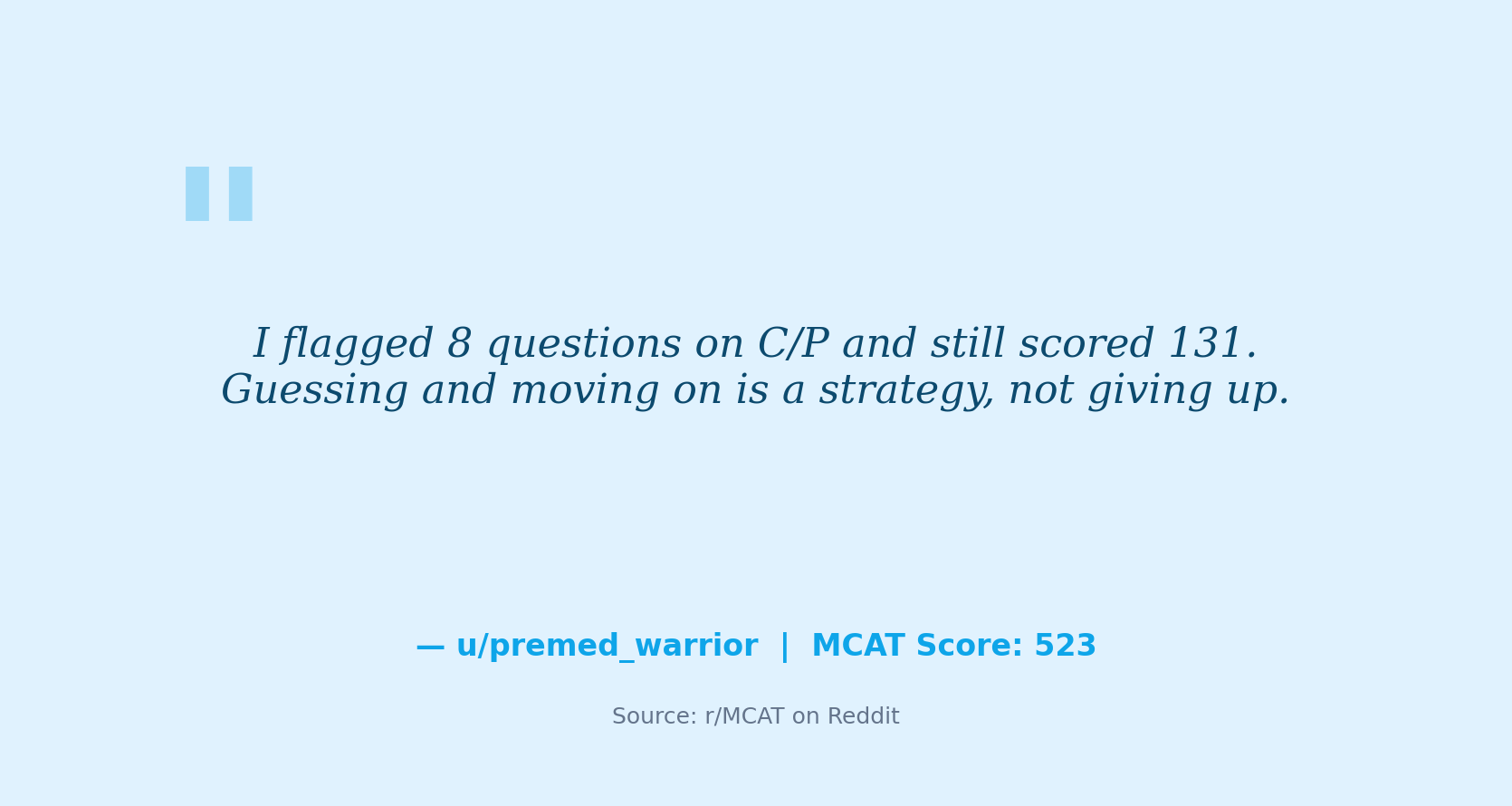
If you’ve spent more than 90 seconds on a standalone question without progress — flag it and move on.
This isn’t giving up. It’s strategic time management. You have roughly 1 minute and 35 seconds per question on C/P and B/B, and 1 minute and 42 seconds per question on CARS. Getting stuck on one hard question means losing time on three easier ones.
The MCAT’s flag feature exists for a reason. Use it aggressively. Come back to flagged questions during your review time at the end of the section.
A note on guessing: There is no penalty for wrong answers on the MCAT. Never leave a question blank. If you’re stuck, eliminate what you can and make an educated guess before moving on.
Tip #10 — Use the Noteboard Strategically
You’ll receive a laminated noteboard booklet (not scratch paper) and a fine-point marker. Here’s how top scorers use it:
For Chem/Phys:
- Write key equations immediately (PV=nRT, Henderson-Hasselbalch, Bernoulli’s)
- Show all math work — it’s easy to make arithmetic errors under pressure
- Draw diagrams for circuit problems and optics questions
For CARS:
- Jot the main idea of each passage in 3–5 words after reading it
- Note the author’s tone (positive, critical, neutral, ambivalent)
- Map paragraph functions (“P1: intro argument, P2: counter, P3: evidence”)
For Bio/Biochem:
- Amino acid classifications and properties chart
- Quick metabolic pathway sketches when relevant
- Draw experimental setups to visualize complex passages
For Psych/Soc:
- Note any terms that could be confused (e.g., social facilitation vs. social loafing)
- Sketch quick diagrams for experiments described in passages
If you run out of space, raise your hand and request a new noteboard. You can exchange it at any time during the exam.
MCAT Break Strategy — Don’t Skip Your Breaks
Your breaks are not optional. They are a strategic weapon that every high scorer uses to maintain performance across 7+ hours.
Tip #11 — Take Every Single Break
Even if you feel fine after a section, take the full break. Here’s why:
- Your brain needs time to transition between different types of thinking (e.g., C/P calculations → CARS reading comprehension)
- Standing up and moving improves blood flow and cognitive function
- Eating maintains glucose levels that your brain is rapidly burning through
- A mental reset prevents fatigue from compounding across sections
”I took every break even when I felt fine. After Bio/Biochem, I stood up, stretched, ate a Snickers, and took 5 deep breaths. Crushed Psych/Soc.” — r/MCAT, 520 scorer
Tip #12 — Plan Your Snacks Like a Scientist
Your brain consumes about 20% of your body’s energy. During 7 hours of intense focus, it’s burning through glucose at an accelerated rate. Plan your fuel accordingly.
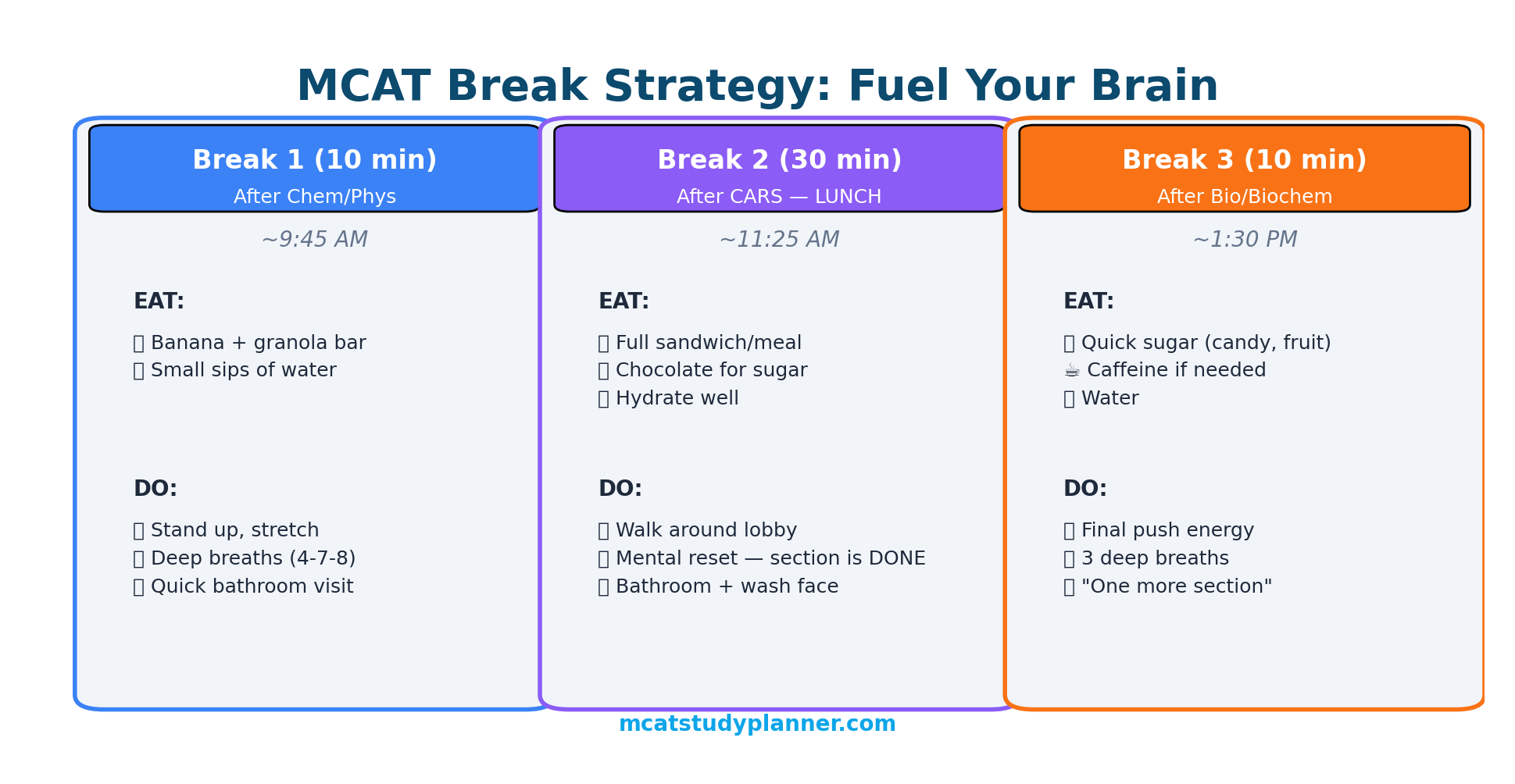
Break 1 (10 min, after Chem/Phys):
- 🍌 Banana + granola bar (quick energy without heaviness)
- 💧 Small sips of water
- 🚶 Stand, stretch, walk to the bathroom
- 🧘 3 deep breaths — shake off C/P, fresh mind for CARS
Break 2 (30 min, after CARS — this is lunch):
- 🥪 Full sandwich or real meal (this is your longest break — eat well)
- 🍫 Chocolate or candy for quick sugar
- 💧 Hydrate properly
- 🚶 Walk around the lobby, wash your face with cold water
- 🧠 Complete mental reset — CARS is done, it has zero impact on what comes next
Break 3 (10 min, after Bio/Biochem):
- 🍬 Quick sugar hit — candy, fruit snacks, or juice
- ☕ Small caffeine boost if you drink it regularly (not if you don’t)
- 💪 Pump yourself up — one more section, then you’re done
Pro tip: The Reddit favorite combo across dozens of 520+ score threads? Uncrustables + Snickers bars. Easy to eat fast, good mix of carbs and sugar, zero prep required.
Mindset & Anxiety Management
Your mental state during the MCAT is arguably as important as your content knowledge. Here’s how to stay composed when the pressure peaks.
Tip #13 — Treat Each Section as a Fresh Start
This is critical: your MCAT sections are scored independently. A rough Chem/Phys section has absolutely zero impact on your CARS score.
The biggest trap high scorers warn about? Carrying emotional baggage from one section into the next. If C/P felt brutal, your natural instinct is to spiral: “That was terrible. I’m going to do badly. This whole test is ruined.”
Stop. That thought pattern is factually wrong and strategically destructive.
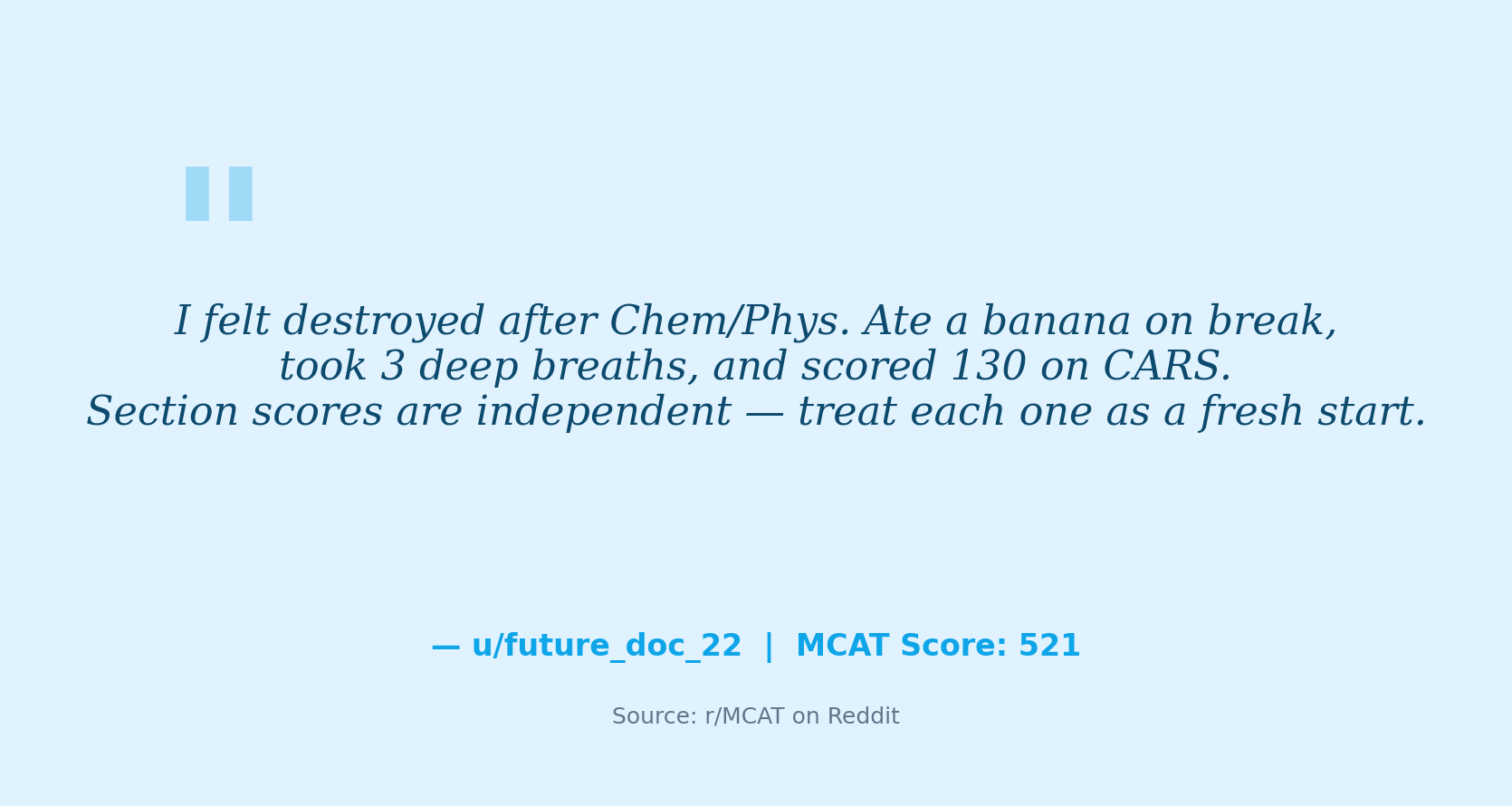
During each break, explicitly tell yourself: “That section is done. This is a new test.” Whether the last section went amazingly or terribly — it’s over. The only thing that matters now is the section in front of you.
Tip #14 — Use Controlled Breathing Between Passages
Don’t wait until your break to manage stress. Build micro-recovery moments into the exam itself.
Between every passage (or every 2–3 passages if you’re pressed for time):
- Close your eyes for 5 seconds
- Take one slow, deep breath
- Consciously relax your jaw, shoulders, and hands
- Open your eyes and begin the next passage fresh
This takes less than 10 seconds and prevents the compounding fatigue that turns the last 20 questions of a section into a blurry struggle.
The 4-7-8 breathing technique (great for breaks):
- Inhale through your nose for 4 seconds
- Hold for 7 seconds
- Exhale through your mouth for 8 seconds
- Repeat 3 times
Many 520+ scorers on Reddit describe this exact technique as their “secret weapon” for CARS focus.
After the Last Section
Tip #15 — The Void/Score Decision: Almost Always Score It
After your final section, you’ll see a screen asking whether you want to void your exam (no score recorded) or score it.
The Reddit consensus from thousands of test-takers is overwhelming: almost always score it.
Here’s why:
- Everyone feels terrible after the MCAT. This is universal. Feeling bad does not mean you did badly.
- Your predicted score is almost always higher than you think. The MCAT’s difficulty is designed to make you feel uncertain.
- You need data. Even a lower-than-expected score gives you information to improve. A voided exam gives you nothing.
The only valid reasons to void:
- You had a genuine emergency (illness, panic attack that lasted an entire section)
- You know with certainty that you skipped large sections or Christmas-treed answers
- You’re testing early as pure practice with another test date scheduled
”I walked out convinced I scored 505. Actual score: 519. The MCAT is designed to make you feel like you failed. Trust the process.” — r/MCAT
The Complete MCAT Test Day Checklist
Here’s your consolidated quick-reference checklist. Print it out and use it the week of your exam:
One Week Before:
- Drive to your test center — know the route, parking, and building entrance
- Begin tapering your study — light review only
- Start waking up at your test-day wake time
- Plan and buy your test-day food and snacks
The Night Before:
- Pack your bag: ID, food, water, layers, earplugs
- Set 2 alarms on 2 devices
- Lay out comfortable clothes
- Avoid screens 30 min before bed
- Remind yourself: you are prepared
The Morning Of:
- Eat your planned, familiar breakfast
- Double-check your ID is in your bag
- Leave early — arrive 30–45 min before start time
- Sit in your car, listen to calming music, breathe
At the Test Center:
- Check in, store belongings, locate the bathroom
- Write key formulas/references on your noteboard immediately
- Take every break — eat, drink, stretch, breathe
- Treat each section as a completely fresh start
- Score your exam (don’t void unless there’s a real reason)
Frequently Asked Questions
How long is the MCAT?
The MCAT takes approximately 7 hours and 30 minutes from check-in to completion. The actual testing time is 6 hours and 15 minutes across four sections, with 50 minutes of total break time (two 10-minute breaks and one 30-minute lunch break). You should plan to be at the testing center from roughly 7:30 AM to 3:15 PM.
Is the MCAT all multiple choice?
Yes. The MCAT consists of 230 multiple-choice questions distributed across four sections. Each question has four answer choices (A through D). There are no fill-in-the-blank, essay, or short-answer questions on the current MCAT.
What happens if you’re late to the MCAT?
If you arrive after the check-in cutoff time, you will not be allowed to test. Your registration fee is forfeited and your exam is recorded as a no-show. The AAMC does not make exceptions for tardiness. This is why Tip #7 (arrive 30+ minutes early) is critical.
Can you bring earplugs to the MCAT?
Yes. You are allowed to bring your own foam earplugs (no electronic/noise-canceling devices). The testing center also provides earplugs and over-ear headsets. Many high scorers recommend bringing your own foam earplugs that you’ve practiced with during full-length practice tests.
Can you eat during the MCAT?
Not during the test sections. You can only eat during breaks from the food stored in your locker. You cannot have food, drinks, or snacks at your testing station. You also cannot leave the building to get food from your car or have food delivered.
What is the MCAT noteboard?
Instead of traditional scratch paper, you receive a laminated noteboard booklet (several pages) and a fine-point marker. You can use this for any scratchwork during the exam. If you fill up your noteboard, you can request a new one from the test center staff at any time — including during a section.
What should you do the day before the MCAT?
The day before should be a rest day. Do not study new material. At most, do a light 20-minute review of your highest-yield notes or cheat sheet. Focus on packing your bag, eating well, staying hydrated, and going to bed at a reasonable time. Many 520+ scorers on Reddit recommend doing something fun and relaxing to take your mind off the exam.
Final Thoughts
The MCAT is a marathon — both intellectually and physically. The students who score highest aren’t just the ones who studied the most content. They’re the ones who treated test day as its own skill to master.
Every tip in this article comes from students who’ve been in that chair, stared at that screen, and come out the other side with scores in the 99th percentile. Their unanimous advice?
Trust your preparation. Fuel your body. Reset your mind between sections. And score your exam.
You’ve put in the work. Now go show it.
Looking for a structured way to plan your MCAT prep? Check out our MCAT Study Plan Templates or build your personalized schedule with the MCAT Study Planner.
For section-specific strategies, see our guides on MCAT CARS study strategies and MCAT Physics preparation, and MCAT psych/soc strategy.
Planning your practice exams? Our week-by-week guide to when to take MCAT full lengths shows where each one belongs before test day.
Written by
Dr. Sarah Johnson
Last updated 2/16/2026