
4 Month MCAT Study Plan (16 Weeks, 15 to 25 Hours)
By MCAT Study Planner Team • Updated 9/20/2026
Short answer: 16 weeks at 15 to 25 hours a week is 240 to 400 total hours. Not one of those numbers reaches the 475-hour median in our dataset of 43 real reports. Four months is not the variable that decides this plan. Your weekly number is.
Every page ranking for this search gives you a weekly hour range and a three-phase outline. Google’s AI Overview opens with “about 15 to 25 hours per week” and tells you to spend 70 percent of phase one on content review, then “flip to 70% practice and 30% content review.”
Nobody multiplies any of it out. So this guide does that first, and then puts the flip on numbered weeks, because once you cost it in hours the popular version of a four-month plan turns out not to fit inside four months.
The 30-second answer: multiply your honest weekly hours by 16 before you pick a date. Take the free AAMC Unscored Sample Test in week 1. At 20 or more hours a week, run content review through week 9 and put the six scored exams at the end of weeks 10 through 15. Below 20 hours a week, the exams need two weeks between them, so they start at the end of week 5 and run every other week to week 15. Week 16 is a taper either way. The exam block is the largest line item in the plan, so place it before you plan anything else.
In this guide
- What 16 weeks actually buys, at every weekly rate
- Four months is three months at a different weekly rate
- The content-to-practice flip, with the hours attached
- Why the six official exams will not fit in the final third
- The 16-week calendar, both tracks
- How many full lengths a four-month plan actually needs
- Every official question, counted and costed
- Is four months enough? Count the hours left over
- What the ranking pages get wrong
- If you are starting this week
- The whole 16 weeks on one page
What 16 Weeks Actually Buys, at Every Weekly Rate
Four months is not a study budget. Hours per week times 16 is a study budget.
This is our arithmetic, and the only assumption is that you study in all 16 of the weeks:
| Weekly hours | 16-week total | Where that sits in our 43-report dataset |
|---|---|---|
| 15 | 240 hours | Below the first quartile |
| 19 | 304 hours | Just above the first quartile |
| 20 | 320 hours | Between the first quartile and the median |
| 25 | 400 hours | Below the median |
| 30 | 480 hours | Just above the median |
The comparison column comes from our own data. In our analysis of 43 students who reported both total hours and score, the median was 475 hours, the middle half fell between 300 and 600, and the range ran from 45 to 2,625.
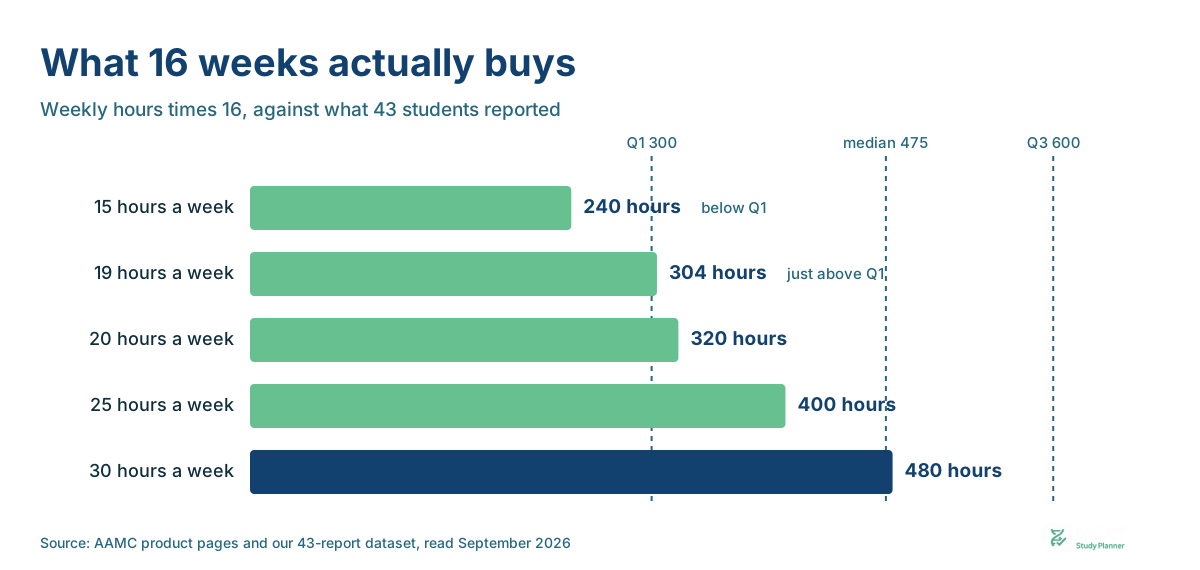
Read the bottom two rows. Reaching the 475-hour median in 16 weeks takes about 30 hours a week, which is above the top of every range published on this search. The 15 to 25 hour range that makes four months sound comfortable produces a total between the first quartile and the median, and at the bottom of that range it does not clear the first quartile at all.
That does not make four months wrong. It makes 19 hours a week the floor rather than the middle. Nineteen hours times 16 weeks is 304 hours, which just clears the 300-hour first quartile.
Four Months Is Three Months at a Different Weekly Rate
Here is the equivalence that makes the timeline decision simple.
Twelve weeks at 25 hours a week is 300 hours. Sixteen weeks at 19 hours a week is 304 hours. Twenty-four weeks at 12.5 hours a week is 300 hours. The budgets are the same. Only the weekly rate changed.
So the real question is never “how many months do I need.” It is “how many hours can I protect in a week, every week, without the plan collapsing.” Our 3-month MCAT study schedule asks for 25 hours a week, which is not compatible with a full course load. Our 6-month MCAT study schedule drops to 12 to 15 and pays for it in retention, because material from month one has to survive to month six.
Four months sits between them, and it is the only one of the three where the weekly number changes the structure of the plan rather than just its pace. That is what the rest of this guide works out.
The Content-to-Practice Flip, With the Hours Attached
Every page on this search describes the same shape: heavy content review early, heavy practice late, with a flip somewhere in the middle.
The Brem Method’s schedule guide, read September 20, 2026, is the only one that states it as a rule. In its words: “we break it up into thirds. The first third should be 70% content review and 30% active practice. The second third should be 50% content review and 50% active practice. The final third should be 30% content review and 70% active practice.” Google’s AI Overview repeats a two-phase version of the same idea.
Nobody attaches hours to it. Here is what the thirds look like on 16 real weeks at 20 hours a week. Sixteen does not divide by three, so the thirds land as weeks 1 to 6, weeks 7 to 11 and weeks 12 to 16. This is our arithmetic:
| Phase | Weeks | Total hours | Content | Practice |
|---|---|---|---|---|
| First third, 70/30 | 1 to 6 | 120 | 84 | 36 |
| Second third, 50/50 | 7 to 11 | 100 | 50 | 50 |
| Final third, 30/70 | 12 to 16 | 100 | 30 | 70 |
| Whole plan | 1 to 16 | 320 | 164 | 156 |
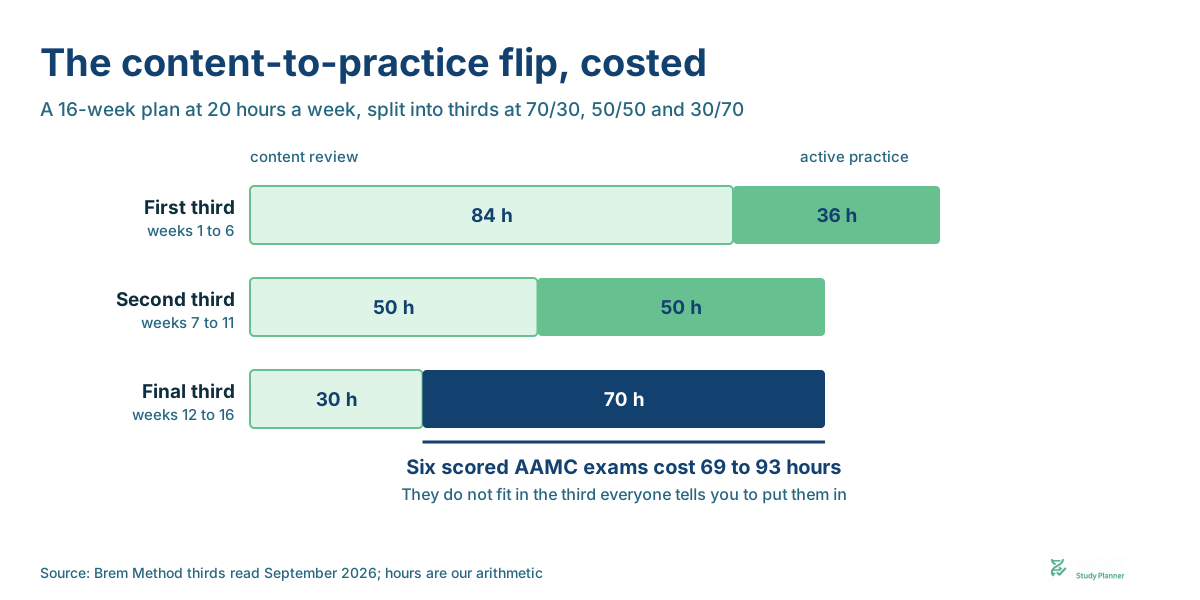
Two numbers in that table decide the whole calendar. The plan has 156 hours of practice in it, total. And the final third, the one everybody tells you to fill with full lengths, holds 70 of them.
Why the Six Official Exams Will Not Fit in the Final Third
Per the AAMC, the exam is 230 questions, 6 hours 15 minutes of testing and about 7 hours 30 minutes of seated time. Reviewing a full length properly takes another 4 to 8 hours, which is our figure, carried from our 3-month guide. So one sitting plus its review costs 11.5 to 15.5 hours, or about 13.5 at the midpoint.
The AAMC’s prep page, read September 20, 2026, states that it “offers two free full-length practice exams and five low-cost practice exams.” In practice that is Practice Exam 1 free, Practice Exams 2 through 6 at $35.00 each on the AAMC store as of September 20, 2026, plus a separate free Unscored Sample Test which, in the AAMC’s words, has “the same look and feel and the same length and functionality as the actual MCAT exam but does not provide a scaled score or percentile rank.”
Now do the collision. Six scored exams at 11.5 to 15.5 hours each is 69 to 93 hours. The final third holds 70 practice hours.
They fit only at the very bottom of the review range, with nothing left for question banks, CARS or anything else. At the top of the range they overflow by 23 hours. The standard advice to finish content review and then run full lengths in the last quarter does not survive its own arithmetic on a 16-week plan.
So the exam block starts earlier, in the middle third. Where exactly depends on one number, and it is the same threshold our six-month guide found from the other direction:
| Weekly hours | Cost of one sitting | Hours left that week |
|---|---|---|
| 15 | 13.5 | 1.5 |
| 19 | 13.5 | 5.5 |
| 20 | 13.5 | 6.5 |
| 25 | 13.5 | 11.5 |
A weekly exam cadence needs room for the sitting plus the error-log work the next exam depends on, which we budget at about 6 hours. That is 19.5 hours, so call it 20. At 20 hours a week and above, you can run one exam per week. Below 20, you cannot, and the exams have to go two weeks apart. Our week-by-week full-length calendar works through the placement rules across the other timelines.
Do this before you build anything else: decide whether your honest weekly number is above or below 20 hours. That single answer picks your calendar, your exam spacing and the week your first scored exam lands. Everything else in a 16-week plan arranges itself around the exam block, so place the exams first and fill the gaps afterwards, not the other way round.
The 16-Week Calendar, Both Tracks
Both calendars count backward from test day. Week 16 ends on your exam. Find your test date, count back 16 weeks, and that is the start of week 1. Every exam day should land on the same weekday as your real test date, because the rehearsal should match the performance.
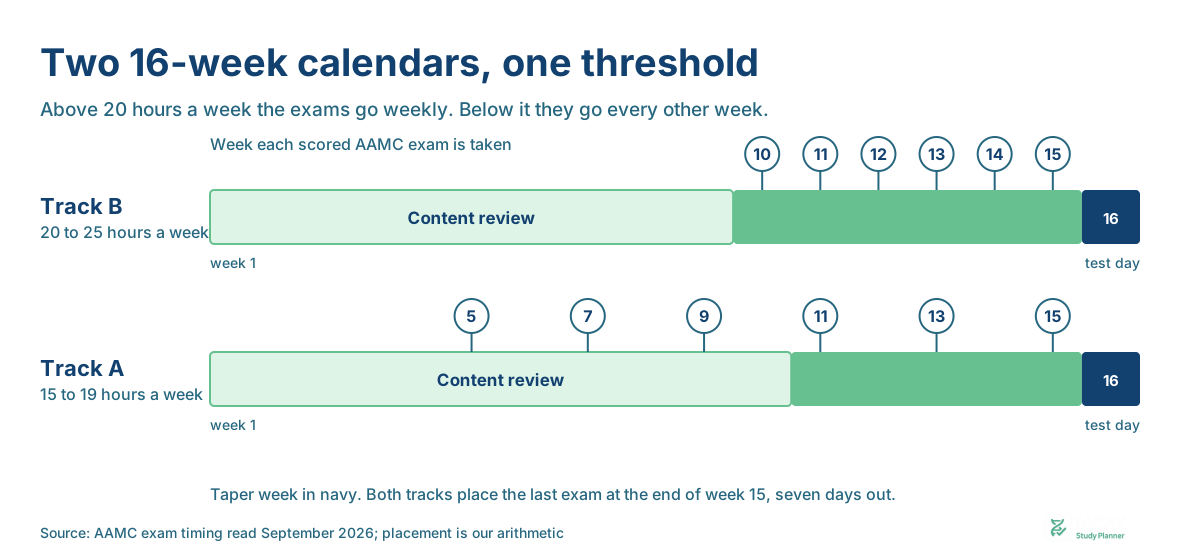
Track B: 20 to 25 hours a week
This is the standard four-month plan, and it is the one most people mean.
| Week | What runs | Sitting at the end of the week |
|---|---|---|
| 1 | Free Unscored Sample Test on day 1, then content review | Baseline, day 1 |
| 2 to 8 | Content review, daily CARS, timed question blocks, Anki new cards | none |
| 9 | Content review ends, new Anki cards go to zero | none |
| 10 | Error log work begins, targeted content | Practice Exam 1 |
| 11 | Error log from Exam 1, targeted content | Practice Exam 2 |
| 12 | Error log from Exam 2, targeted content | Practice Exam 3 |
| 13 | Error log from Exam 3, targeted content | Practice Exam 4 |
| 14 | Error log from Exam 4, targeted content | Practice Exam 5 |
| 15 | Error log from Exam 5, then timed section blocks | Practice Exam 6, seven days out |
| 16 | Taper: error-log review, light section blocks, sleep schedule | Test day |
Six scored exams across weeks 10 to 15, the last one seven days out. That is the same six-exam practice block our step-by-step MCAT study method uses on every timeline of 12 weeks or more, and at 20 or more hours a week it survives the table above with 6.5 hours to spare on exam weeks.
Track A: 15 to 19 hours a week
Here the exams cannot go weekly, so they go every other week, and that pushes the first one much earlier than anyone on this search would tell you.
| Week | What runs | Sitting at the end of the week |
|---|---|---|
| 1 | Free Unscored Sample Test on day 1, then content review | Baseline, day 1 |
| 2 to 4 | Content review, daily CARS, Anki new cards | none |
| 5 | Content review | Practice Exam 1 |
| 6 | Error log from Exam 1, content review continues | none |
| 7 | Content review | Practice Exam 2 |
| 8 | Error log from Exam 2, content review continues | none |
| 9 | Content review | Practice Exam 3 |
| 10 | Error log from Exam 3, content review ends | none |
| 11 | New Anki cards go to zero, targeted content | Practice Exam 4 |
| 12 | Error log from Exam 4 | none |
| 13 | Targeted content from the error log | Practice Exam 5 |
| 14 | Error log from Exam 5, timed section blocks | none |
| 15 | Review day, then timed section blocks | Practice Exam 6, seven days out |
| 16 | Taper: error-log review, light section blocks, sleep schedule | Test day |
The uncomfortable part of Track A is that exams 1 through 3 land while content review is still running. That is not a compromise, it is the only arrangement that fits: six exams two weeks apart need eleven weeks of span, and the last one has to be at week 15.
It also happens to match what the one first-person account on this search recommends. Med School Insiders’ four-month plan, read September 20, 2026, says “The plan I’ve laid above incorporates testing within week 5 or week 6 - assuming this is a 4-month plan, regular testing can be sustained for 8-10 weeks.”
For the topic order to march through during the content weeks on either track, our 10-week content review schedule sequences them by yield. Once you have a date and a weekly number, the free MCAT study schedule generator lays either of these tracks out day by day around your job or your classes, with the exams already placed.
One Anki note that matters more on this timeline than on a longer one. Set new cards to zero when the error-log phase starts, week 10 on Track B and week 11 on Track A. A 16-week plan is too short to absorb a review queue that is still growing in the weeks your full lengths need the time. Our Anki settings guide covers the rest of the setup, including maximum interval.
How Many Full Lengths a Four-Month Plan Actually Needs
The two dedicated four-month schedules on this search disagree with each other by a factor of about two and a half, on the most expensive item in the plan, and neither acknowledges the other exists.
| Plan | Full-length sittings scheduled | Official exams available |
|---|---|---|
| Jack Westin, 16-week plan | 5 | 7 |
| This guide | 7 | 7 |
| Shemmassian 4-month PDF | 12 | 7 |
Jack Westin’s “4-Month MCAT Study Schedule (2026)”, read September 20, 2026, runs its final stage across weeks 13 to 16 with “One full-length exam per week,” plus a baseline before week 1. That is four scored exams and five sittings, which leaves two of the six scored AAMC exams unused. Its weekly template for those four weeks also gives Saturday to the exam and Sunday to the review, one day for something that takes 4 to 8 hours.
The Shemmassian 4-month PDF, which ranks on this search as a raw download and which we read on September 20, 2026, goes the other way. Its 16-week day-by-day grid contains twelve separate full-length review entries. Seven official sittings exist, so that schedule silently requires at least five third-party full lengths on top of the entire official set, and the page carries no hours figure and no cost anywhere.
Seven is the number that matches the material. One free Unscored Sample Test as a baseline, which costs nothing and burns none of the scored exams, plus all six scored exams as your actual data points. Our comparison of every full length on the market covers what the third-party options cost and how well they predict, if you want more than seven. For picking the week 1 baseline specifically, our guide to which MCAT diagnostic test to take covers the free options.
Every Official Question, Counted and Costed
Here is something no four-month plan on this search tells you: the official material is finite, and on a 16-week timeline you can measure it against the hours you have.
These counts come from the AAMC’s own product page, read September 20, 2026, with prices from the AAMC store the same day:
| Product | Questions | Price |
|---|---|---|
| Section Bank Volume 1 | 300 | $45.00 |
| Section Bank Volume 2 | 300 | $45.00 |
| Biology Question Pack Volume 1 | 120 | $15.00 |
| Biology Question Pack Volume 2 | 120 | $15.00 |
| Chemistry Question Pack | 120 | $15.00 |
| Physics Question Pack | 120 | $15.00 |
| Independent Question Bank | 150 | $10.00 |
| Practice Exams 2 to 6 | 1,150 | $35.00 each |
| Practice Exam 1 and Unscored Sample Test | 460 | Free |
That is 1,230 official questions outside the full lengths, and another 1,610 inside them, for 2,840 in total.
Now price the 1,230. The AAMC gives 59 questions in 95 minutes for the science sections, which is 1.61 minutes a question. Add 3 minutes a question for review, which is our assumption and the part worth arguing with. That comes to about 95 hours to work the non-exam official inventory properly.
Put the two together and the official material alone costs 175.5 to 203.5 hours:
| Your weekly hours | 16-week total | Official material as a share of it |
|---|---|---|
| 15 | 240 | 73 to 85 percent |
| 19 | 304 | 58 to 67 percent |
| 20 | 320 | 55 to 64 percent |
| 25 | 400 | 44 to 51 percent |
At 15 hours a week, working through the official material and nothing else consumes most of the plan. At 25, it takes about half and leaves real room for content review. That table is the clearest answer we can give to whether your weekly number is high enough.
Is Four Months Enough? Count the Hours Left Over
The honest test is not the calendar. It is what remains after the exam block.
Seven sittings cost 80.5 to 108.5 hours. Subtract that from your total, and what is left is everything else: content review, question banks, CARS, Anki, the lot.
| Weekly hours | 16-week total | Left after seven sittings | Per week |
|---|---|---|---|
| 15 | 240 | 131.5 to 159.5 hours | 8 to 10 |
| 25 | 400 | 291.5 to 319.5 hours | 18 to 20 |
At 15 hours a week you are trying to learn or refresh four sciences plus CARS on 8 to 10 hours a week. If you are refreshing material you took recently, that can work. If you are learning it, it is a six-month plan wearing a four-month label, and you would be better served by the 24-week version than by squeezing.
One more piece of context from our own data, because the totals above look alarming in isolation. In that 43-report dataset, 6 of the 43 came in under 200 total hours, and their median score was 517, in a range from 510 to 518. Low totals are not automatically failures. They tend to belong to people whose baseline was already close to their target, which is exactly what your week 1 Unscored Sample Test is for. Take it before you decide your weekly number, not after.
What the Ranking Pages Get Wrong
Four errors repeat across the pages that currently rank for this search, and each one changes what you would do.
The Brem Method’s four-month plan overshoots its own target. Its page, read September 20, 2026, sets the goal as “300 hours of good study, 6 full-length practice exams in testing conditions,” and then describes the four-month plan as “around 20 to 25 hours per week, you reach the same total.” Twenty to 25 hours a week over 16 weeks is 320 to 400 hours, not 300. Its exam count is the only correct one on the search, and its hours contradict its own stated target by 20 to 100 hours.
Kaplan’s schedule page contradicts itself by about 100 hours. It ranks on this search with its six-month page. That page tells you to study “at least three hours per day, six days per week,” and its own FAQ says Kaplan “recommends studying for the MCAT over a period of four to six months for a total of 300 to 350 hours.” Both read September 16, 2026. Three hours over six days is 18 hours a week, which is 432 hours across 24 weeks, well past the range the same page recommends.
The page that calls four months the “sweet spot” publishes no four-month arithmetic. Shemmassian’s schedule guide, read September 20, 2026, gives its four-month section three sentences and a PDF download link. It does publish a 12-week calculation on the same page, “Studying 25 hours per week over the course of 12 weeks will get you to 300 hours of study time,” and never does the same for 16 weeks. It also repeats the five-exam error: “At an absolute minimum, you should take the five AAMC full-length practice exams.” The AAMC’s own page lists Practice Exams 1 through 6.
The first-person plan on this search needs eleven full lengths across three vendors. Med School Insiders’ four-month plan, read September 20, 2026, lists its resource sequence as review books, Memm, UWorld, “Blueprint Practice Tests (1-6)”, the MilesDown Anki deck, “Altius Practice Tests (5 FL’s minimum)”, and then the AAMC bundle. That is eleven or more full lengths bought from three companies, with no cost stated anywhere on the page and no hours figure either. It is a useful account of one person’s plan. It is not a budget.
If You Are Starting This Week
Three dated facts, all read on September 20, 2026, that change what you do in the next ten days.
The 2027 calendar opens on January 15. Our list of official MCAT test dates has all 35 dates in the 2027 season, January 15 through September 11, with January holding five of them. Counting back 16 weeks: January 15, 2027 starts on September 25, 2026. January 22, 2027 starts on October 2, 2026. March 6, 2027 starts on November 14, 2026.
Registration does not open until October 20. The AAMC’s site carries this notice: “Registration for the entire 2027 MCAT testing season (Jan. - Sept.) will open Oct. 20-22, 2026, by testing center location.” A 16-week plan begun this week is four weeks old before you can book the exam you are studying for. Pick the date now and treat the booking as a calendar item for October 20.
Wait ten days before buying the bundle. The AAMC store’s banner reads “The Online-Only Bundle is unavailable for purchase until September 30, when it will return, including the new CARS Question Bank.” The bundle is listed at $336.15 against a $405.00 list price. Buying the pieces separately right now means paying for a bundle you cannot buy and missing a question bank that arrives in ten days. Start week 1 on free material, which is what the Unscored Sample Test is for, and buy on September 30.
If you are choosing between dates rather than starting today, our guide to picking an MCAT test date that fits covers the prerequisite and application-cycle side of the decision.
The Whole 16 Weeks on One Page
| Decision | The number |
|---|---|
| Plan length | 16 weeks, ending on test day |
| Budget at 15 hours a week | 240 hours, below the first quartile of 43 reports |
| Budget at 19 hours a week | 304 hours, just above the first quartile |
| Budget at 25 hours a week | 400 hours |
| Budget for the 475-hour median | About 30 hours a week |
| The track threshold | 20 hours a week |
| Baseline | Free AAMC Unscored Sample Test, week 1, day 1 |
| Content review, Track B | Weeks 1 to 9, with daily CARS throughout |
| Content review, Track A | Weeks 1 to 10, with daily CARS throughout |
| Scored exams, Track B | End of weeks 10, 11, 12, 13, 14 and 15 |
| Scored exams, Track A | End of weeks 5, 7, 9, 11, 13 and 15 |
| Cost per sitting | 7.5 hours seated plus 4 to 8 hours of review |
| Cost of all seven sittings | 80.5 to 108.5 hours, or 25 to 34 percent of a 320-hour plan |
| Official questions outside the exams | 1,230, about 95 hours to work properly |
| Anki new cards | Zero from week 10 on Track B, week 11 on Track A |
| Last full length | End of week 15, seven days out |
| Final week | Week 16, taper, no full length |
Two ways to put this on a real calendar. The MCAT study planner takes your test date, your weekly hours and your resources and builds whichever of these two tracks your hours put you on, with the exams already placed and the days filled in around everything else you do. If you would rather build it by hand, copy the table for your track into a spreadsheet and fill in the topics from our content review schedule.
Either way, do the multiplication before you book the date. Sixteen weeks is a comfortable calendar and a modest budget at the same time, and only one of those two facts appears on the other pages you will read today.
Written by
MCAT Study Planner Team
Last updated 9/20/2026