
When to Take the MCAT: Pick a Test Date That Fits
By MCAT Study Planner Team • Updated 9/18/2026
Short answer: pick the date that still leaves you a retake. On the 2027 calendar that means July 30, 2027 or earlier, because every date from August 14 on releases its score after the last scheduling deadline of the year. Then check that your week can actually reach the hours that date demands.
Almost every page on this question gives you a season. Test in the spring of junior year, before applications open, after you finish your prerequisites. Google’s AI Overview says late April or early May.
None of them does the arithmetic behind those words. So here it is, from the AAMC calendar, the AAMC content outline and the AMCAS applicant guide, all read on September 18, 2026.
The 30-second answer: three numbers set your date. One, how many later seats your score still leaves you: 29 in mid-January 2027, 17 in mid-April, 2 on July 30, and zero from August 14. Two, what coursework you are missing: biochemistry alone is 12.8 percent of the exam, more than physics and organic chemistry together. Three, how many hours a week you can protect: a January 2027 seat needs about 33 hours a week from registration day, a May seat needs 15. Registration for every 2027 date opens October 20 to 22, 2026.
In this guide
- The date is three numbers, not a season
- What “have I finished the prerequisites” is really asking
- The pre-req list everyone uses misses 37 percent of the exam
- Every 2027 date buys a different retake budget
- The retake cliff is July 30, 2027
- What the application cycle actually requires
- Your weekly hours decide which dates you can reach
- The attempt limits and the three-year rule
- Book the date, then build the plan around it
- What the ranking pages get wrong
- Every input on one page
The Date Is Three Numbers, Not a Season
The AAMC’s own page on this question asks you three things: when do you want to attend medical school, will you need to take the exam more than once, and have you mastered the content tested on the exam. That is a good frame and it stops exactly where it gets useful, because AAMC attaches no numbers to any of the three.
Attach the numbers and the three questions become three quantities you can look up:
| AAMC’s question | The number behind it | Where it comes from |
|---|---|---|
| Will I need to take it more than once? | How many later 2027 seats are still bookable when your score lands | Our count across the 35 rows of the AAMC 2027 calendar |
| Have I mastered the content? | What share of the 230 questions your missing course covers | Our arithmetic on AAMC discipline targets and question counts |
| When do I want to attend medical school? | Hours a week your week can hold, times the weeks left to the date | Our analysis of 43 student self-reports, divided by the calendar |
Work those three and the season falls out on its own. Skip them and you are picking a month because a prep company named it.
What “Have I Finished the Prerequisites” Is Really Asking
AAMC is explicit that there is no required course list. Its wording: “While there aren’t specific courses you have to take to be able to register and take the exam, it’s important to feel comfortable with the content and skills tested.” The content it names is introductory biology, general and organic chemistry, physics, plus first-semester biochemistry, psychology and sociology.
AAMC also publishes how much of each section comes from each of those courses, and it publishes how many questions each section has. It never multiplies the two. We did.
| Course | Questions on a 230-question form | Share of the exam |
|---|---|---|
| Introductory biology | 44.25 | 19.2% |
| Introductory psychology | 38.35 | 16.7% |
| First-semester biochemistry | 29.5 | 12.8% |
| General chemistry | 20.65 | 9.0% |
| Introductory sociology | 17.7 | 7.7% |
| Introductory physics | 14.75 | 6.4% |
| Organic chemistry | 11.8 | 5.1% |
| No course covers it (CARS) | 53 | 23.0% |
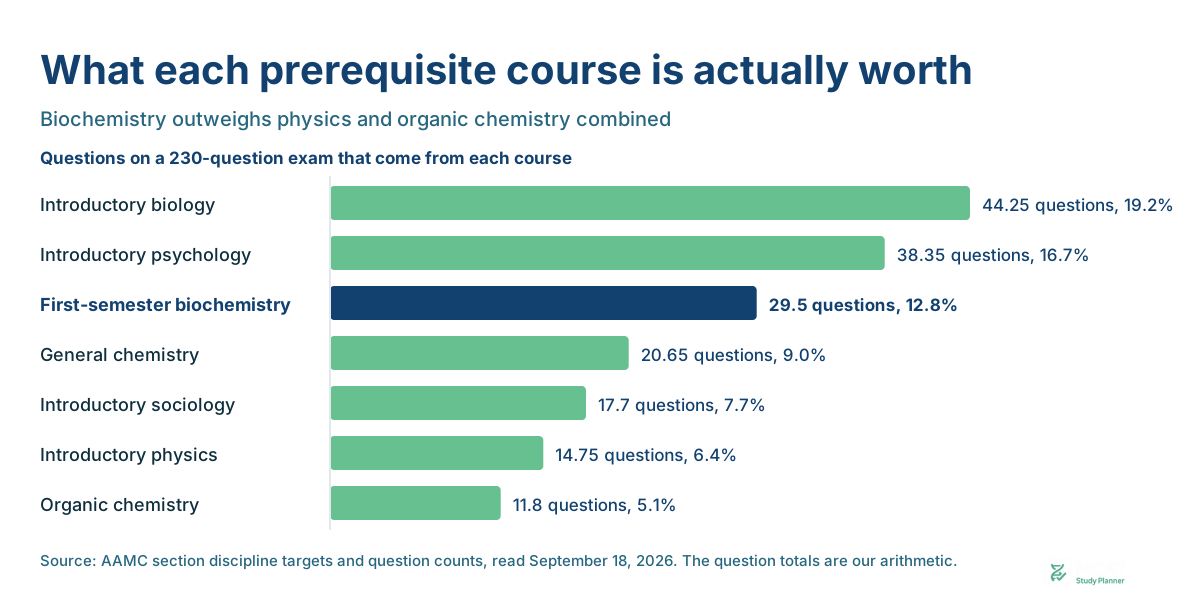
This is our arithmetic, and the assumption matters: AAMC rounds its discipline targets to the nearest 5 percent and says in a footnote that they “will vary from one test to another.” Treat these as targets for a typical form, not a promise about yours.
Two results are worth the trouble of doing the multiplication.
First, biochemistry is the expensive course to be missing. It is 25 percent of both the chemistry and biology sections, which is 29.5 questions. Introductory physics and organic chemistry together are 26.55. Waiting a semester for organic chemistry II buys you less than waiting one semester for biochemistry I.
Second, psychology and sociology together are 56.05 questions, 24.4 percent of the exam. That is more than introductory biology. Most students treat those two as the sections you can self-teach in a month, and many can, but the weight is real.
Do this now: list the courses on that table you have not finished, add their percentages, and write the total down. If it is above about 15 percent, you are not choosing a test date yet. You are choosing a semester.
The Pre-Req List Everyone Uses Misses 37 Percent of the Exam
Princeton Review answers the readiness question this way, on the page ranking eighth for this search as of September 18, 2026: if you have not finished “two semesters each of biology, physics, general chemistry, and organic chemistry,” you probably should not sit.
Those four courses are 91.45 of the 230 questions. That is 39.8 percent of the exam.
The three courses that list does not mention, biochemistry, psychology and sociology, are 85.55 questions, 37.2 percent. CARS, which no course prepares you for, is the remaining 53 questions.
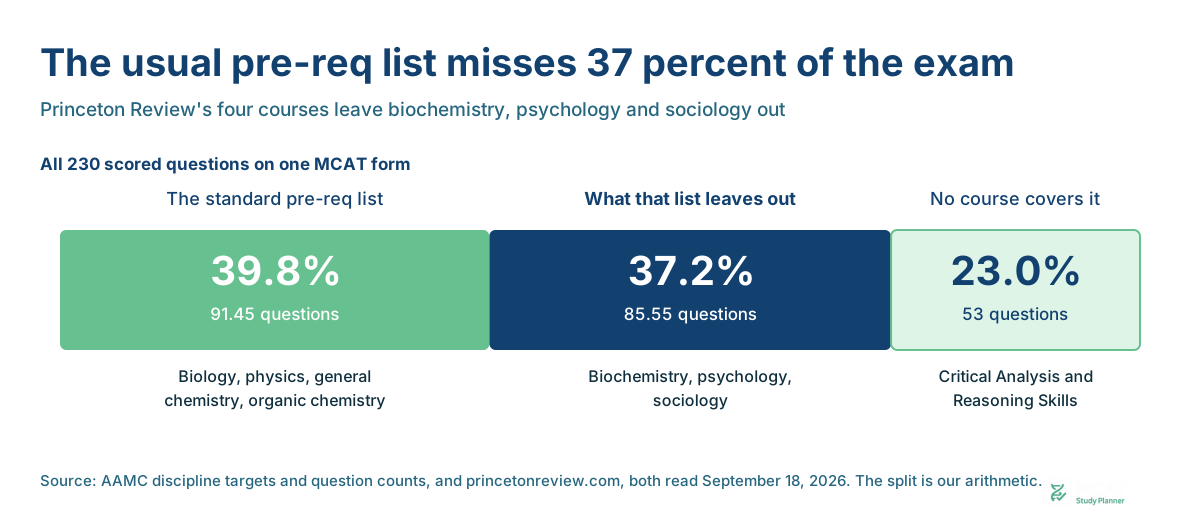
Google’s AI Overview repeats a similar list for this query, naming general chemistry, organic chemistry, biology and biochemistry, and leaving psychology and sociology out. A checklist that ignores a quarter of the exam is not a readiness test. A diagnostic exam is, because it tells you what you actually know rather than what you enrolled in.
Every 2027 Date Buys a Different Retake Budget
AAMC’s advice on retakes is one sentence: “If you think you may re-take the exam, and you want to leave yourself that option, think about taking the exam earlier in a testing year.” It never says how much earlier, and no ranking page fills that in.
You can compute it. AAMC publishes a score release date for each exam and a 10 Day Deadline, the last date on which any exam can be scheduled, rescheduled or cancelled. So for any test date, count the later 2027 dates whose 10 Day Deadline has not yet passed when your score arrives. That count is your retake budget.
| If you sit in | Later 2027 dates still bookable when your score lands |
|---|---|
| January 2027 | 28 to 29 |
| February 2027 | 27 |
| March 2027 | 23 to 25 |
| April 2027 | 17 to 18 |
| May 2027 | 12 to 15 |
| June 2027 | 8 to 10 |
| July 2027 | 2 to 7 |
| August 2027 | 0 |
| September 2027 | 0 |
That is our count over the 35 rows of the AAMC 2027 U.S. calendar, and it carries one honest caveat: the 10 Day Deadline is the last day AAMC allows scheduling, but a seat still has to exist on that date. These are ceilings, not guarantees.
The shape of the number is the point. The popular April window still leaves 17 or 18 second chances. June leaves 8 to 10. The drop from July into August is not gradual.
The Retake Cliff Is July 30, 2027
August 14, 2027 releases its score on September 14. The last 10 Day Deadline of the 2027 testing year is September 1, for the September 11 exam. So on the day an August 14 examinee sees a score, there is no 2027 seat left to book.
Every date after it is the same. Nine of the 35 dates in 2027, every one from August 14 to September 11, leaves zero retake room inside that testing year.
July 30, 2027 is the last date that leaves any. Its score releases August 31, one day before that final deadline, and the two dates still open are September 10 and September 11. July 23 leaves three. If a retake matters to you at all, July 30 is the wall.
Do this now: decide whether a retake inside the same year has to stay possible. If yes, your search stops at July 30, 2027, and realistically earlier, because booking a seat 10 days out is a scramble. If no, the later dates are open to you and you should say out loud that you are taking a one-shot exam.
A retake is not free in other ways either. Medical schools see every attempt you chose to score. AAMC’s position is that taking it more than once does not by itself disadvantage you, and that each program sets its own policy on multiple scores. Voiding your exam on test day or not showing up still counts as an attempt.
What the Application Cycle Actually Requires
Here is where the ranking pages and the source part company.
Kaplan’s page, updated September 17, 2026, says “you will want your official MCAT score to be released and ready to go when you submit your medical school application.” Princeton Review says schools will not look at your file until scores are available.
The 2027 AMCAS Applicant Guide says this instead, in writing: “The AMCAS program does not need your scores to verify your application. You may submit your AMCAS application before or after the release of your MCAT scores.” Once your application is delivered, MCAT scores “are automatically sent as they become available.”
Three more facts from the same guide change the timing math:
- Verification is slow in season. “During peak season, AMCAS verification may take six to eight weeks.” Peak is June through September.
- Every deadline is the school’s, not AMCAS’s. Each medical school sets its own AMCAS deadline; your application has to be submitted by 11:59 p.m. ET that day, and transcripts for regular applicants must arrive within 14 calendar days. Early Decision is the one fixed date: August 1.
- If your score is not back yet, you have to say so. The guide is explicit that you must list upcoming or recently taken test dates, because otherwise schools have no way of knowing a score is coming.
Put those together and the common advice inverts. Submitting early matters, because verification alone can eat six to eight weeks. Having the score in hand on submission day does not, because AMCAS neither needs it nor waits for it.
One thing we are not going to do is tell you the month the next cycle opens. As of September 18, 2026 the 2027 AMCAS application is open, for students starting medical school in Fall 2027, and AAMC has published no opening or submission dates for the cycle that the 2027 MCAT dates feed. Anyone quoting you a date for that cycle is quoting last year.
Your Weekly Hours Decide Which Dates You Can Reach
A test date is a deadline, and a deadline only means something next to a rate.
In our analysis of 43 students who reported both total hours and score, the median was 475 hours, the middle half fell between 300 and 600, and the range ran from 45 to 2,625. Divide 475 by the weeks between registration opening day, October 20, 2026, and the last test date in each 2027 month, and every window prices itself.
| 2027 window | Weeks from Oct. 20, 2026 | Hours a week to reach 475 | Hours a week to reach 300 |
|---|---|---|---|
| January | 12.4 to 14.6 | 33 to 38 | 21 to 24 |
| February | 16.4 | 29 | 18 |
| March | 19.6 to 21.4 | 22 to 24 | 14 to 15 |
| April | 24.4 to 25.6 | 19 | 12 |
| May | 27.6 to 31.6 | 15 to 17 | 9 to 11 |
| June | 33.4 to 35.6 | 13 to 14 | 8 to 9 |
| July | 37.4 to 40.4 | 12 to 13 | 7 to 8 |
| August | 42.6 to 44.6 | 11 | 7 |
| September | 45.3 to 46.6 | 10 | 6 to 7 |
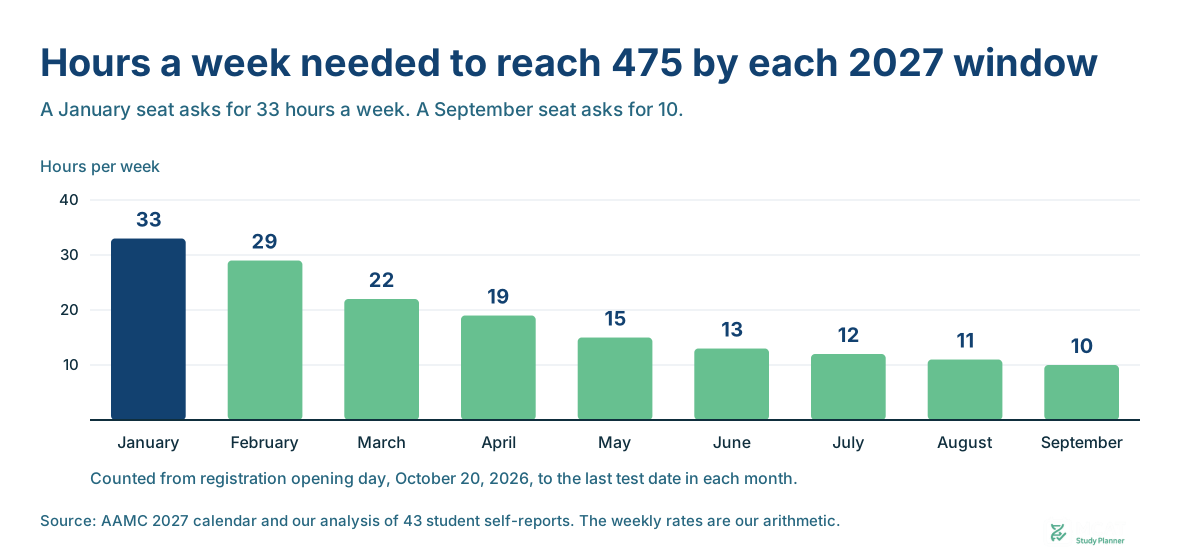
That is our arithmetic and it assumes you start the week registration opens and study every week until test day. Nobody does, which is the argument for building a plan with the empty weeks already in it.
Read the table against your actual week. January 2027 asks for 33 hours a week to reach the median, which is not compatible with a full course load. That is the honest reason most students test in spring rather than winter, and it has nothing to do with seasons.
Once you have a date and an hours number, our free MCAT study schedule generator turns them into a dated calendar, because those two inputs plus your resource list are exactly what a schedule is built from.
If you land on a spring date, the 3-month MCAT study schedule is the shape that fits, at about 25 hours a week. If you land on a summer date and you are working through the academic year, the 6-month MCAT study schedule runs the same total at 12 to 15 hours a week. The full 2027 MCAT test dates table has each date with its three deadlines and its score release date.
The Attempt Limits and the Three-Year Rule
Two hard limits bound everything above, and both are worth knowing before you book anything.
Attempts. AAMC’s rules are: no more than three attempts in a testing year, no more than four over two consecutive testing years, and no more than seven in a lifetime, counting from the April 2015 dates. You may hold only one appointment at a time. AAMC will consider appeals, at its sole discretion, and will not consider more than one appeal in a test year.
Score age. The 2027 AMCAS Applicant Guide states that most medical schools require MCAT scores to be no more than three years old, and points you at each school’s own requirements. Testing very early, two or three years before you apply, can therefore expire on you.
Between them, these two say the same thing the retake budget says. A test date is not a single decision. It is the first of up to three, and the calendar decides how many of the other two you get.
Book the Date, Then Build the Plan Around It
Registration for every 2027 exam opens October 20, 21 and 22, 2026 at 12 p.m. ET, split by testing center region. Four dates are limited to select testing centers: January 30, May 14, July 9 and August 28, 2027.
Book first, plan second. A booked date is a fixed point that a schedule can be counted back from, and until it exists every plan is provisional. Our step-by-step MCAT study method starts from a date for exactly that reason, and the official practice exams have to be spaced backward from it rather than forward from today.
If you want that spacing done for you, build your MCAT schedule from the date and the weekly hours you just picked, and adjust the calendar rather than rebuilding it every time a week goes sideways.
What the Ranking Pages Get Wrong
Four specific claims from the pages ranking for this question, all read on September 18, 2026, that do not survive a check against the source:
| Claim | Where | What the source says |
|---|---|---|
| ”Thirty MCAT test dates” | princetonreview.com | The AAMC 2027 U.S. calendar lists 35 |
| Pre-reqs are biology, physics, general chemistry, organic chemistry | princetonreview.com | Those four are 39.8% of the questions; biochemistry, psychology and sociology are another 37.2% |
| Your score has to be released when you submit AMCAS | kaptest.com | ”The AMCAS program does not need your scores to verify your application” |
| Scores take about four weeks or about a month | Google AI Overview, princetonreview.com | 31 to 33 days across all 35 rows of the 2027 calendar: 31 days on 14 dates, 32 on 17, 33 on 4 |
None of these is a small error. The first three change which date a reader books.
Every Input on One Page
| Input | The number | Source |
|---|---|---|
| 2027 test dates | 35, January 15 to September 11 | AAMC 2027 U.S. calendar |
| Registration opens | October 20 to 22, 2026, 12 p.m. ET, by region | AAMC |
| Score release lag | 31 to 33 days | Our arithmetic over 35 AAMC rows |
| Last date with retake room | July 30, 2027, and it leaves 2 | Our arithmetic |
| First date with none | August 14, 2027 | Our arithmetic |
| Biggest course by exam share | Introductory biology, 44.25 questions, 19.2% | AAMC targets and question counts |
| Costliest course to skip | First-semester biochemistry, 29.5 questions, 12.8% | Same |
| Attempts allowed | 3 per year, 4 per two years, 7 per lifetime | AAMC |
| Score age most schools accept | Three years | 2027 AMCAS Applicant Guide |
| AMCAS verification, peak | Six to eight weeks | Same |
| Median total study hours | 475, middle half 300 to 600 | Our 43-report dataset |
| Select-center dates in 2027 | January 30, May 14, July 9, August 28 | AAMC |
Pick the date that survives all three tests: it leaves you a retake, it sits after the coursework that carries real weight, and its weekly hours fit in the week you actually have. Every other consideration is downstream of those three.
Written by
MCAT Study Planner Team
Last updated 9/18/2026