
MCAT Accommodations: How to Apply and How Far Ahead to Start
By MCAT Study Planner Team • Updated 10/16/2026
Short answer: apply 105 days before your test date, not 60. The AAMC publishes a recommended accommodations submission date for every one of the 35 MCAT dates in 2027, and every single one of them falls exactly 105 days before the exam. The widely repeated “60 days” is the review window, not the lead time, and planning around it puts your decision on roughly the day you sit the exam. We read the AAMC accommodations pages on October 16, 2026 to get these numbers.
Search this and you will be told to allow “several weeks”, or to submit “60 days before your exam”. Both are wrong in the same direction, and the second one is a number lifted from the wrong column.
The AAMC does publish the real dates. It publishes 140 of them, four columns across 35 rows, and it never once tells you what the intervals between those columns are. Work them out and the whole process becomes a backward plan you can put on a calendar.
The 30-second answer: The AAMC’s accommodations calendar is three fixed intervals. Submit the initial application 105 days before the exam, submit a reconsideration by 45 days before if the first decision is not what you need, and be approved and scheduled with Pearson by 15 days before. Those gaps are 60 days and 30 days, which are exactly the review windows the AAMC publishes, so the schedule assumes both reviews run their full length and leaves nothing spare. One incomplete decision restarts the clock and lands your answer 15 days after the exam. To survive that you need 165 days, not 105. Initial reviews take up to 60 days, reconsiderations, appeals and extensions up to 30.
In this guide
- Apply 105 days out, not 60
- Every 2027 test date and its accommodations deadline
- The recommended schedule has no slack in it
- What one incomplete decision costs
- Which of the four applications you are filing
- What actually goes in the application
- What test day looks like with extra time
- What the AAMC will and will not tell you
- If the evaluation is what is stopping you
- What the ranking pages get wrong
- The whole timeline on one page
Apply 105 Days Out, Not 60
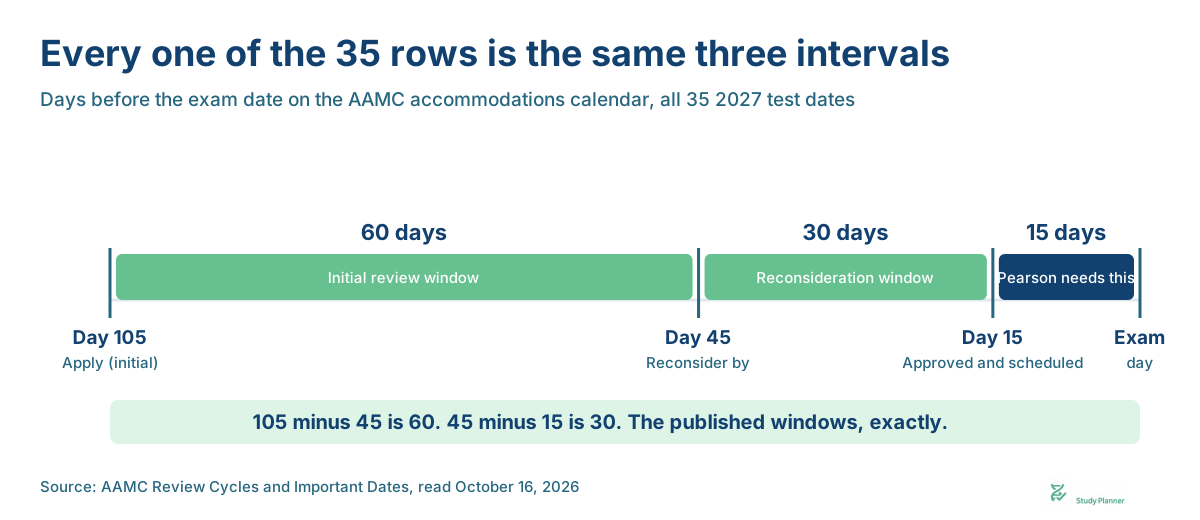
The AAMC’s Review Cycles and Important Dates page carries a four-column table: the recommended submission date for initial applications, the recommended date for reconsiderations, appeals and extensions, the date 15 days before the exam, and the exam date itself. Thirty-five rows, one per 2027 test date.
We differenced all 35 rows on October 16, 2026. The intervals do not vary at all.
| Milestone | Days before the exam | What has to happen |
|---|---|---|
| Recommended initial submission | 105 | Complete application in the system by 11:59 p.m. ET |
| Recommended reconsideration, appeal or extension | 45 | Only if the first decision is not what you need |
| Pearson deadline | 15 | Approved and a scheduling request submitted |
| Exam | 0 | 8:00 a.m. start |
That 105 is our arithmetic on the AAMC’s own dates, not a figure the AAMC prints. It is exact on all 35 rows.
The 60 days everyone quotes is real, but it is the review window. The AAMC states it on three separate pages: “Initial requests for accommodations will generally be reviewed within 60 days of submission of a complete application.” Reconsiderations, appeals and extensions get 30 days. Those are how long the AAMC takes, not how early you should file.
If you are still choosing between dates, how to pick an MCAT test date is the decision this deadline hangs off. The accommodations clock starts from whichever date you pick.
Every 2027 Test Date and Its Accommodations Deadline
Here is the full table, read from the AAMC on October 16, 2026. All submission dates are 11:59 p.m. ET on the day shown.
| 2027 exam date | Apply by (initial) | Reconsideration by | Approved and scheduled by |
|---|---|---|---|
| January 15, 2027 | October 2, 2026 | December 1, 2026 | December 31, 2026 |
| January 16, 2027 | October 3, 2026 | December 2, 2026 | January 1, 2027 |
| January 21, 2027 | October 8, 2026 | December 7, 2026 | January 6, 2027 |
| January 29, 2027 | October 16, 2026 | December 15, 2026 | January 14, 2027 |
| January 30, 2027 * | October 17, 2026 | December 16, 2026 | January 15, 2027 |
| February 12, 2027 | October 30, 2026 | December 29, 2026 | January 28, 2027 |
| March 6, 2027 | November 21, 2026 | January 20, 2027 | February 19, 2027 |
| March 19, 2027 | December 4, 2026 | February 2, 2027 | March 4, 2027 |
| April 9, 2027 | December 25, 2026 | February 23, 2027 | March 25, 2027 |
| April 10, 2027 | December 26, 2026 | February 24, 2027 | March 26, 2027 |
| April 16, 2027 | January 1, 2027 | March 2, 2027 | April 1, 2027 |
| April 17, 2027 | January 2, 2027 | March 3, 2027 | April 2, 2027 |
| May 1, 2027 | January 16, 2027 | March 17, 2027 | April 16, 2027 |
| May 7, 2027 | January 22, 2027 | March 23, 2027 | April 22, 2027 |
| May 8, 2027 | January 23, 2027 | March 24, 2027 | April 23, 2027 |
| May 13, 2027 | January 28, 2027 | March 29, 2027 | April 28, 2027 |
| May 14, 2027 * | January 29, 2027 | March 30, 2027 | April 29, 2027 |
| May 21, 2027 | February 5, 2027 | April 6, 2027 | May 6, 2027 |
| May 29, 2027 | February 13, 2027 | April 14, 2027 | May 14, 2027 |
| June 11, 2027 | February 26, 2027 | April 27, 2027 | May 27, 2027 |
| June 12, 2027 | February 27, 2027 | April 28, 2027 | May 28, 2027 |
| June 25, 2027 | March 12, 2027 | May 11, 2027 | June 10, 2027 |
| June 26, 2027 | March 13, 2027 | May 12, 2027 | June 11, 2027 |
| July 9, 2027 * | March 26, 2027 | May 25, 2027 | June 24, 2027 |
| July 10, 2027 | March 27, 2027 | May 26, 2027 | June 25, 2027 |
| July 23, 2027 | April 9, 2027 | June 8, 2027 | July 8, 2027 |
| July 30, 2027 | April 16, 2027 | June 15, 2027 | July 15, 2027 |
| August 14, 2027 | May 1, 2027 | June 30, 2027 | July 30, 2027 |
| August 20, 2027 | May 7, 2027 | July 6, 2027 | August 5, 2027 |
| August 21, 2027 | May 8, 2027 | July 7, 2027 | August 6, 2027 |
| August 28, 2027 * | May 15, 2027 | July 14, 2027 | August 13, 2027 |
| September 2, 2027 | May 20, 2027 | July 19, 2027 | August 18, 2027 |
| September 3, 2027 | May 21, 2027 | July 20, 2027 | August 19, 2027 |
| September 10, 2027 | May 28, 2027 | July 27, 2027 | August 26, 2027 |
| September 11, 2027 | May 29, 2027 | July 28, 2027 | August 27, 2027 |
* These four dates are offered at select testing locations only.
Three things fall out of this table that nobody publishes.
For the first five test dates, the accommodations deadline came before registration opened. Those recommended initial dates are October 2, 3, 8, 16 and 17, 2026. Registration for all 2027 exams opens October 20, 21 and 22, 2026 at noon ET, by testing centre region. So for the January 15 through January 30, 2027 exams, you were meant to apply for accommodations before you could book the seat. The full registration picture is in every 2027 test date and deadline.
Three of the 35 recommended dates have already passed. As of October 16, 2026, the January 15, 16 and 21, 2027 exams are past their recommended submission date. January 29, 2027 is the earliest 2027 exam still on its full recommended lead, and its date is today.
The season has a hard end. The 2027 testing year closes on September 11, 2027, and the AAMC says initial applications submitted after May 29, 2027 “are not guaranteed accommodations that can be implemented in the 2027 testing year.”
Do this now: find your intended test date in the table above and put the “apply by” date in your calendar today. If that date has already gone, you are not out of options, but you have lost the reconsideration path, and the next section explains what that actually means.
The Recommended Schedule Has No Slack in It
Look at what the gaps are made of. 105 minus 45 is 60, which is exactly the published initial review window. 45 minus 15 is 30, which is exactly the published reconsideration window.
The AAMC confirms this is deliberate: “The recommended submission dates allow time for review, as well as additional time for an applicant to submit a Reconsideration or Appeal request if necessary.”
Follow the recommended schedule exactly and the arithmetic runs like this. Submit on day 105. The initial review takes its full 60 days and your decision arrives on day 45. You file a reconsideration the same day. That review takes its full 30 days and the decision arrives on day 15, which is the Pearson deadline itself. Not a day earlier.
So the recommended date is not a comfortable cushion. It is the minimum that makes the reconsideration path possible at all, assuming every step runs to the published maximum and you turn each one around the same day.
Two AAMC rules make that worse rather than better. Applications “are reviewed in the order they are received and cannot be expedited.” And withdrawing an application to change something restarts the review timeline.
There is a quieter consequence. Missing the recommended date does not cost you the approval. It costs you the second attempt. Apply on October 16, 2026 for the January 15, 2027 exam and the 60 day review still lands on December 15, 2026, which clears that exam’s December 31 Pearson deadline by 16 days. What you no longer have is room to reconsider if the first answer is wrong.
What One Incomplete Decision Costs
An incomplete decision is not a denial. The AAMC is explicit: it means the documentation submitted “is not sufficient for us to fully evaluate the request”, and your decision letter names what is missing.
The cost is in the restart rule. From the AAMC’s submission page: “If your application or request is incomplete, the review cycle starts over. The entire application or request must be re-reviewed along with the additional documentation provided with your resubmission. Initial applications will take up to an additional 60 days to review.”
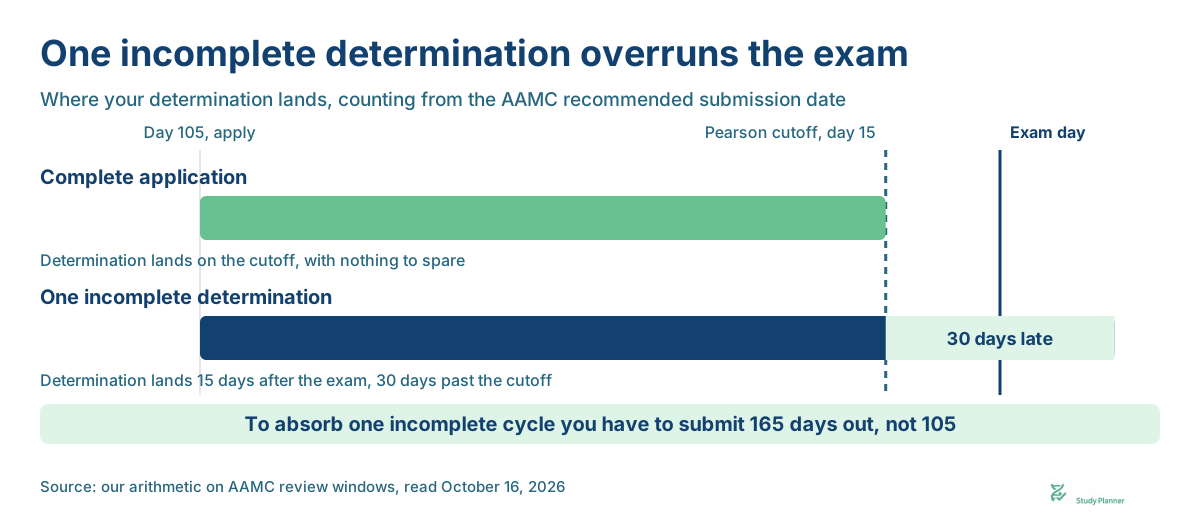
Run it on the recommended schedule. Submit on day 105. The incomplete decision arrives on day 45. You resubmit the same day and the restarted 60 day review ends 15 days after your exam. The Pearson deadline was 15 days before it, so you are 30 days late. That is our arithmetic on the AAMC’s published windows, assuming every review takes its full length and you resubmit immediately.
One incomplete decision, on the schedule the AAMC itself recommends, costs you the test date.
To absorb one incomplete cycle you have to submit 165 days before the exam, which is 105 plus the 60 day restart. That is roughly five and a half months, and it is why the only ranking page that tells you to start 5 to 7 months out is directionally right even though its headline number is wrong.
If the decision does land inside 15 days, the AAMC tells you what happens: the accommodations are not available for that exam, you may sit under standard conditions, and the approval carries to future exams. You have until 10 days before the exam to reschedule under the normal policy, and what a date change costs covers the fees that applies.
The one thing that protects the date: completeness, not speed. Read the AAMC’s documentation chart before you submit and send everything it marks Required for your condition. A complete application reviewed in 60 days beats a fast one that comes back incomplete and costs you 60 more.
Which of the Four Applications You Are Filing
There are four types, and picking the wrong one wastes a review cycle. All four definitions below are the AAMC’s own, read October 16, 2026.
| Type | What it is | Review window |
|---|---|---|
| Initial | Your first request. Required before any other type | Up to 60 days |
| Reconsideration | A re-review, or a request for accommodations not previously asked for. Must include new and substantial information | Up to 30 days |
| Appeal | A re-review with no new or substantially different documentation. May be submitted once only, and the decision is final | Up to 30 days |
| Extension | Extending previously approved accommodations only | Up to 30 days |
Two traps sit in that table.
Reconsideration versus appeal. A reconsideration needs new and substantial information, and the AAMC says a follow-up letter that “only conveys previously provided information is insufficient”. An appeal needs nothing new, but you get exactly one and the decision is final. If you have anything new to add, reconsideration is the one that keeps a door open.
The five year reset. If more than five years have passed since your last decision you have to file a new initial application, and the AAMC keeps your file for five years from your most recent decision. Approvals themselves are generally valid until the close of the following testing year, so an approval granted in the 2027 testing year generally runs through the end of 2028. Your decision letter states the actual authorisation period.
If your application comes back incomplete, you cannot start a different application until you finish that one.
What Actually Goes in the Application
An initial application has four parts. Everything here comes from the AAMC’s Application Guidelines and Requirements page.
- The application questions in the online Accommodations Application System.
- A personal statement. The AAMC defines it as a narrative describing “your current functional limitations, history of accommodations, and what you feel is necessary to ‘level the playing field’“. It wants concrete examples of what would go wrong under standard conditions, drawn from past standardised tests where you have them. It explicitly does not want you restating your evaluator’s report or listing every educational experience.
- A current comprehensive evaluation from a qualified professional, with separate AAMC evaluation guidelines for learning disabilities, ADHD and psychiatric disabilities, physical disabilities, sensory disabilities, diabetes and acquired brain injury.
- Academic and medical supporting documentation, which varies by condition.
That fourth item is where applications fail, so here is the AAMC’s chart in full.
| Condition | Transcripts | Test score reports | Verification of previous accommodations | Supporting academic records | Previous evaluations |
|---|---|---|---|---|---|
| Acquired brain injury | Strongly recommended | Strongly recommended | Required | If applicable | Required |
| ADHD | Strongly recommended | Strongly recommended | Required | Strongly recommended | Strongly recommended |
| Learning disability | Strongly recommended | Required | Required | Strongly recommended | Strongly recommended |
| Physical disability | If applicable | If applicable | Required | If applicable | If applicable |
| Psychiatric disability | Strongly recommended | If applicable | Required | Strongly recommended | Strongly recommended |
| Sensory disability | Strongly recommended | Strongly recommended | Required | Strongly recommended | Strongly recommended |
Verification of previous accommodations is Required for all six categories, where you have any. That means IEPs, Section 504 plans, disability services letters, or accommodation records from the SAT, ACT or GRE, showing which accommodations you had and when. If you have never received accommodations, you do not have to submit it, but the AAMC’s personal statement guidance asks you to explain why.
Four more rules worth knowing before you start.
- Everything must be in English. Materials in another language “will not be reviewed.”
- Nothing is accepted by email. Documents sent by email “will be deleted for security purposes.”
- Your decision deadline appears in the portal once you submit, and can take up to two business days to show.
- Practice test scores on their own do not support a request, because they are not taken under standardised conditions.
Picking the evaluator matters too. The AAMC requires someone with training and experience in the area of impairment, who has personally evaluated you, and who is not a relative or employer. It does not require any specific test, but it does require assessment of specific areas of functioning using adult age norms where possible.
Once the deadline is on your calendar, the rest of the timeline is ordinary scheduling. Put your test date, your hours a week and your resources into the free MCAT study schedule generator and it lays the study plan out around the date your accommodations decision has to clear.
What Test Day Looks Like With Extra Time
The AAMC does not publish accommodated section timings. It does publish the standard exam structure, and it says an accommodated administration “may vary from what is outlined in this guide in order to deliver specific and individualized accommodations”. So the table below is our arithmetic, not an AAMC schedule.
Here is what the AAMC does publish, read October 16, 2026: certification 4 minutes, optional tutorial 10 minutes, Chemical and Physical Foundations 59 questions in 95 minutes, a 10 minute break, CARS 53 questions in 90 minutes, a 30 minute mid-exam break, Biological and Biochemical Foundations 59 questions in 95 minutes, a 10 minute break, Psychological, Social and Biological Foundations 59 questions in 95 minutes, a 3 minute void question and an optional 5 minute survey. Total content time 6 hours 15 minutes, total seated time about 7 hours 30 minutes. The section-by-section version of that is in the MCAT time breakdown.
Apply a multiplier to the four scored sections and leave the breaks as published.
| Section | Standard | Time and a half | Double time |
|---|---|---|---|
| Chemical and Physical Foundations | 95 min | 142.5 min | 190 min |
| CARS | 90 min | 135 min | 180 min |
| Biological and Biochemical Foundations | 95 min | 142.5 min | 190 min |
| Psychological, Social and Biological Foundations | 95 min | 142.5 min | 190 min |
| Total content time | 6h 15m | 9h 22m | 12h 30m |
| Total seated time | about 7h 30m | about 10h 38m | about 13h 45m |
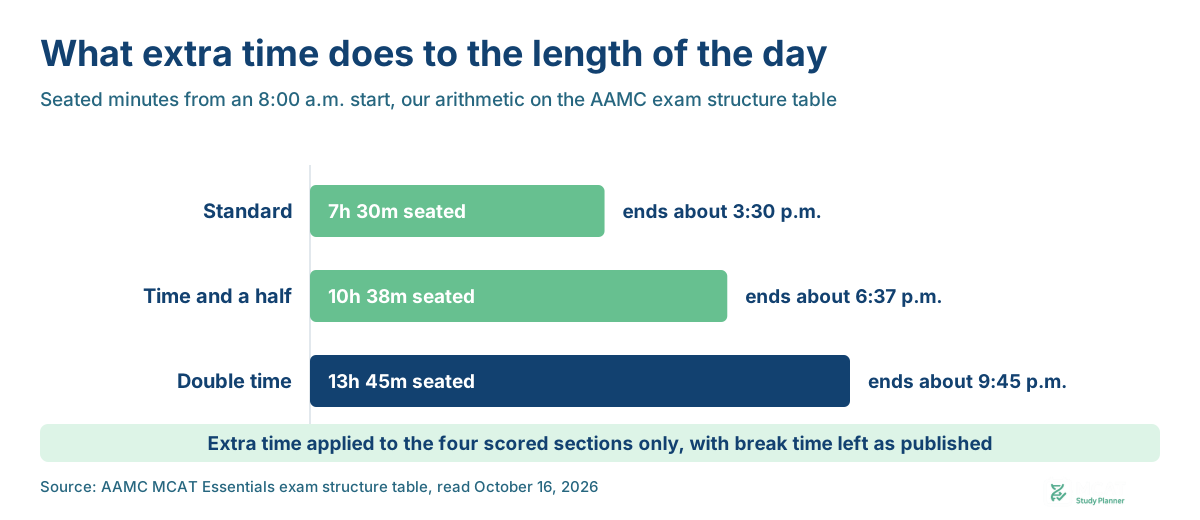
MCAT exams start at 8:00 a.m. unless otherwise noted, so from a standard start those finish about 3:30 p.m., about 6:37 p.m. and about 9:45 p.m. That last figure is the practical reason an accommodated administration is often arranged differently, and it is why the AAMC’s “may vary” sentence matters more than any table.
Per question, the shift is smaller than it sounds. A science section gives you 97 seconds a question at standard timing, 145 at time and a half and 193 at double time. CARS gives you 102, 153 and 204. In passage terms CARS is the clean one: 9 passage sets in 90 minutes is exactly 10 minutes a passage, going to 15 and then 20.
Two practical notes. The MCAT Official Prep Hub supports practice with certain accommodations including extended time and ZoomText, so you can rehearse the real clock. And a day that long is a stamina problem before it is a timing problem, which is worth reading alongside the test day checklist.
What the AAMC Will and Will Not Tell You
Your score is not marked. This is the question people are most anxious about and the AAMC answers it directly: “The scores resulting from MCAT exam administrations delivered with accommodations are identical to scores from standard administrations. The AAMC does not annotate scores resulting from non-standard administrations of the MCAT exam.”
It will not tell you the odds. Nothing the AAMC publishes gives approval rates by condition or by accommodation. Every request is “considered on an individual basis”.
It will not name every accommodation. The examples it gives are extended testing time, additional break time, an adjustable-height workstation, an adaptive mouse and text enlargement, and it says that list is not exhaustive. You are expected to request what you and your qualified professional think you need.
It will not discuss your application with anyone else. Not even a parent, without a signed release filed in the system. Decisions cannot be changed by phone or email either.
Weekend deadlines roll forward. If a decision is due on a weekend or holiday, you can expect it on or before the end of the next business day.
The contacts, as published: MCAT Accommodation Services at [email protected] or 202-828-0600, Monday to Friday 9 a.m. to 7 p.m. ET. Pearson VUE accommodations scheduling at 1-800-466-0450, Monday to Friday 8 a.m. to 8 p.m. ET.
If the Evaluation Is What Is Stopping You
A current comprehensive evaluation is the expensive part, and the AAMC runs a benefit for it. As of October 16, 2026 the Accommodations Financial Benefit offers up to $1,000 to AAMC Fee Assistance Program recipients whose most recent evaluation is not current.
The eligibility rules are narrow and worth reading twice.
- You must already be approved for the Fee Assistance Program.
- It is not for first-time evaluations. You have to supply a prior, outdated comprehensive evaluation.
- It cannot be used retroactively, so you must be approved before you get the evaluation.
- It is first come, first served.
- It is not intended to fund a new evaluation in order to challenge an earlier decision.
As of June 29, 2026 all benefit applications are reviewed for the 2027 testing year, with decisions issued starting October 1. Approval for the benefit does not guarantee approval of accommodations.
If you do not qualify, the AAMC points at three lower-cost routes: university-based training clinics that offer low-cost evaluations, your insurance or a sliding-scale local mental health clinic, and your state vocational rehabilitation agency, which sometimes includes an assessment in its intake.
What the Ranking Pages Get Wrong
We read the top-ranking page and the closest competitor to this one on October 16, 2026.
The page at position one says that if you are granted time and a half “your test will be given over the course of two days”, and that your neuropsychological documentation must be “no more than three years old”. Neither statement appears anywhere on the AAMC’s accommodations pages. The AAMC sets recency requirements per impairment in separate evaluation guidelines rather than as a flat three-year rule, and it does not publish how a time-and-a-half administration is split. Its per-passage timing, 15 minutes for CARS, is right, and is the only arithmetic on the page.
The month-by-month countdown at position 13 tells readers “AAMC strongly recommends: submit 60 days before your exam”. That is the review window in the submission column’s place. A reader who follows it files on day 60, waits the full 60 day review, and gets a decision on the day of the exam, 15 days after the Pearson deadline has closed. The same page is also the only one that tells you to start 5 to 7 months out, which is good advice sitting next to a number that contradicts it.
Across the whole first page, nobody reproduces the AAMC’s dated table, nobody names the intervals inside it, nobody works out what an incomplete decision costs, and nobody computes the accommodated clock. Three of the ten results that came back are selling the neuropsychological evaluation itself.
There is no AI summary on this search at all, which is unusual for a logistics question and tells you how thin the published answer is.
The Whole Timeline on One Page
| Item | Value | Source |
|---|---|---|
| Recommended initial submission | 105 days before the exam | our arithmetic, exact on all 35 AAMC rows |
| Recommended reconsideration, appeal or extension | 45 days before the exam | our arithmetic, exact on all 35 rows |
| Approved and scheduled with Pearson | 15 days before the exam | AAMC, read 2026-10-16 |
| Initial review window | up to 60 days | AAMC, read 2026-10-16 |
| Reconsideration, appeal, extension window | up to 30 days | AAMC, read 2026-10-16 |
| Cost of one incomplete decision | 60 more days, landing 30 days past the cutoff | our arithmetic |
| Lead time that survives one incomplete cycle | 165 days | our arithmetic |
| 2027 test dates on the calendar | 35, January 15 to September 11, 2027 | AAMC, read 2026-10-16 |
| Last initial submission for the 2027 year | May 29, 2027 | AAMC, read 2026-10-16 |
| Deadline time of day | 11:59 p.m. ET | AAMC, read 2026-10-16 |
| Application types | Initial, Reconsideration, Appeal, Extension | AAMC, read 2026-10-16 |
| Appeals allowed | one, decision final | AAMC, read 2026-10-16 |
| New initial application required after | 5 years since last decision | AAMC, read 2026-10-16 |
| Approval validity | generally to the close of the following testing year | AAMC, read 2026-10-16 |
| Score annotation | none | AAMC, read 2026-10-16 |
| Seated day at time and a half | about 10h 38m, ending about 6:37 p.m. | our arithmetic |
| Seated day at double time | about 13h 45m, ending about 9:45 p.m. | our arithmetic |
| Evaluation financial benefit | up to $1,000, Fee Assistance recipients only | AAMC, read 2026-10-16 |
The accommodations decision is upstream of everything else in your prep, because it decides which test date you can realistically commit to. Once that date is fixed, build your MCAT schedule around it and let the plan adjust to the hours you actually have.
Written by
MCAT Study Planner Team
Last updated 10/16/2026