
Retaking the MCAT: Limits, When It Helps, and a Rebuild Plan
By MCAT Study Planner Team • Updated 9/22/2026
Short answer: the average MCAT retake gains 1 to 3 points, and what those points are worth depends entirely on where you start. Applying the AAMC’s published mean gain for each starting band to its own percentile table, the average second attempt moves a 500 up 13 percentile points and a 523 up none at all.
Every page ranking for this search gives you a score threshold. Retake below 500. Maybe retake at 505. Do not bother above 515. None of them converts a point into the thing medical schools actually read on your score report, which is a percentile rank.
The AAMC publishes both halves of that conversion, for free, in two documents. Nobody crosses them. So this guide does that first, and the answer turns out to be sharper than any threshold: the same average retake is worth thirteen percentile points in the middle of the curve and nothing at the top.
The 30-second answer: the AAMC’s mean gain on a second attempt peaks at 3.7 points for first-attempt scores of 494 to 497 and falls off in both directions, to 2.7 at the bottom of the scale and 1.2 for scores of 518 and above. In percentile terms that is a 13 point move from 500, a 7 point move from 512 and nothing from 523. Retaking is normal: 42 percent of 2023 to 2025 examinees were retesters. You get three attempts a year, four across two years and seven for life, and both no-shows and voided exams count. If you wait for your score before booking, the soonest you can sit again in 2027 is 41 to 56 days later, and the AAMC says longer gaps produce larger gains.
In this guide
- What a retake is actually worth, in percentile points
- How many times you can take the MCAT
- Where the popular retake advice goes wrong
- The section to rebuild is not the lowest number on your report
- Every school sees every score
- How soon you can actually sit again in 2027
- What a rebuild changes that a first plan did not
- What a retake costs
- The whole decision on one page
What a Retake Is Actually Worth, in Percentile Points
The AAMC’s guide Using MCAT Data in 2027 Medical Student Selection, read September 22, 2026, publishes the mean total-score change between first and second attempts for every starting band, drawn from 56,953 people who tested twice between 2023 and 2025. Its separate percentile table, in effect May 1, 2026 to April 30, 2027, converts any score into a rank against 305,494 results.
Put one through the other and you get the table below. Our method, so you can check it: take the midpoint of each AAMC band, add that band’s mean gain, round to a whole score, and read both ends off the percentile table.
| First-attempt band | AAMC mean gain | Midpoint, before and after | Percentile, before and after | Percentile points gained |
|---|---|---|---|---|
| 472 to 477 | 2.7 | 475 to 478 | 1 to 2 | 1 |
| 482 to 485 | 3.0 | 484 to 487 | 9 to 14 | 5 |
| 490 to 493 | 3.6 | 492 to 496 | 25 to 36 | 11 |
| 494 to 497 | 3.7 | 496 to 500 | 36 to 48 | 12 |
| 498 to 501 | 3.6 | 500 to 504 | 48 to 61 | 13 |
| 502 to 505 | 3.5 | 504 to 508 | 61 to 74 | 13 |
| 506 to 509 | 3.2 | 508 to 511 | 74 to 82 | 8 |
| 510 to 513 | 2.8 | 512 to 515 | 84 to 91 | 7 |
| 514 to 517 | 2.1 | 516 to 518 | 92 to 95 | 3 |
| 518 to 528 | 1.2 | 523 to 524 | 99 to 99 | 0 |
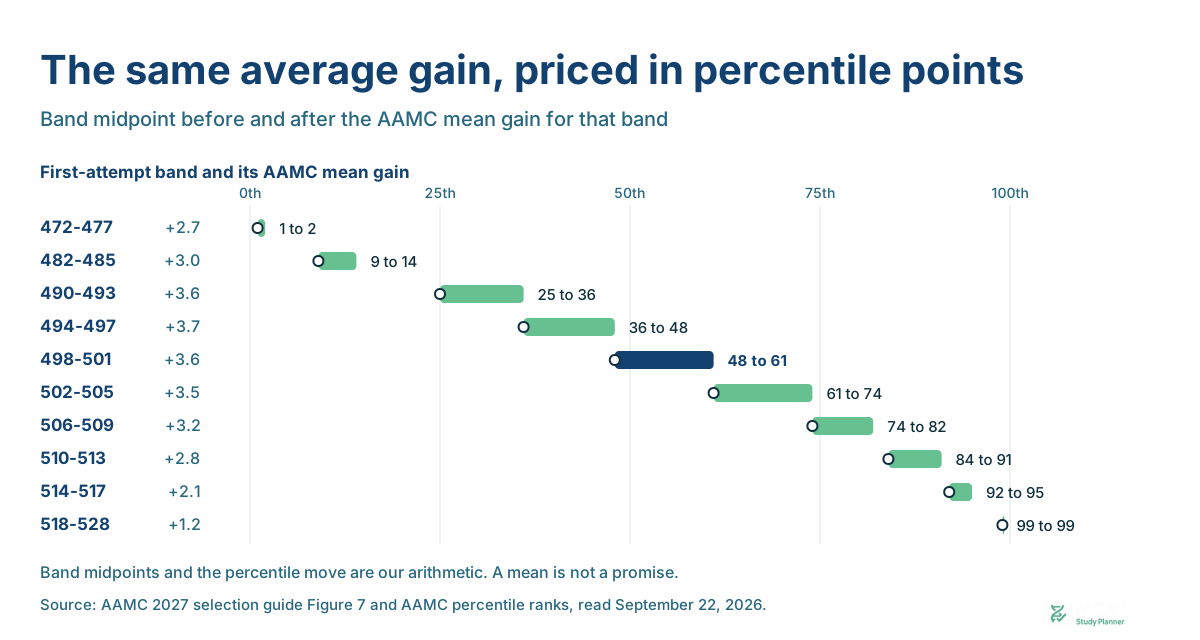
Thirteen percentile points is not an abstraction. By the same arithmetic, across the 305,494 scores the percentile table is built from, it is roughly 39,700 results you move ahead of. The same three and a half scaled points at 523 move you past nobody, because the curve has run out of room.
Two honest limits on this table, both ours to state. A band midpoint is not your score, and the 518 to 528 row is the worst offender: its midpoint of 523 sits well above where most of its 110 examinees actually scored, so that row understates a retake from 518. And a mean is a mean. The AAMC is explicit that there was “considerable variation in the magnitude and direction of score changes,” which is the polite way of saying some of those 56,953 people went down.
How Many Times You Can Take the MCAT
Straight from the AAMC’s testing attempt limits page, read September 22, 2026:
| Limit | Number |
|---|---|
| Appointments held at once | 1 |
| Attempts in a testing year | 3 |
| Attempts across two consecutive testing years | 4 |
| Attempts in a lifetime, from the April 2015 dates | 7 |
Two rules inside those numbers catch people out, and both come from AAMC pages rather than from prep-company summaries.
A no-show is an attempt. The AAMC’s repeat-policy document states it plainly: “Not showing up for an exam counts as an attempt toward the lifetime limit.”
A void is an attempt too. The same document says “Voided scores count as an attempt toward the lifetime limit,” and the AAMC’s page on scoring or voiding your exam repeats it: “A voided exam does count toward your testing limits regardless of the reason.” Voiding protects your score report. It does not protect your allowance.
You can ask for an exception. The AAMC says it may consider appeals of these limits, that approval is at its sole discretion, and that it will not consider more than one appeal in a test year.
For scale: the AAMC reports that just under 95 percent of examinees since 2015 have tested at most once or twice, about 5 percent three times, and about 1 percent more than three times. Running out of attempts is not the realistic risk. Running out of application cycles is.
Where the Popular Retake Advice Goes Wrong
Google’s AI Overview for this search, captured September 22, 2026, says a retake is “strongly recommended if you scored below 500, where average score gains on a second attempt are highest (+5 to +7 points),” and that at 515 or above “the average retake gain is near zero.”
Both halves are wrong against the AAMC’s own figure, and the first half is wrong in an interesting way.
Gains are not highest below 500. They peak just under it and then fall. The AAMC’s mean gain rises from 2.7 in the 472 to 477 band to a maximum of 3.7 at 494 to 497, then declines. The lowest scorers do not gain the most. They gain about what the highest scorers in the 510s gain, which is not what anyone on this search tells you.
The gain at the top is not zero. It is 2.1 points for 514 to 517 and 1.2 points for 518 to 528. Small, and smaller than the variation around it, but not nothing.
The page that ranks sixth for this search is titled “Retaking the MCAT: Score Change Statistics and Acceptance Impact” and is the only result promising data. Read September 22, 2026, it gives gains of “+5 to +7” for initial scores of 490 to 499 and attributes them to “a rough, pattern-level summary from AAMC datasets.” It links to no dataset. Its own hedges include “The exact tables change by year” and “Numbers vary slightly year to year.” The AAMC table it is gesturing at is public, is linked from the AAMC’s admissions-officer resources page, and says 3.6 and 3.7.
None of this makes a retake a bad idea. It makes the sub-500 retake a slower climb than the internet promises, which is worth knowing before you book a date six weeks out.
The Section to Rebuild Is Not the Lowest Number on Your Report
Your score report gives four numbers between 118 and 132, and they look directly comparable. They are not. The AAMC publishes a separate percentile table for each section, and the same scaled score ranks very differently depending on which section it sits in.
| Section score | Chem/Phys | CARS | Bio/Biochem | Psych/Soc | Spread |
|---|---|---|---|---|---|
| 122 | 25 | 25 | 23 | 17 | 8 |
| 124 | 46 | 50 | 43 | 34 | 16 |
| 126 | 67 | 74 | 64 | 54 | 20 |
| 128 | 85 | 90 | 84 | 76 | 14 |
| 130 | 96 | 98 | 96 | 92 | 6 |
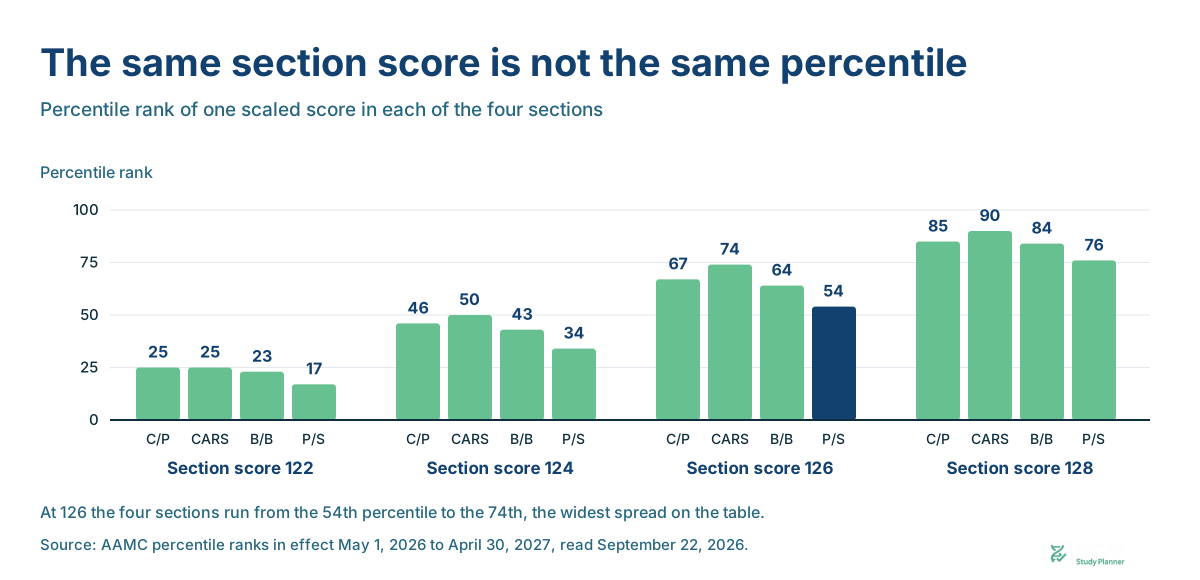
Read the 126 row. A 126 in CARS is the 74th percentile. The identical 126 in psych/soc is the 54th. That is a 20 percentile point gap for the same number printed on the same report, and it is the widest spread the table contains.
What that changes: a 128/126/127/125 is not a chem/phys problem because 128 is the biggest number. In percentile terms it reads 85, 74, 75, 44. The weakest part of that report by a wide margin is psych/soc, and psych/soc is the section where the AAMC’s own skill weighting makes targeted study most tractable. Rank your four sections by percentile before you decide what the rebuild is about.
The spread also narrows fast at both ends. At 130 it is six points and at 122 it is eight. The section-choice effect is a middle-of-the-curve phenomenon, which is where most retakers are.
Every School Sees Every Score
The AAMC has run what it calls a full disclosure policy since April 2003. Its AMCAS score-reporting page, read September 22, 2026, states that all tests taken from April 2003 onward are included in score reports or made available through your AMCAS application, and that scores are pulled into the application automatically as soon as they are released, “regardless of application status.”
There is no cancelling a released score. The only thing that keeps an exam off the report is voiding it on test day, and the AAMC’s page is blunt about the mechanics: you get one chance at the void question, telling the test administrator is not sufficient, and if you do not answer before time expires the exam is scored.
What committees do with multiple scores is not one thing. The AAMC surveyed admissions officers and reported four approaches in use:
- All scores read together with other information in the file that might explain the change.
- The most recent scores only.
- The applicant’s best score, meaning the highest reported total.
- The average total across attempts.
Under approaches 2 and 4, a retake that goes down costs you directly. Under 1 and 3 it mostly does not. Nobody publishes which schools use which, and any page that tells you “most schools take the highest” is guessing at a distribution the AAMC declined to quantify.
Do this before you book anything: write down your four section percentiles, not your section scores. Then look up the band your total sits in on the table at the top of this guide and read the percentile move next to it. If that number is under 5, the retake is not the highest-value thing you could do with the next three months.
How Soon You Can Actually Sit Again in 2027
Two AAMC rules set the floor. Score release falls 31 to 33 days after test day on every one of the 35 rows in the 2027 US calendar. And 10 days before exam day is the last day you can schedule an exam at all.
So if you want your first score in hand before committing to a second date, the earliest retake is the first later date whose 10 Day Deadline has not passed when your score lands. We computed that for all 35 dates in the 2027 calendar.
| Sitting on | Score lands | Earliest retake you can still book | Days later |
|---|---|---|---|
| March 6 | April 6 | April 16 | 41 |
| April 17 | May 18 | May 29 | 42 |
| February 12 | March 16 | April 9 | 56 |
| July 30 | Aug. 31 | September 10 | 42 |
| August 14 | September 14 | None left in 2027 | n/a |
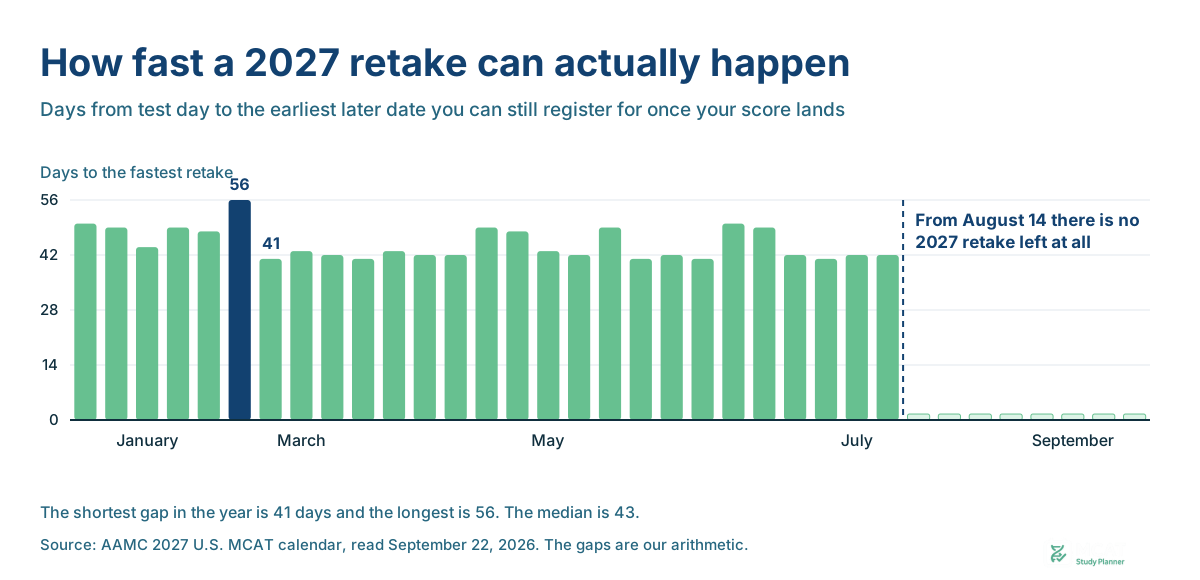
Across the whole year the gap runs from 41 days to 56, with a median of 43. Call it six weeks. That is the floor, and it is the assumption behind every “you can always retake” reassurance you will read.
Here is the problem with using it. The same AAMC guide that publishes the gain figures also reports that “average score gains on the second attempt are greater with more time between the first and second attempts.” Six weeks is the fastest the calendar allows and, by the AAMC’s own data, close to the weakest gap you could choose.
The eight dates from August 14 onward leave no 2027 retake at all, because their scores land after the last scheduling deadline of the season. Our guide to picking an MCAT test date that fits works through the same cliff from the first-attempt side, and the full 2027 calendar has all 35 rows with their deadlines.
What a Rebuild Changes That a First Plan Did Not
A retake plan is not a first plan run again. Four things change, and three of them are in the AAMC’s data.
Time between attempts is a lever, and it is the one the calendar fights you on. The AAMC’s Figure 8, covering 2019 to 2023, reports mean score change by education level between attempts: 2.8 points for no change in academic year or level (N = 36,070), 3.7 for advancing one year or level (N = 22,443), and 4.6 for advancing two or more (N = 2,255). The AAMC adds that longer gaps help independently of any formal education change. Whatever else you do, choosing the second date rather than the third makes the rebuild harder.
Your baseline is a real score now, not a diagnostic. That changes the arithmetic you should be doing. Our analysis of 43 student reports with hours and scores found a median of 475 total hours, with the middle half between 300 and 600, and one report that logged roughly 400 hours across three attempts moving 505 to 511 to 521. Those totals were first-attempt budgets against a cold baseline. A retaker who already did content review once is buying something different with the same hours, which is why re-baselining with a fresh full length before you rebuild matters more than it did the first time.
You cannot reuse your practice material. The longest-running retake thread on Student Doctor Network, opened by SN2ed in August 2010 and still the seventh result for this search, makes the case better than anything written since: a retaken full length gives you an inflated score, which “negates the predictive power of the test.” Its score thresholds are on the pre-2015 45-point scale and do not transfer. Its method does. Decide only once you have the score, never on test-day feeling. Take a real break first. Write down what went wrong before you buy anything. Our comparison of every full length available covers what is left once the AAMC set is spent.
The plan has to fit a shorter window than your first one did. Six to twelve weeks is the usual retake runway, not four to six months, which makes it a sequencing problem rather than a coverage problem. The 12-week schedule is the closest template, with the caveat that a retaker should front-load practice and cut content review to the sections whose percentiles were lowest. If you would rather not hand-build it, the free MCAT study schedule generator takes your new test date, your honest weekly hours and the resources you have left and lays the weeks out for you.
What a Retake Costs
Straight off the AAMC’s scheduling fees page, read September 22, 2026.
| Item | Standard | Fee Assistance Program |
|---|---|---|
| Registration | $355 | $145 |
| Reschedule, 60 or more days out | $55 | $25 |
| Reschedule, 30 to 59 days out | $110 | $45 |
| Reschedule, 10 to 29 days out | $210 | $85 |
| Cancellation refund, 30 or more days out | $175 | $75 |
| Cancellation refund, inside 29 days | $0 | $0 |
Examinees testing outside the US, Canada and US territories pay a $130 international fee on top. No changes of any kind are allowed inside 10 days.
Two things worth noticing. A cancellation refunds $175 of $355, which is 49 percent, and only if you pull out at least 30 days ahead. And booking early then moving once inside the month costs $465 all in, which is more than the sticker price most pages quote.
On that: the fourth-ranking page for this search says standard registration is $345 and Fee Assistance is $140. The fifth says “the current standard registration fee is $325.” Both were read the same day as the AAMC page that says $355 and $145. Prices on prep-company pages go stale; the AAMC’s fee page does not.
The Whole Decision on One Page
| Question | The number |
|---|---|
| Average gain, second attempt | 1 to 3 points, peaking at 3.7 for a first attempt of 494 to 497 |
| Worth of the average retake at 500 | 13 percentile points, from the 48th to the 61st |
| Worth of the average retake at 516 | 3 percentile points |
| Worth of the average retake at 523 | None |
| Share of 2023 to 2025 examinees who were retesters | About 42 percent |
| Attempts allowed | 3 a year, 4 across two years, 7 lifetime |
| Counts as an attempt | Sitting it, voiding it, and not showing up |
| Scores schools see | All of them, since April 2003 |
| Ways committees use multiple scores | 4, per the AAMC’s survey: all, most recent, highest, average |
| Fastest 2027 retake with your score in hand | 41 to 56 days, median 43 |
| 2027 dates with no retake left after them | 8, from August 14 |
| Widest section percentile spread | 20 points, at a section score of 126 |
| Registration | $355, or $145 with Fee Assistance |
| Cost of moving the date inside a month | $110, and no changes at all inside 10 days |
| Mean gain by time and education between attempts | 2.8, 3.7 and 4.6 points |
The decision is not really “is my score too low.” It is “is the percentile move big enough to be worth a cycle.” For most people sitting between 494 and 508 it plainly is, because that is where the curve is steepest and where the AAMC’s mean gains are largest at the same time. Above 514 the same effort buys three percentile points or fewer, and the rest of the application is where the leverage went.
If the answer is yes, pick the later date rather than the earlier one, and build the plan around your section percentiles instead of your section scores. Put your new date and your honest weekly hours into the MCAT study planner and it will place the weeks and the full lengths for you. Then spend the first of them doing the one thing the 2010 SDN thread got right and nobody has improved on since: working out, in writing, what actually went wrong.
Written by
MCAT Study Planner Team
Last updated 9/22/2026