
Best Way to Study for MCAT Psych/Soc (AAMC Data)
By Dr. Sarah Johnson • Updated 9/3/2026
The best way to study psych/soc is to split your time the way the AAMC splits the section: about a third on terminology, two thirds on reasoning, research design and data.
Almost every guide on this topic gives the same advice. Read the 300-page document, turn it into Anki cards, review daily.
That advice is not wrong, it is just incomplete in a way you can measure. According to the AAMC’s own published weighting for this section, pure recall is 35% of what is tested. The remaining 65% is reasoning, experimental design and statistics.
We checked the page currently ranking first for this question. It recommends comparison flashcards, recognition over memorization, and Anki. It does not mention research methods, experimental design or statistical reasoning anywhere.
The 30-second version: terminology gets you to about a 127. The jump from 127 to 132 lives in passage reasoning and in the research-design and stats questions that flashcards never touch. Study the weighting, not the word list.
In this guide
- What the section actually is
- The 35% problem
- Where the weight actually sits
- A study plan that matches the weighting
- The 300-page doc, honestly
- The 20% nobody studies
What the Section Actually Is
Its full name is the Psychological, Social, and Biological Foundations of Behavior section, and knowing the official shape of it changes how you study.
It is 59 questions in 95 minutes, mixing passage-based and discrete questions. By discipline the AAMC targets 65% introductory psychology, 30% introductory sociology and 5% introductory biology, and notes that about 5% of the section is psychology that is biologically relevant on top of the biology target (AAMC).
One caveat the AAMC states directly and most guides drop: “These percentages have been approximated to the nearest 5% and will vary from one test to another for a variety of reasons.”
Two consequences worth acting on:
- Sociology is 30% of the section, not a footnote. Students routinely under-study it because the psychology list is longer and more familiar.
- It is the last section of the day. You will sit it after roughly six hours of testing, which is why practising it while fresh flatters your accuracy. Our MCAT time breakdown guide covers where it falls in the day.
The 35% Problem
Here is the number that should reorganise your prep. The AAMC publishes how the four Scientific Inquiry and Reasoning Skills are weighted within this section.
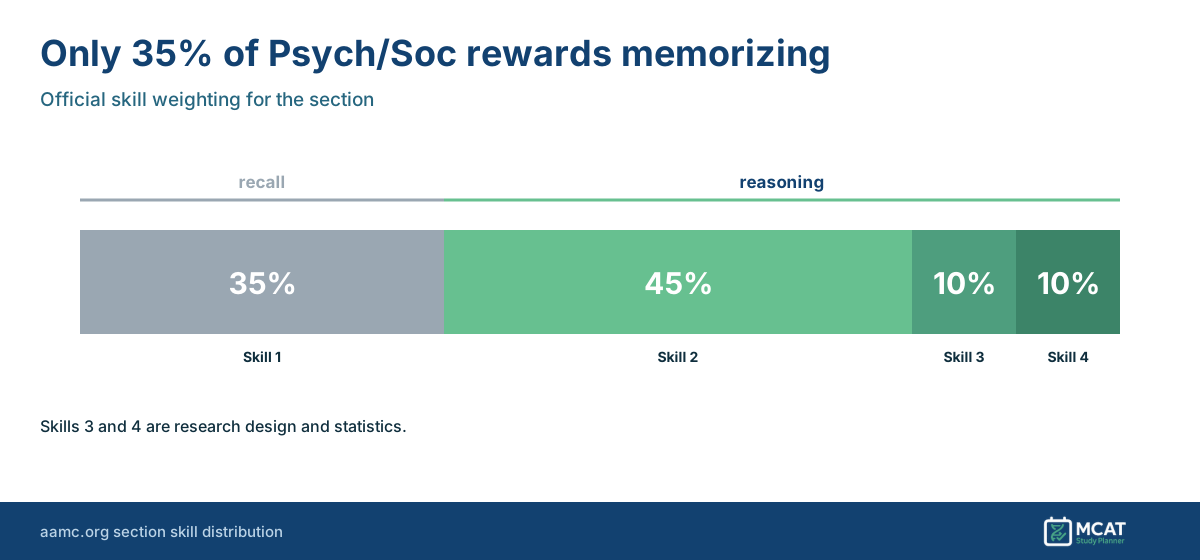
| Skill | Share | What trains it |
|---|---|---|
| Skill 1: Knowledge of Scientific Concepts and Principles | 35% | Flashcards, the 300-page doc |
| Skill 2: Scientific Reasoning and Problem-solving | 45% | Passage practice with review |
| Skill 3: Reasoning about the Design and Execution of Research | 10% | Study-design questions |
| Skill 4: Data-based Statistical Reasoning | 10% | Figure and table interpretation |
Skill 2 alone is larger than pure recall. And Skills 3 and 4 together are 20% of the section, which is roughly twelve questions on a 59-question section, sitting in the exact territory that terminology review does not cover.
If your psych/soc prep is a flashcard deck, you are studying hard for a third of the section.
That 35 percent is not unique to this section. The AAMC publishes the same 35, 45, 10 and 10 split for Bio/Biochem and Chem/Phys, which is why our guide to MCAT biochemistry reaches the same conclusion about memorizing metabolic pathways.
Where the Weight Actually Sits
The AAMC also publishes how the section splits across its five Foundational Concepts. This is the map for deciding what to study first.
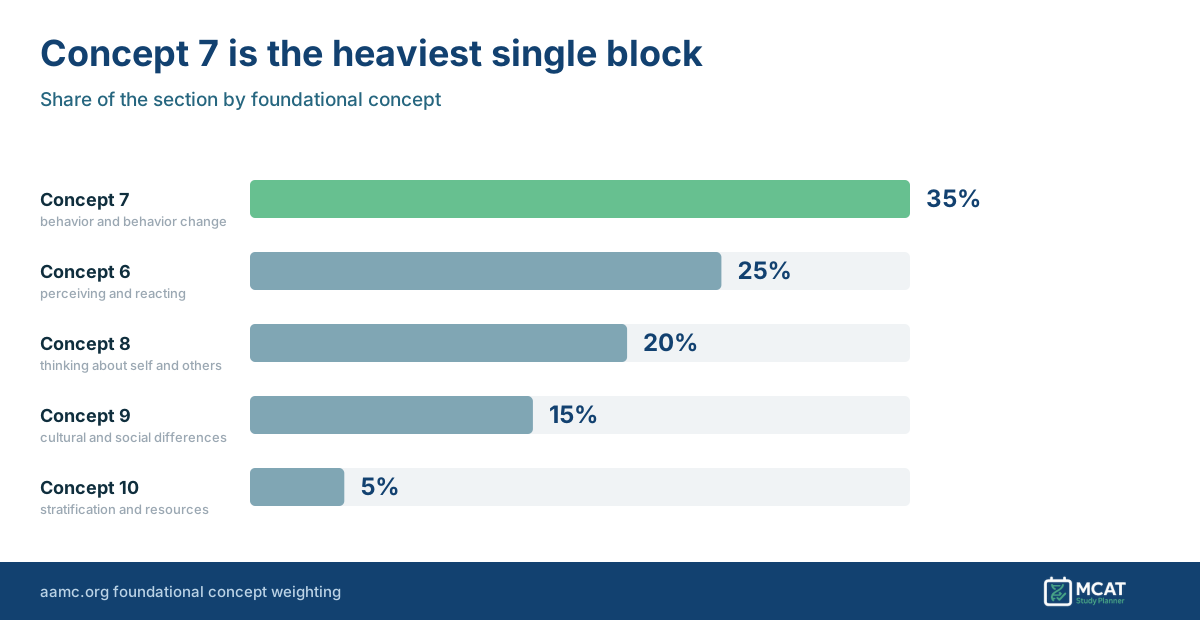
| Concept | Share | Covers |
|---|---|---|
| Concept 7 | 35% | Behavior and behavior change: nervous system, personality, psychological disorders, motivation, attitudes, social processes |
| Concept 6 | 25% | How individuals perceive, think about and react to the world |
| Concept 8 | 20% | How we think about ourselves and others |
| Concept 9 | 15% | Cultural and social differences and well-being |
| Concept 10 | 5% | Social stratification and access to resources |
Concept 7 is the single heaviest block in the section, and inside it Content Category 7A is the densest list on the whole outline: the nervous system down to neurotransmitters and brain regions, the endocrine system, behavioral genetics, six theories of personality, the full classification of psychological disorders, four theories of motivation, and attitude-behavior effects including cognitive dissonance and the foot-in-the-door phenomenon (AAMC 7A).
Concept 10, by contrast, is 5%. It is worth about three questions. Learn social stratification, spend the rest of your time elsewhere.
A Study Plan That Matches the Weighting
Here is how to convert those percentages into weeks. This assumes psych/soc alongside your other sections, not instead of them.
Weeks 1 to 2: terminology, front-loaded
Cover Concepts 7 and 6 first, because they are 60% of the section between them. Use the 300-page doc or a P/S Anki deck, and keep it fast. You are aiming for recognition, not perfect recall of definitions.
Two habits that pay off here:
- Group opposites and near-twins on one card. Assimilation against multiculturalism, functionalism against conflict theory. Almost every psych/soc trap is a pair of similar terms.
- Stop when you can recognise the term in a sentence. You do not need to produce a textbook definition, because the exam gives you the term and asks you to apply it.
Weeks 2 to 4: passages become the main activity
This is the shift most students never make. Once you recognise most terms, terminology review should drop to maintenance and passages should become 70% of your psych/soc time.
Work AAMC material specifically. Section Bank passages for this section are the closest match to the reasoning style the real exam uses, and discrete questions are worth practising separately because they behave differently from passage sets.
Weeks 3 to 5: research design and stats, deliberately
Give this its own slot rather than hoping it turns up. Details in the next section.
Throughout: practise it tired
Psych/soc is the last section of test day. Do at least three of your practice sets late in the day, after several hours of other work, so you learn what your accuracy does when you are depleted. Our guide on when to take MCAT full lengths covers building that into a full-length calendar.
The 300-Page Doc, Honestly
It deserves its reputation, and it also gets over-credited.
The document circulating as the “300-page doc” is a community compilation built from Khan Academy’s psychology and sociology material for the MCAT. Its exact authorship is not well documented, and it is often confused with MileDown’s review sheets, which are a separate and much shorter resource.
What it is good at: breadth of terminology in one place, in plain language, free.
What it does not do:
- It does not teach you to reason through a passage, which is 45% of the section.
- It does not cover experimental design or statistical interpretation, the other 20%.
- It is community-maintained, so it can drift from the current AAMC outline. Check anything surprising against the official content categories.
Use it as a glossary during weeks one and two, then put it down. Reading it a third time is one of the most common ways to feel productive without gaining points. If you want a structured deck instead, our roundup of the best MCAT Anki decks covers which ones actually include P/S content, and our guide to studying with Anki covers settings.
The 20% Nobody Studies
Skills 3 and 4 are 10% each, and they are the most learnable points in the section because the question patterns repeat.
Research design questions ask you to evaluate how a study was built. What you need:
- Study types and what each can and cannot show: experimental, quasi-experimental, correlational, case study, cross-sectional against longitudinal.
- Independent and dependent variables, identified quickly from a methods paragraph.
- Confounding variables, which is the single most frequently rewarded concept here.
- Random assignment against random sampling, and what each protects against.
- Internal against external validity, plus selection bias, attrition, placebo and observer effects.
- Why correlation does not establish causation, phrased as an answer choice rather than a slogan.
Data-based statistical reasoning asks you to read the figure. What you need:
- Mean, median, mode and which is distorted by skew.
- Standard deviation and what a wide one implies about overlap between groups.
- Reading p-values as significance thresholds, and knowing that significant does not mean large.
- Interpreting error bars, scatter plots, and the direction and rough strength of a correlation.
- Spotting when an axis or a scale is doing the persuading.
Practical move: for every psych/soc passage you work, answer one extra question of your own before checking the key. What was the design, and what would break it? That habit converts passage practice into Skill 3 practice at no extra time cost.
Highest yield against commonly over-studied
| Spend more time on | Spend less time on |
|---|---|
| Research design and confounds | Memorizing every developmental stage name |
| Nervous system and neurotransmitters | Obscure sociologists and dates |
| Sociology theoretical approaches | Rereading the 300-page doc |
| Psychological disorder classification | Concept 10 minutiae, worth about 5% |
Building It Into Your Schedule
Psych/soc fails quietly when it becomes the section you do “if there is time left.” Because it feels the most memorizable, it gets pushed to the end of the day and the end of the plan.
Give it named blocks, with the passage phase and the research-methods phase scheduled separately. Our free MCAT study schedule generator will place them across your calendar from your test date and weekly hours.
For the other sections in this series, see our Reddit-sourced guides to CARS and physics.
Frequently Asked Questions
What is the best way to study psych/soc?
Match the AAMC weighting: about a third of your time on terminology and two thirds on passages, research design and data interpretation.
Is the 300-page doc enough?
No. It is a good glossary for weeks one and two. It does not build passage reasoning (45%) or cover research design and statistics (20%).
How many questions is psych/soc?
59 questions in 95 minutes, mixing passage-based and discrete questions.
What is the highest-yield concept?
Foundational Concept 7 at 35% of the section, covering the nervous system, personality, psychological disorders, motivation, attitudes and social processes.
How much sociology is on it?
30% of the section is introductory sociology. It is commonly under-studied relative to that weight.
How do I get a 132?
The last few points come from the reasoning skills rather than more terminology. For context, a 515 total sits at the 91st percentile and a 520 at the 97th, against a national mean of 500.6 (AAMC percentile data).
Written by
Dr. Sarah Johnson
Last updated 9/3/2026