
How To Study MCAT Using Anki: Ultimate Guide
By Dr. Sarah Johnson • Updated 1/15/2026
The MCAT doesn’t test what you’ve read - it tests what you can retrieve and apply under pressure.
Every second you spend searching your memory for a formula or mechanism is a second you lose analyzing passages.
Studying for the MCAT with Anki isn’t about memorizing thousands of cards. It’s about building a mental operating system that automatically surfaces what you need to recall - right when you need it.
Our guide on how to study MCAT using Anki will take you from beginner to mastery, showing you how to build lasting knowledge without wasted time.
Understanding The Anki Method
There are two types of MCAT students:
-
Those who read their notes over and over, hoping they’ll “remember enough.”
-
Those who train their brain to recall any concept on command - like it’s muscle memory.
If you want to be in the second group, this guide is for you.
Anki is a spaced-repetition flashcard system originally designed for medical students. It works by combining spaced repetition (reviewing cards right before you forget them) with active recall (forcing your brain to retrieve information).
For MCAT beginners, this means systematically locking in essentials like biology pathways, equilibrium rules, psych/soc definitions, and amino acid structures.
You don’t cram - Anki automates your review schedule so high-yield MCAT facts become long-term, test-ready knowledge.
What Makes Anki Perfect For The MCAT?
The MCAT’s biggest challenge lies in having to memorize thousands of high-yield facts across biology, chemistry, physics, psychology, and sociology, and applying those facts under time pressure.
Anki stands out as a highly effective tool for MCAT preparation primarily due to its reliance on spaced repetition and active recall, which are proven methods for long-term memory retention.
- Spaced Repetition System (SRS)
Anki’s algorithm predicts when you’re about to forget something and schedules a review just before that happens.
How exactly does this work?
Well, after revealing the answer on a flashcard, you grade your recall using one of four buttons (Again, Hard, Good, Easy). Anki then schedules the card’s next review date based on your rating, increasing the time interval for cards you know well.
This ensures you review tough cards (high-yield content) more frequently and the mastered cards less frequently, minimizing wasted time on redundant reviews.
Spaced repetition ensures you truly retain essentials like hormone pathways, amino acid properties, electrochemistry rules, and behavioral theories.
- Active Recall
Unlike passively rereading a textbook or review sheet, Anki’s flashcard format forces you to generate the answer from your memory (Active Recall). This retrieval process strengthens neural connections, leading to more durable memory where you can retain information for months.
Active recall trains your brain to remember details fast, which is exactly what you need for CARS-timed passages, discrete questions, and complex multi-step science items.
- Customization and Media Support
Anki supports various card types, including Cloze deletions (fill-in-the-blank), which are great for complex passages and diagrams.
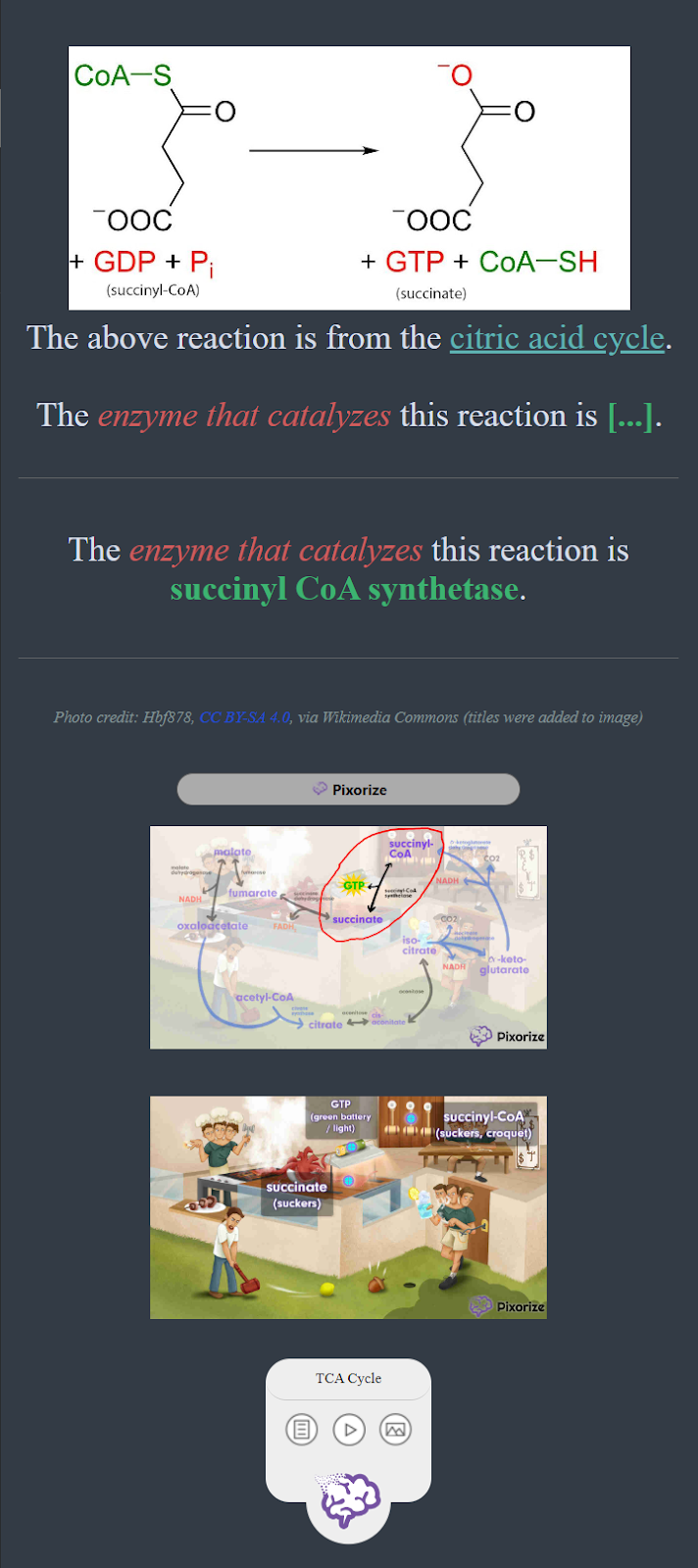
You can embed images, videos, audio, and scientific markup (like chemical structures or equations) to make cards more comprehensive and visually engaging.
- Flexibility and Efficiency
Anki breaks down overwhelming MCAT topics into manageable daily reviews. This prevents burnout while maximizing mastery and score potential.
You can use pre-made, high-quality MCAT decks to save the time of creating cards from scratch, or you can also easily create your own cards based on missed questions from practice exams or topics you are struggling with, for targeted weakness review.
Overall, Anki is a fundamental tool for establishing a strong content foundation for the MCAT, especially for the memorization-heavy Psychology/Sociology and core science facts/equations.
The MCAT tests long-term recall and conceptual application. Anki builds your durable memory.
With Anki, you’re not just memorizing biochemistry; you’re training your brain to retrieve it instantly during a passage. It’s not just flashcards - it’s a neuroscience-backed system to automate recall.
Before getting started though, here are a few ground rules you need to keep in mind at all times:
-
Anki isn’t a notebook: It’s a training arena. If information isn’t testable, don’t make a card.
-
Consistency beats intensity: 30 focused minutes every day > 3 hours once a week.
-
MCAT prep is a 3-legged stool: Anki for recall + Passage/QBank practice for reasoning + Full-lengths for endurance. You’ll get results by combining all three - never just one. For help organizing your overall prep strategy, check out the best MCAT study plan builders.
Installing & Setting Up Anki
Think of Anki as an engine. If it’s not configured right, you’ll burn out, waste time, or forget cards you thought you learned.
Setting up Anki correctly is about building a stable, frictionless system that:
-
Feeds you the right cards, at the right time.
-
Keeps your decks organized and synced.
-
Tracks your progress visually.
-
Minimizes wasted effort.
Step 1: Download Anki
Go to Anki’s official website and download the latest version for Windows, Mac, or Linux. (Anki is free on desktop.)
Step 2: Install Anki on your Desktop
Make sure you install the latest desktop version for optimal speed with large MCAT decks.
Step 3: Create an Account & Sync
Open the app and immediately create an AnkiWeb account (for sync/backup). Set your account to Sync Daily. This safeguards your study progress and allows cross-device use.
The desktop app is your command center - you’ll make and manage cards from here.
Step 4: Install the Mobile Version on your Phone
Install the respective Anki mobile app from the store. The app allows you to sync across devices (desktop ↔ mobile), making it perfect for efficient, on-the-go review during short breaks.
(While AnkiDroid (Android) is free and powerful, AnkiMobile (iOS) is a paid app (~$25), but worth it for serious study.)
Step 5: Sync Across Devices
Log into the same AnkiWeb account on your phone.
Test one sync cycle (create a card → hit sync → see it appear on mobile). Now, your cards and progress are backed up automatically.
Pro Tip: Use the same AnkiWeb account to sync progress seamlessly between devices.
Essential Anki Add-ons For MCAT Students
These essential Anki add-ons turbocharge your efficiency.
Go to: Tools → Add-ons → Get Add-ons and install these:
-
Review Heatmap - Visually tracks your daily review streaks on a calendar. Highly motivating for the long, marathon study period required for the MCAT.
-
Image Occlusion Enhanced - Masks parts of diagrams to turn them into flashcards. Perfect for visual recall of amino acids, metabolic pathways, and anatomy diagrams.
-
Frozen Fields - Speeds up MCAT deck creation by preserving repeated information fields across cards.
-
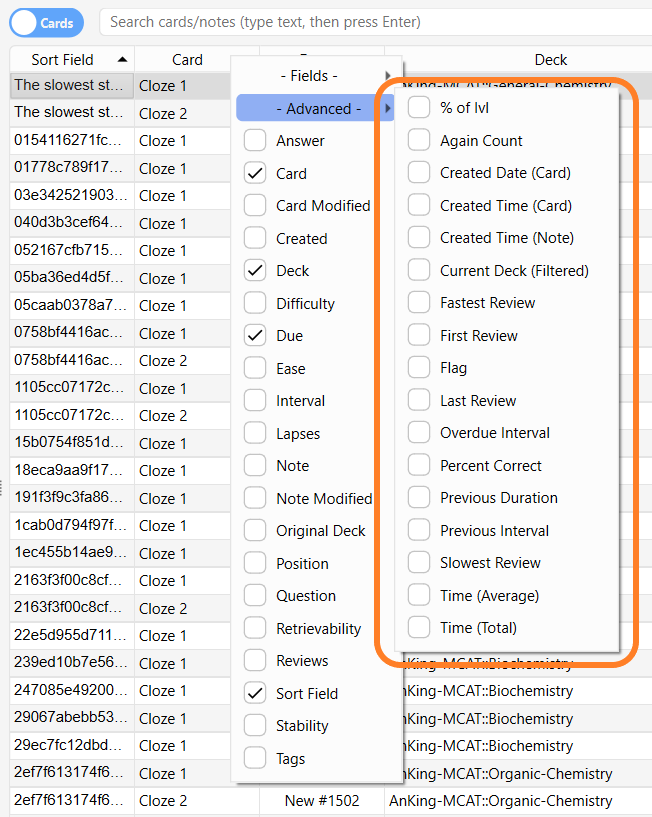
Advanced Browser - Adds filters and columns to search by tag, interval, lapses, etc. Enables powerful search/filter of MCAT decks to target weak content areas.
-
AnKing Overhaul / Hierarchical Tags - Transforms the tag sidebar into a clear, expandable tree with nested tag folders (e.g., Biology::Metabolism::Glycolysis). Organizes massive MCAT decks into clean, searchable sections (by topic and source).
-
Speed Focus Mode - Forces you to answer quickly by setting a time limit per card, preventing “learning” the card instead of actively recalling the answer.
-
Cloze Overlapper - Automatically generates overlapping cloze cards from a single list. Excellent for sequential info like memorizing steps in metabolic pathways (e.g., Glycolysis, TCA Cycle), hormone cascades, or classification hierarchies in order.
Pro Tip: Always update to the latest version before installing add-ons.
Anki Decks: Premade Vs. Self-Made Cards
Anki premade decks offer convenience and time savings, providing comprehensive coverage of high-yield MCAT topics created by experienced students.
Decks like MileDown, Jack Sparrow, and AnKing MCAT already include high-yield AAMC-aligned facts, and thousands of students have refined these cards, so you know that the decks are credible.
Premade MCAT Anki decks are great for beginners, in that you can start reviewing immediately without content-creation lag.
On the other hand, making your own decks promotes deeper learning. You can customize cards to your unique understanding and focus on personal weak areas.
Creating your own Anki cards forces you to process and rephrase content, strengthening comprehension through active engagement.
On the downside, it takes practice to write good Anki cards (unambiguous, minimal information, context-rich). Creating thousands of high-quality cards takes an enormous amount of time, which can pull focus away from actually learning the core material.
Your early cards will very likely be poorly structured, leading to wasted review time later. Also, it’s very easy to overbuild and burn out in the process.
Premade decks are often the preferred option.
Better yet, you can use a hybrid approach whereby you use premade decks for core facts (P/S terms, amino acids, pathways) and make your own cards only for things you miss - especially from AAMC practice questions and UWorld explanations.
The Hybrid Deck Strategy
Primary Deck (Premade): Use a high-quality, comprehensive deck for 80-90% of your foundational review. These decks are pre-vetted and save hundreds of hours of card-making time.
Secondary Deck (Personalized): Create a separate, small deck containing cards only for:
-
Concepts missed during practice questions and full-length exams.
-
Specific, complex diagrams from your review books (using Image Occlusion).
-
Personalized mnemonics or difficult concepts you struggle to grasp.
Combining both approaches can optimize your MCAT preparation by maximizing retention while saving time.
How to Make High-Quality MCAT Anki Cards
When making your own Anki cards as a supplement to the premade decks, here are the key points you need to keep in mind to maximize retention and efficiency in your MCAT prep:
- Keep Cards Extremely Simple
A single flashcard should test only one fact, idea, concept, or piece of information. Don’t combine multiple concepts.
Break down complex ideas (like a metabolic pathway) into 5-10 interconnected, atomic cards, rather than one giant card.
- Use Clear, Active-Recall Questions
Phrase cards as questions rather than statements, and ask the questions the way the MCAT tests them: “What happens to R state hemoglobin affinity when pH drops?”
Ensure your cards test application, not just definition. Focus on why and how, not just what.
- Make Cards Testable, Not Memorized
Avoid trivia - create cards that help with reasoning, not just regurgitation.
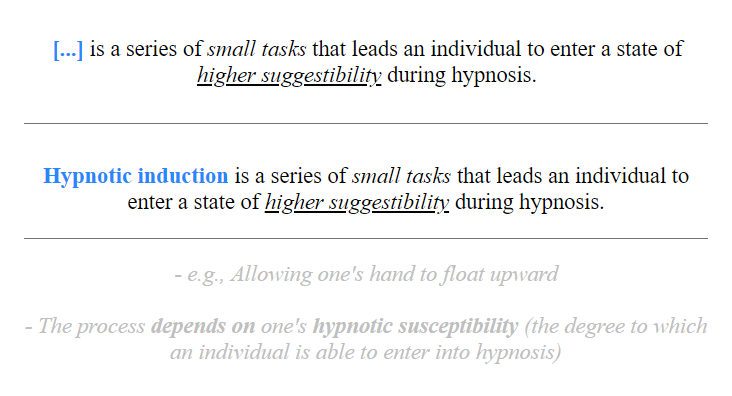
Use the “Question” field to ask about the relationship between variables (e.g., “In Boyle’s Law, what happens to volume when pressure is doubled at constant temperature?” “What does increasing Km indicate about enzyme affinity?”)
- Avoid Copy-Pasting Passages
Summarize explanations into your own words - this forces deeper understanding. Aim for 1–2 lines. If your answer is a paragraph, split the card.
Anki is for Recall, Not Storage. Your review card should be a test of knowledge, not a repository of all related information. Use the “Extra” field on the card template for external context, diagrams, or memory aids, keeping the answer simple.
- Focus on Your Weak Areas
Only make cards for things you consistently miss.
- Include Useful Figures but Don’t Overload
Incorporate images, diagrams, and mnemonics to reinforce complex science topics. Use Image Occlusion only for complex diagrams that truly matter, such as the full Krebs Cycle or Glycolysis.
Add context cards (mini clinical vignettes) for reasoning. This forces spatial and sequential recall, which is a high-yield testing style on the MCAT.
- The Power of Tagging & Filtering
Do not rely on the main deck structure for organization. Use source tags, topic tags, and difficulty tags to filter and focus your study.
This way, you can create a filtered deck to review only your “Hard” cards on “Amino Acids” before taking a topical quiz.
Most Common Anki Mistakes MCAT Students Make
Mistake 1: Adding too many new cards too fast
If you add 100 new cards today, they will all require reviews tomorrow, and then the day after, and so on. This creates an unsustainable “wave” of reviews, leading to overwhelming backlogs and forced inconsistency.
Fix: Set a realistic daily new card limit to cap your daily exposure. A common starting point for intensive studying is 50-75 new cards per day. Lower this number if your overall review time consistently exceeds 90 minutes.
If your reviews are too high, use the Load Balancer add-on to distribute cards more evenly across the week.
Mistake 2: Using Anki for Content Review (Passive Learning)
The biggest failure is trying to use Anki to learn a topic for the first time, whereby you read the card and the answer during the review, hoping the information “sticks.”
Fix: Anki is for Retention: First, learn the content (read a chapter, watch a video). Then, use Anki to move that content from short-term to long-term memory.
Mistake 3: Making cards that are too long
Paragraph-length answers overwhelm you and slow reviews. Avoid creating “compound cards” that test multiple independent facts, often resulting in a long, difficult answer.
Fix: One Fact Per Card. Separate concepts to ensure efficient, targeted studying.
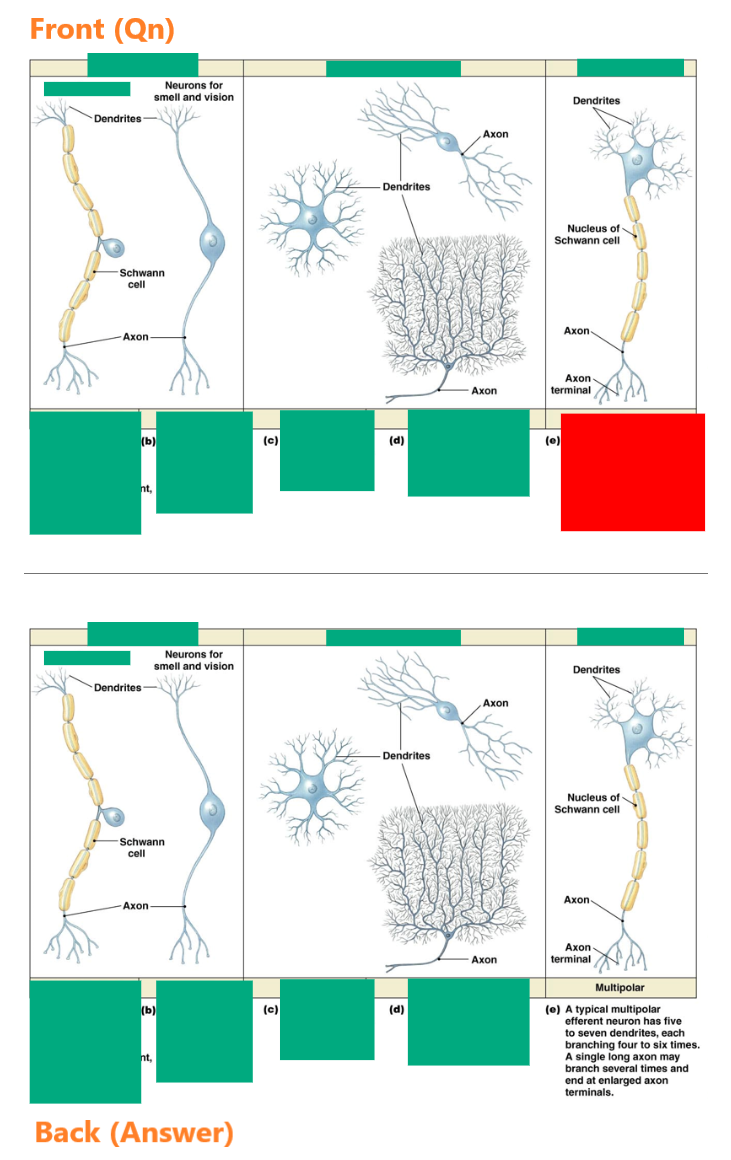
If you forget the role of intermediate filaments but remember microtubules and microfilaments, you still have to press “Again” and unnecessarily reset the interval for the other two facts you knew.
Mistake 4: Skipping reviews
Anki relies on consistent, timely exposure (spaced repetition). Don’t skip reviews for 1-2 days and then try to clear a massive backlog.
Spaced repetition relies on precise timing; missing a day messes up the optimal scheduling, making the reviews less effective.
Fix: Study Every Day. Make Anki a non-negotiable part of your routine (even 30 minutes on a busy day is better than zero).
Use the Review Heatmap add-on to visualize your consistency and stay motivated.
Mistake 5: Using premade decks passively
You must still engage with the premade deck: edit, delete, suspend, and tag cards to fit your study style. Make an attempt to engage with the source material.
Fix: Treat the premade cards as a framework. As you review a card, pause to recall its original context (e.g., “Where did I learn about the Na+/K+ pump?”). Add your own mnemonics or notes to the card.
Mistake 6: Not Suspending Low-Yield Cards
Avoid keeping every card active, even ones that cover irrelevant, overly specific, or redundant information that won’t be tested. This bloats your review queue.
Fix: Be ruthless with the suspend button when reviewing pre-made decks. If a card is too obscure, confusing, or simply not high-yield for your specific exam, suspend it.
Focus your limited time on the 80% of content that yields 90% of the points. You can always unsuspend the card later.
Optimizing Anki As An Efficient MCAT Study Tool
To make Anki truly work for MCAT prep, you must focus on efficiency, consistency, and high-yield mastery.
Here are a few strategies you should apply:
-
Start by customizing a single high-quality premade deck (like MileDown or AnKing MCAT) and aggressively suspend irrelevant cards. Place emphasis on high-yield MCAT topics and your personal weak areas.
-
Use spaced repetition settings tailored for your retention pace, avoiding burnout.
-
Consistently review cards daily to reinforce long-term memory and prevent card backlog. Set a realistic, sustainable daily goal and finish all due reviews every day, even on light or rest days.
-
Prioritize reviews before new cards, and avoid adding more new cards than you can handle long-term.
-
Add new cards only for missed UWorld/AAMC questions, not for every detail you encounter.
-
Integrate multimedia (images, diagrams) to reinforce complex science concepts.
-
Regularly refine cards by simplifying questions and removing redundancy. Keep cards short, specific, and tied to AAMC-style thinking.
-
Sync Anki across devices for flexible study sessions anytime, anywhere.
-
Combine Anki with full-length practice tests for application and contextual learning.
These tactics maximize Anki’s power to master MCAT content effectively and sustainably. With the right workflow, Anki becomes the most powerful system for turning MCAT content into reliable, test-ready recall.
Establishing Daily Anki Discipline
Daily Anki discipline is the foundation of MCAT success. Because Anki’s spaced-repetition algorithm depends on consistency, even missing one day can cause your review load to spike.
As such, Anki’s effectiveness is limited by your consistency and rating honesty.
Over time, this routine builds strong recall, minimizes forgetting, and transforms Anki into your most reliable MCAT study habit.
- The Dedicated Anki Slot
Set aside two non-negotiable review times each day to break up the cognitive load and prevent burnout:
Morning Session (High Yield): Focus on all reviews and the first half of new cards. Doing this early when your mind is fresh maximizes retention.
Evening Session (Low Focus): Complete the rest of the new cards. This is a good time for content that is slightly less challenging or requires less synthesis.
You may want to schedule a “no new cards” week once a month to catch up on reviews. Additionally, reduce new cards during full-length exam weeks to about 0–20 new cards/day.
The main takeaway here is: Consistency trumps intensity. Doing 30 minutes of Anki reviews every day is far more effective than trying to clear a five-hour backlog once a week.
Remember to sync after every study session, in order to protect your data across your devices.
- Rate Cards Honestly & Accurately
Your rating dictates Anki’s scheduling algorithm. Poor self-assessment ruins the spacing in that if you lie to Anki, it can’t schedule your knowledge correctly.
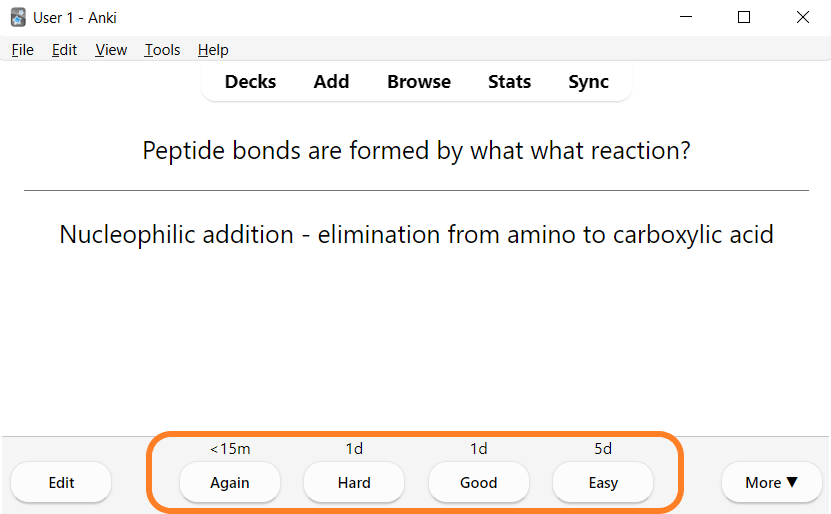
Button | When to Press | The Consequence of Misuse |
|---|---|---|
Again | If you could not recall the answer, or had to recall it slowly and haltingly. | If pressed when you knew the answer, you waste time seeing the card too soon. |
Hard | If you recalled the answer, but only with significant effort and doubt. | If pressed for an easy card, you waste time seeing it too soon. |
Good | If you recalled the answer quickly, easily, and confidently. | If pressed for a hard card, you will likely forget it before the next long interval. |
Easy | If the card is trivial, simple, and you are 100% sure you will never forget it. | Use this sparingly for MCAT content. Most concepts are complex enough to require testing. |
How To Review Full-Length Exams Using Anki
Full-length exams are your closest simulation of real MCAT thinking. Every mistake should become a targeted Anki card so the concept never slips again.
After every full-length exam or question bank session:
- Create a Single Card per Mistake
Immediately create a card for every missed concept, but do not just write the question you missed. Create a highly specific, atomic card (one fact per card) that tests the knowledge gap.
Extract the core concept, not the verbatim question.
Example: If you missed a calculation involving the Nernst potential, the card should ask: “What is the Nernst equation for a monovalent ion at body temperature?” (Answer: E = 61.5 mV/z ✕ log (Cout/Cin)).
Summarize the question, the correct answer, and a brief explanation. Include diagrams or mnemonics if relevant.
- Add a Mini ‘***Why I Missed It*****’ Note**
In the Extra field, include a note on why you got the question wrong. This improves metacognition and prevents repeat errors.
Example: “Misread graph; forgot that V**max is unchanged in competitive inhibition.”
“Confused A Vs. B due to [specific reasoning].”
- Tag Immediately
Tags let you filter, search, and create custom study sessions where you can review and target weaknesses.
This is crucial for segmentation, as it lets you later review:
-
All your MCAT reasoning errors.
-
All your knowledge gaps.
-
A specific exam’s mistakes.
For easy filtering and review, tag the new card with:
-
The source of the question.
-
The reason behind the mistake.
Example: Use a tag structure like: AAMC_FL1_ChemPhys_Q42, FL2_ContentGap, FL3_ReasoningError, UWorld-Chem_Q145
- Isolate the Missed Cards with a Filtered Deck
Once you have created cards for all your mistakes, you need to study them intensely before they get buried in your main review queue.
-
Create a Filtered Deck: Go to Anki’s menu and select Tools > Create Filtered Deck (or Custom Study on some versions).
-
Set the Search Query: Use a search query to pull only the relevant, newly created cards: Tag : FL-2 is : due OR is : new
- Immediate & Focused Review
These are your highest-yield cards because they directly reflect AAMC logic. Treat them as top-priority even over premade deck cards.
-
Work the Filtered Deck: Complete this filtered deck immediately after creating it, and again the next day. This ensures the missed concept starts its spaced repetition cycle immediately, maximizing the impact of your recent review session.
-
Study Before the Next Test: This specialized deck allows you to review only the concepts you failed before you take the next practice exam. This directly reinforces your weak points and prevents repeated mistakes.
Turning missed questions into Anki cards ensures that your study time is spent efficiently addressing your personal knowledge gaps. This is the fastest way to increase your MCAT score, by turning every mistake into a concrete opportunity for long-term learning.
How To Review CARS Using Anki
When it comes to CARS, the key is to use Anki not to memorize content, but to memorize strategies, error patterns, and metacognitive steps. For comprehensive CARS strategies beyond Anki, see our guide on how to study for MCAT CARS.
Your CARS Anki deck should be low-volume and contain only cards generated from the AAMC material (official Q-banks and full-length exams). Do not mix these cards with your high-volume science deck.
How to create CARS Anki cards:
- Use cloze deletions for keywords and logic cues.
Quiz yourself on high-level words used to describe argument structure, tone, or the author’s attitude.
Example: “‘Define the author’s tone if the text is ‘Incredulous’.”
- Build cards for question patterns you consistently struggle with.
Make cards for reasoning patterns, not passage content.
Example: “When a question asks for ‘main idea,’ what’s the reasoning sequence?”
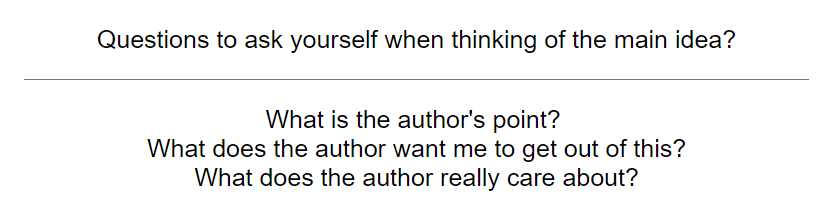
- Reinforce the timing and reading techniques that help you maximize efficiency.
Example: “What is my three-minute drill for starting any CARS passage?”
- Highlight wrong answer traps.
Example: “Extreme language = usually wrong.”
When To Stop Adding New MCAT Anki Cards
Knowing when to stop adding new cards is just as important as knowing what to add.
Stop adding new Anki MCAT cards when you are close to your exam date, and your review backlog is manageable - typically 2-4 weeks before test day.
This final period must be dedicated to:
-
High-Volume Review: Clearing any backlogs and ensuring all existing cards are mature and spaced out.
-
Practice Exams: Taking and reviewing 2-3 full-length exams (FLs) per week.
-
Mistake Remediation: The only new cards you create during this time should be based on critical mistakes from AAMC FL 4 and 5, or high-yield formulas or concepts you continually forget.
At this stage, focus shifts from learning new material to solidifying retention and mastering existing cards. Prioritize reviewing and refining your current deck, especially high-yield and previously missed concepts, to maximize retention and test readiness.
Optimizing Your Anki Settings For MCAT Study
Anki’s default settings aren’t ideal for the MCAT’s massive content load, but the settings that matter changed when Anki introduced the FSRS scheduler.
The interval settings this guide previously recommended (graduating interval, easy interval, and ease factor tuning) belonged to the older SM-2 algorithm. Anki hides them entirely once FSRS is switched on, so changing them no longer affects your scheduling. The old advice to use learning steps of 15m 1d 3d is now explicitly discouraged, because steps of a day or longer keep cards out of FSRS’s hands.
The short version for a current Anki install:
- Turn FSRS on. It is still off by default. Deck Options, FSRS section, then click Optimize.
- Desired retention 0.90. This replaces most of the old interval dials.
- Learning and relearning steps 10m. Nothing measured in days.
- New cards/day 20 to 30. Anki’s own manual puts 20 new cards at roughly 200 daily reviews.
- Maximum reviews/day 9999. Never cap reviews; lower new cards instead.
For the full setup, the workload arithmetic behind those numbers, and the settings that no longer do anything, see our best Anki settings for the MCAT guide.
Common Anki Challenges (And What To Do)
- “***I’m overwhelmed by 5,000+ cards - help!*”**
Why it happens: Too many decks, importing everything, or a build-up of daily review backlogs.
Fixes:
-
Focus on one core premade deck (e.g., Milesdown/AnKing).
-
Suspend 50-80% of low-yield or irrelevant cards.
-
Cap new cards at 20-40/day.
-
Do NOT unsuspend everything at once.
- “***My reviews are taking too long.*”**
Why it happens: Too many cards/day, cards are too wordy, or you’re rereading instead of recalling.
Fixes:
-
Aim for 5–10 seconds per card and use strict timers.
-
Fix your card design (use cloze deletions + break big cards).
-
Clear reviews first, then new cards if time allows.
-
Reduce new cards/day to 10–20 if reviews exceed ~300.
- “***My retention is bad - why?*”**
Why it happens: You’re clicking “Good” without true recall, cards test memorization instead of understanding, or intervals are too long for tough content.
Fixes:
-
Optimize Anki settings: Lapses 6 days, Max interval 30 days.
-
Add mnemonics, images, or contextual examples for tough topics.
-
Test yourself harder: employ active recall by explaining the concept out loud - no guessing.
-
Break complex cards into simpler clozes.
- “***New cards feel good. Reviews feel painful.*”**
Why it happens: You’re chasing novelty instead of reinforcement.
Fixes:
-
Prioritize reviews over new cards ALWAYS.
-
Don’t add new cards until there are 0 overdue.
-
Embrace discomfort - that’s where learning happens.
- “***I keep failing the same card.*”**
Why it happens: The card tests random trivia without context, there’s poor wording, or you don’t truly understand the concept yet.
Fixes:
-
Rewrite the card to focus on the key idea.
-
Add context (diagram, equation, quick definition).
-
Rebuild the card from a new angle (diagram, reasoning, or mnemonic).
-
Connect to AAMC/UWorld examples.
-
Tag as “trouble card” and review separately.
Rewrite confusing cards; don’t brute-force.
- “***I struggle with creating high-quality cards.*”**
Why it happens: Trying to include too much info, copying notes directly, or not knowing what the MCAT actually tests.
Fixes:
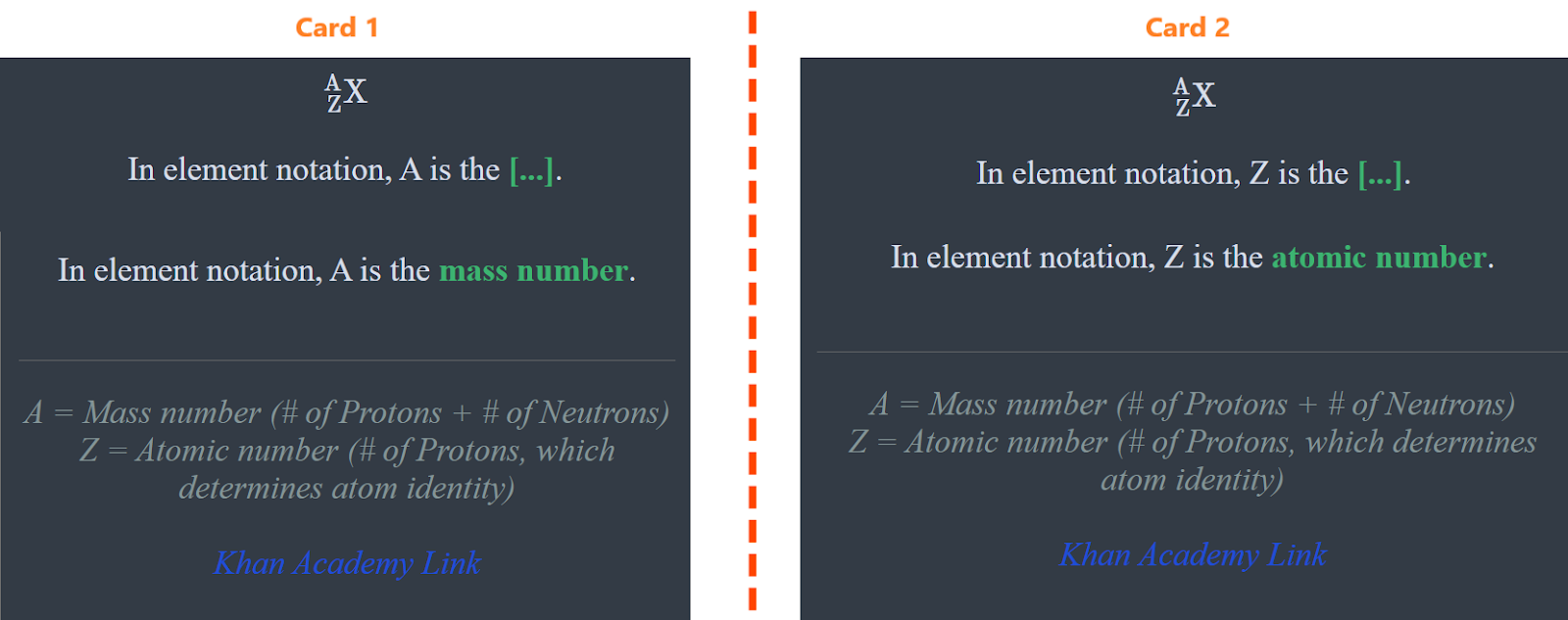
- Follow 1 fact = 1 card (atomic learning).
-
Use cloze deletions, not paragraphs.
-
Prioritize AAMC-style recall (definitions, pathways, equations).
-
Add only brief context, if needed for understanding.
Great MCAT Anki cards are short, specific, and test what actually shows up.
Pro Tip: When it comes to Anki, consistency matters more than volume. Anki is not about finishing decks. It’s about retaining what gets you points on the MCAT.
How To Identify Over-Memorization Vs. Under-Practice
Many MCAT students tend to stall because they’re great at Anki but bad at the exam. This happens when memorization is high, but real MCAT practice is low.
Differentiating between over-memorization (shallow knowledge) and under-practice (lack of application) is the key to moving past a score plateau on the MCAT.
Anki is designed to test recall, but the MCAT tests application, analysis, and synthesis. Your diagnosis dictates whether you need to change your Anki card type or your study activity ratio (Anki vs. Practice).
Here’s how to tell which problem you’re dealing with, and how to fix it.
Over-Memorization (Shallow Knowledge)
Over-memorization occurs when you focus heavily on memorizing facts without applying them or practicing with full-length exams, leading to strong recall but weak problem-solving skills.
This results in a scenario whereby you are efficient at reviewing Anki cards but cannot apply that isolated knowledge to a complex, multi-step scenario.
Signs of over-memorization include:
- You know every Anki card cold, but miss questions in Full-Length tests/UWorld.
You can recall facts, but struggle with applying them in passages or experiments.
- You panic in new situations.
If you memorize isolated facts but can’t reason through new scenarios, your knowledge is static, not usable.
- You rely heavily on definitions.
You have P/S definitions, amino acids, and equations all perfectly memorized, but you still get concept questions wrong because you are memorizing words instead of relationships and function.
- Your Anki deck keeps growing, but your practice scores stay flat.
You’ve reached diminishing returns. More cards aren’t translating to points.
- You rarely annotate or deeply review explanations.
Over-memorizers often skip the reasoning behind right/wrong answers.
- Difficulty with Calculation Setups.
For physics or chemistry, you can recall the formula (e.g., V=IR) but struggle to choose the correct variables from a long, confusing passage.
Fixes For Over-Memorization
- Convert Definition Cards to Application Cards:
Bad Card: “What is the function of the Na+/K+ pump?” (Pumps 3 Na+ out, 2 K+ in).
Good Card: “If the Na+/K+ pump is inhibited, what happens to the cell volume and membrane potential in the short term?”
Stop adding new cards. Instead, refine your existing cards to force synthesis, and suspend overly detailed cards.
- Focus on “Why” and “How”:
When creating cards, ask questions that require reasoning, not just identification.
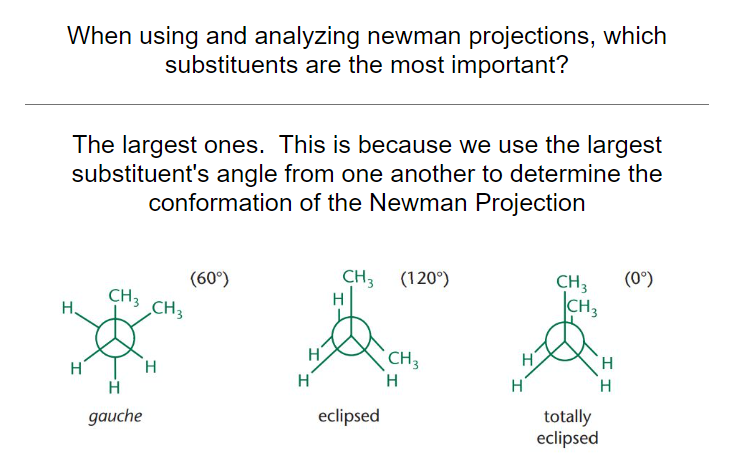
Instead of: “What is a competitive inhibitor?”
Ask: “In the presence of a competitive inhibitor, what is the effect on K**m and Vmax?”
- Use Image Occlusion for Pathways:
Force yourself to recall the sequence, inputs, and outputs of complex diagrams (e.g., the electron transport chain) without surrounding text cues.
Under-Practice (Lack of Application)
Under-practice happens when you skip practice tests or avoid timed drills, resulting in poor time management and test-day anxiety.
In such a scenario, you have the foundational knowledge, but you haven’t given your brain enough experience applying that knowledge under time pressure or switching between contexts rapidly.
Signs of under-practice include:
- You struggle with passage interpretation.
If the passages feel confusing or slow, you need more exposure to MCAT-style logic and scientific reasoning, which Anki cannot provide.
- You miss experimental logic questions.
The MCAT is experiment-heavy. If you struggle with control variables, interpreting graphs, enzyme kinetics, or research setups, you need more AAMC/UWorld exposure.
- You improve in isolated topics but not in overall section scores.
This means you’re learning facts, but not MCAT reasoning.
- Your timing is inconsistent.
Timing can’t be learned with Anki. Only practice builds natural pacing.
- You hesitate when two answer choices seem correct.
This improves with question exposure, not flashcards.
- ”I Knew That!” Frustration.
You review a practice question you missed and immediately realize the answer once the explanation is shown.
Fixes for Under-Practice
- Shift Your Activity Ratio:
Dedicate less time to pure Anki review and increase time on practice material. Aim for 30–60 practice questions per day.
Ideal Ratio: During the last 6-8 weeks, the ratio should be approximately 30-40% Anki Review / 60-70% Practice & Review. Do weekly full-length exams in the final phase of your MCAT prep. If you’re on a tight timeline, see our 1-month MCAT study schedule for guidance on balancing Anki with practice.
Practice reading graphs, tables, and experimental setups.
- Implement Mistake-Based Learning Discipline:
Review explanations deeply, then turn every missed question into a small, targeted Anki card that addresses the specific gap exposed by the question.
- Use Filtered Decks to Emulate Interleaving:
Create a filtered deck that mixes several distinct topics you’re currently studying (e.g., tag : Endocrinology OR tag : Electrochemistry OR tag : Kinematics).
Reviewing these mixed concepts helps train your brain to quickly change cognitive gears, mitigating the context-switching failure experienced on full-length practice exams.
In a nutshell,
-
If your mistakes are factual gaps → under-memorization / knowledge gaps.
-
If your mistakes are reasoning-based → under-practice / application failure.
-
If your cards are detailed but your scores stay flat → over-memorization
How To Measure Anki Mastery
True mastery isn’t finishing all your Anki cards - it’s confirming that your knowledge survives outside Anki.
Signs you’re mastering content include:
-
You can recall 90%+ of cards effortlessly over long time intervals.
-
Reviews feel fast (5–10 sec per card).
-
You can confidently explain answers and reasoning aloud, without reading the card.
-
You apply the facts correctly in MCAT-style questions.
-
You rarely mark cards “Again” once they’ve graduated.
-
You can recall concepts without hesitation and are able to context-switch fluidly under time pressure.
Final Thoughts
The MCAT doesn’t reward who studies the most - it rewards who remembers the most.
Anki ensures that you never forget what you’ve learned. Used properly, this powerful MCAT memory tool trains your brain into becoming a memory retrieval machine that supports reasoning, synthesis, and confidence under pressure.
Ideally, you don’t study with Anki. You actually train your brain through Anki. Every click teaches your hippocampus how to prioritize MCAT information.
Just stay consistent, follow the structure, and let Anki’s algorithm do the heavy lifting, while you climb to a 520+.
Written by
Dr. Sarah Johnson
Last updated 1/15/2026