MCAT Biochemistry: What Is Tested and How to Study It
By MCAT Study Planner Team • Updated 9/28/2026
Short answer: biochemistry is 25 percent of the Bio/Biochem section and another 25 percent of the Chem/Phys section, which works out to about 30 questions on a test form. That is one sixth of every science question on the MCAT, and more than physics and organic chemistry put together.
Almost every page ranking for this search treats “MCAT biochemistry” and “the Bio/Biochem section” as the same thing. They are not. The AAMC publishes a first-semester biochemistry target of 25 percent for two different sections, and only one of them has biochem in the name.
Count it once and biochemistry looks like a quarter of one section. Count it twice, the way the AAMC actually publishes it, and it becomes the second-largest science discipline on the exam.
The 30-second answer: 25 percent of Bio/Biochem plus 25 percent of Chem/Phys equals 29.5 questions on a 230-question exam, by our arithmetic on the AAMC’s published percentages read September 28, 2026. Study content categories 1A and 1D first: they are the only two of the AAMC’s 19 categories where every topic heading is tagged first-semester biochemistry. Give it one sixth of your content-review window, which is 14 days on a 24-week plan and 2 days on an 8-week one. Then stop memorizing, because only 35 percent of either section is knowledge.
In this guide
- Biochemistry is 25 percent of two different sections
- What that works out to in questions
- Where the biochemistry actually sits in the outline
- Four topics are on the list twice
- Only 35 percent of the section is knowledge
- How long a biochemistry block should be
- The order to study it in
- What the ranking pages get wrong
- Every number on one page
Biochemistry Is 25 Percent of Two Different Sections
We read all four section overview pages on students-residents.aamc.org on September 28, 2026. Here is what the AAMC publishes for each one.
| Section | Questions | Time | First-semester biochemistry |
|---|---|---|---|
| Biological and Biochemical Foundations of Living Systems | 59 | 95 minutes | 25 percent |
| Chemical and Physical Foundations of Biological Systems | 59 | 95 minutes | 25 percent |
| Psychological, Social, and Biological Foundations of Behavior | 59 | 95 minutes | none listed |
| Critical Analysis and Reasoning Skills | 53 | 90 minutes | no science content |
The rest of the Bio/Biochem split is introductory biology at 65 percent, general chemistry at 5 percent and organic chemistry at 5 percent. The rest of the Chem/Phys split is general chemistry at 30 percent, introductory physics at 25 percent, organic chemistry at 15 percent and introductory biology at 5 percent.
That second row is the one nobody reads. Chem/Phys is the section students think of as physics and gen chem, and it carries exactly as much biochemistry as the section named after it.
One caveat the AAMC prints under every one of those tables, and which applies to every number in this guide: “These percentages have been approximated to the nearest 5% and will vary from one test to another for a variety of reasons. These reasons include, but are not limited to, controlling for question difficulty, using groups of questions that depend on a single passage, and using unscored field-test questions on each test form.”
So these are the shape of a test form, not a promise about yours.
What That Works Out to in Questions
Percentages are hard to budget against. Questions are not. Multiply each published percentage by its section’s question count and add across sections, and the seven disciplines rank like this. This is our arithmetic on the AAMC’s numbers, under the caveat above.
| Discipline | Questions on a form | Share of the 177 science questions | Where it comes from |
|---|---|---|---|
| Introductory biology | 44.25 | 25.00 percent | 65 percent of B/B, 5 percent of C/P, 5 percent of P/S |
| Introductory psychology | 38.35 | 21.67 percent | 65 percent of P/S |
| First-semester biochemistry | 29.50 | 16.67 percent | 25 percent of B/B, 25 percent of C/P |
| General chemistry | 20.65 | 11.67 percent | 5 percent of B/B, 30 percent of C/P |
| Introductory sociology | 17.70 | 10.00 percent | 30 percent of P/S |
| Introductory physics | 14.75 | 8.33 percent | 25 percent of C/P |
| Organic chemistry | 11.80 | 6.67 percent | 5 percent of B/B, 15 percent of C/P |
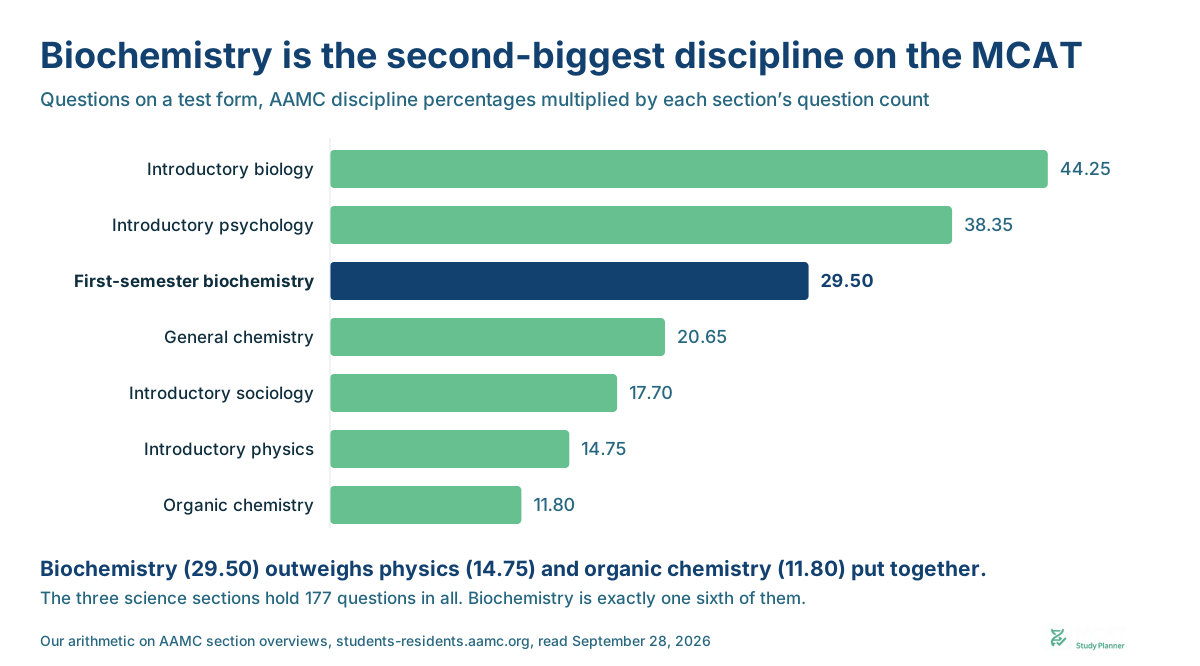
Three things fall out of that table.
Biochemistry at 29.50 beats introductory physics at 14.75 and organic chemistry at 11.80 combined, which come to 26.55. If you have been giving orgo and physics their own study weeks and slotting biochem in beside biology, the budget is upside down.
The orgo row is the one worth reading twice. At 11.80 questions it is the smallest discipline on the exam, and our guide to how much organic chemistry is on the MCAT counts the AAMC tags behind it: 9 of the 15 OC-tagged topic headings also carry the BC tag, so most of the orgo you need arrives inside the biochemistry block you are already planning.
The share works out to 16.67 percent of the 177 science questions, which is one sixth exactly. That is not an approximation we rounded to. It falls straight out of the AAMC’s published percentages, and it is the cleanest planning number in this guide.
Against all 230 questions on the exam, CARS included, biochemistry is 12.8 percent. Our section-by-section MCAT timing guide has the full question and minute counts if you want the denominators.
Where the Biochemistry Actually Sits in the Outline
The AAMC does something useful that almost nobody uses. Every topic heading in its content outline carries a tag for the course it is normally learned in. In the AAMC’s words: “The abbreviations found in parentheses indicate the course(s) in which undergraduate students at many colleges and universities learn about the topics and associated subtopics.” And the key defines BC as first-semester biochemistry.
So the outline itself says where the biochemistry is. We read all 19 content-category pages on September 28, 2026 and counted. Of the 104 topic headings, 30 carry the BC tag, and they are heavily clustered.
| Category | What it covers | Topic headings tagged BC |
|---|---|---|
| 1D | Principles of bioenergetics and fuel molecule metabolism | 8 of 8 |
| 1A | Structure and function of proteins and their constituent amino acids | 5 of 5 |
| 5D | Structure, function and reactivity of biologically relevant molecules | 7 of 12 |
| 3A | Structure and function of the nervous and endocrine systems | 2 of 7 |
| 5A | Unique nature of water and its solutions | 2 of 4 |
| 5E | Chemical thermodynamics and kinetics | 2 of 3 |
| 1B | Transmission of genetic information from gene to protein | 1 of 10 |
| 2A | Assemblies of molecules and cells, including the plasma membrane | 1 of 4 |
| 2C | Cell division, differentiation and specialization | 1 of 5 |
| 5C | Separation and purification methods | 1 of 1 |
| 1C, 2B, 3B, 4A to 4E, 5B | Genetics, prokaryotes and viruses, organ systems, the five categories under Foundational Concept 4, covalent bonding | 0 of 45 |
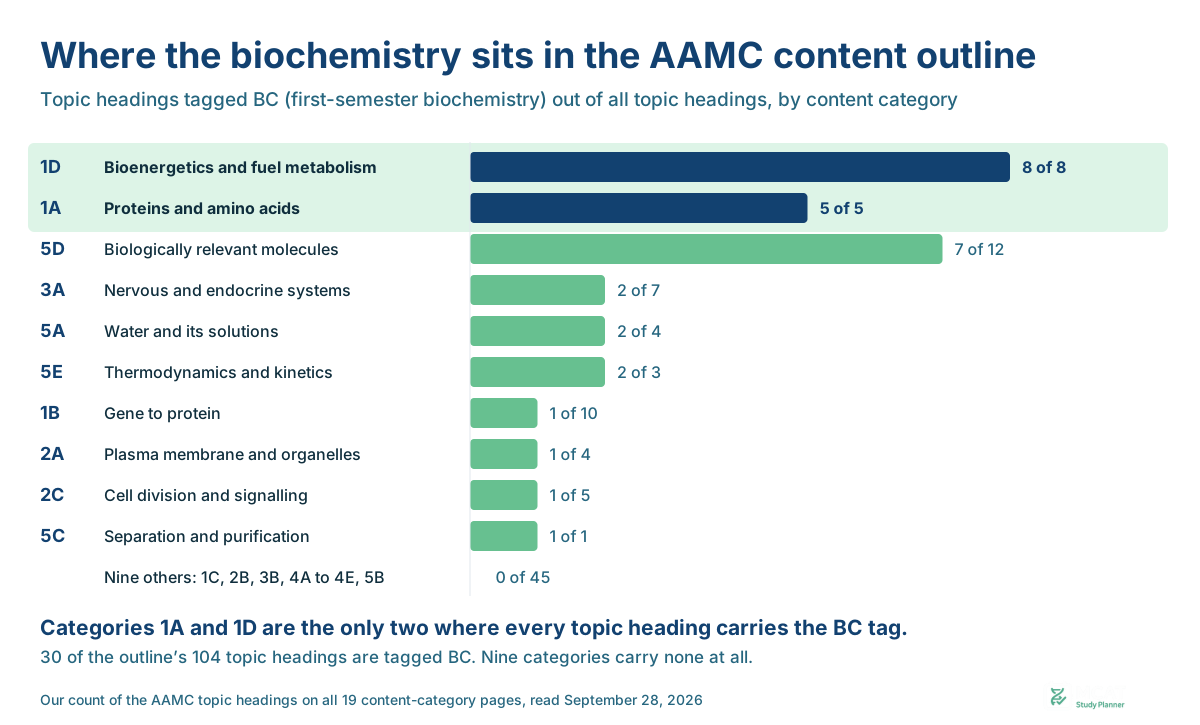
Read the top two rows and the bottom one together. Thirteen of the 30 tagged headings sit in just two categories, both of them 100 percent biochemistry. Nine categories carry none at all, and that group includes all five categories under Foundational Concept 4 and all eleven organ-system headings in 3B.
One limit worth stating plainly. The AAMC publishes percentages down to the Foundational Concept level and no further, so this is a count of tagged topic headings, not a count of questions. It tells you where the biochemistry lives in the syllabus. It does not tell you that category 1D is worth eight questions.
Four Topics Are on the List Twice
Four of those 30 headings appear under two different content categories, once in each section. Non-Enzymatic Protein Function is in 1A and again in 5D. Principles of Bioenergetics is in 1D and again in 5E. Biosignalling is in 2C and again in 3A. Lipids is in 3A and again in 5D. That leaves 26 distinct topic names across 30 listings.
The AAMC is explicit about what a repeat means: “Please note topics that appear on multiple content lists will be treated differently. Questions will focus on the topics as they are described in the narrative for the content category.”
In practice that is a warning against learning a topic once. Bioenergetics in category 1D is written as fuel metabolism and regulated pathways. The same heading in 5E sits under chemical thermodynamics and kinetics. Same free energy, two framings, two sections.
Do this when you hit a repeat topic: open both content-category pages side by side before you make a single flashcard. The four repeats are bioenergetics, non-enzymatic protein function, biosignalling and lipids. If your notes on any of them only make sense in one section’s framing, they are half-built.
Only 35 Percent of the Section Is Knowledge
Here is the number that decides how you study, not how long.
The AAMC publishes a Scientific Inquiry and Reasoning Skills split alongside every science section, and for both Bio/Biochem and Chem/Phys it is identical: Skill 1, knowledge of scientific concepts and principles, 35 percent. Skill 2, scientific reasoning and problem solving, 45 percent. Skill 3, reasoning about the design and execution of research, 10 percent. Skill 4, data-based statistical reasoning, 10 percent.
| Skill | What it asks for | Share of either section |
|---|---|---|
| Skill 1 | Knowledge of scientific concepts and principles | 35 percent |
| Skill 2 | Scientific reasoning and problem solving | 45 percent |
| Skill 3 | Reasoning about the design and execution of research | 10 percent |
| Skill 4 | Data-based statistical reasoning | 10 percent |
Writing out glycolysis from memory trains Skill 1. That is 35 percent of the questions. The other 65 percent asks you to predict what a pathway does when an enzyme is knocked out, read a Lineweaver-Burk plot off a figure, or decide whether an experiment’s control was adequate.
This is the same weighting we found behind the AAMC skill weighting argument for Psych/Soc, and it holds across all three science sections. The practical version: once you can recite a pathway, stop reviewing it and start doing passages on it.
How Long a Biochemistry Block Should Be
If biochemistry is one sixth of the science content, it gets one sixth of your content-review window. Content review only covers the science sections, so the 177-question denominator is the right one.
Our own published plans set the windows. The 8-week MCAT plan runs content triage on days 3 to 14. The 12-week plan runs content review through day 42. The 16-week plan runs it through week 9, and the 24-week plan through week 12. Divide by six and convert the weekly hour bands at seven days a week.
| Your plan | Content-review days | Biochemistry days | Biochemistry hours |
|---|---|---|---|
| 8 weeks | 12 | 2.0 | 7.1 to 11.4 |
| 12 weeks | 42 | 7.0 | 20.0 to 30.0 |
| 16 weeks | 63 | 10.5 | 22.5 to 37.5 |
| 24 weeks | 84 | 14.0 | 24.0 to 30.0 |
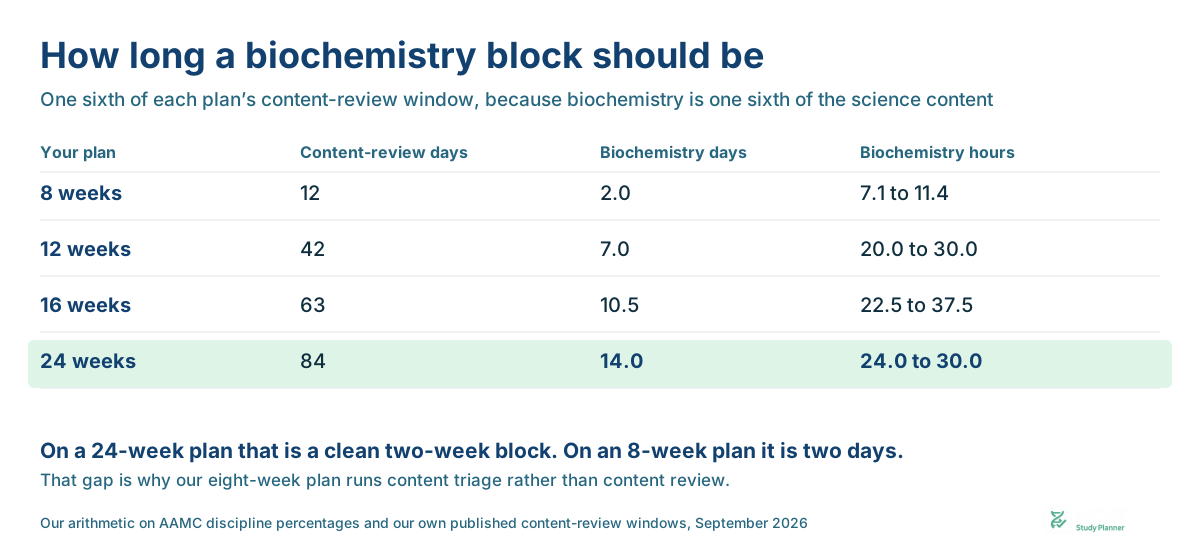
The 24-week row is the clean one: a two-week biochemistry block, 24 to 30 hours, enough to work through 1A and 1D properly and still touch 5D. The 12-week plan lands in the same hour range in half the days, because the weekly hours are higher.
The 8-week row is the warning. Two days and 7 to 11 hours does not cover 26 distinct topics, which is exactly why that plan schedules triage rather than review.
Those are the same two inputs any schedule is built from. Feed your test date and your honest weekly hours into the free MCAT study schedule generator and it lays the content-review window out day by day, so you can put a real two-week block on real dates instead of a rule of thumb.
The Order to Study It In
Rank by where the tags actually cluster, not by what a book’s table of contents happens to put first.
- Category 1A, proteins and amino acids. Five of five headings tagged BC: amino acids, protein structure, non-enzymatic protein function, enzyme structure and function, control of enzyme activity. The AAMC’s own narrative says “Special emphasis is placed on enzyme catalysis, including mechanistic considerations, kinetics, models of enzyme-substrate interaction, and regulation.” Start here because everything else assumes it.
- Category 1D, bioenergetics and fuel metabolism. Eight of eight headings tagged BC, the largest block in the outline: bioenergetics, carbohydrates, glycolysis and gluconeogenesis and the pentose phosphate pathway, metabolic regulation, the citric acid cycle, fatty acid and protein metabolism, oxidative phosphorylation, hormonal integration.
- Category 5D, biologically relevant molecules. Seven of twelve tagged BC, and it is where the Chem/Phys half of your biochemistry mostly lives. Four of its BC headings are 1A and 3A topics seen again from an organic chemistry angle.
- Categories 5A, 5C and 5E. Five tagged headings between them: acid-base equilibria, ions in solution, separations and purifications, enzymes, bioenergetics. Small, but they are why biochemistry shows up in a section people study as gen chem.
- Categories 1B, 2A, 2C and 3A. One or two headings each: nucleic acid structure, the plasma membrane, biosignalling, lipids. Worth a pass, not worth a week.
For the full topic sequence across all subjects, our 10-week content review schedule orders them by yield and slots this block into the rest. If you are turning the 26 distinct topics into flashcards, the best MCAT Anki decks cover the pathway-heavy ones well, and the FSRS setup for MCAT decks keeps the daily load survivable once you add a metabolism deck on top of everything else.
What the Ranking Pages Get Wrong
We read the ranking pages on September 28, 2026. The pattern is consistent.
Sketchy’s overview gives the Bio/Biochem split correctly at 65, 25, 5 and 5, then spends the article on cellular organelles, organ systems and Mendelian genetics. Those are introductory biology topics, and the AAMC tags none of them BC. The Chem/Phys 25 percent never appears.
Shemmassian’s guide is a long topic list plus five study tips, several of them good, including studying metabolism through rate-limiting steps. It publishes no percentage, no question count and no time budget.
Inspira Advantage gets closest. It is the only page that gestures at the second section at all, and it still gives only the Bio/Biochem figure: “About 25% of the 59 questions in this section draw directly on first-semester biochemistry.”
Khan Academy’s result is a video course index. The AAMC’s own page ranks third on this search and is a bare percentage table with no arithmetic on it. Nobody on the first page multiplies a percentage into a question count, and nobody adds the two sections together.
That is the whole gap this guide fills. The data has been published all along.
Every Number on One Page
| Figure | Value | Source |
|---|---|---|
| Biochemistry in Bio/Biochem | 25 percent of 59 questions | AAMC section overview, Sept 28, 2026 |
| Biochemistry in Chem/Phys | 25 percent of 59 questions | AAMC section overview, Sept 28, 2026 |
| Questions on a form | 29.50 | Our arithmetic on the two above |
| Share of the 177 science questions | 16.67 percent, one sixth | Our arithmetic |
| Share of all 230 questions | 12.83 percent | Our arithmetic |
| Rank among the seven disciplines | Third, behind biology and psychology | Our arithmetic |
| Physics plus organic chemistry | 26.55 questions, 2.95 fewer | Our arithmetic |
| Topic headings tagged BC | 30 of 104, across 10 of 19 categories | Our count of the AAMC outline |
| Distinct topic names | 26, with four listed twice | Our count of the AAMC outline |
| Fully biochemistry categories | 1A (5 of 5) and 1D (8 of 8) | Our count of the AAMC outline |
| Knowledge share of either section | Skill 1, 35 percent | AAMC section overviews |
| Block length, 24-week plan | 14 days, 24.0 to 30.0 hours | Our arithmetic |
| Block length, 8-week plan | 2 days, 7.1 to 11.4 hours | Our arithmetic |
Two weeks on a 24-week timeline, ten and a half days on 16 weeks, a week on 12. The MCAT study planner takes your test date, your weekly hours and the resources you already own, and puts that block on actual dates with the practice exams already placed around it. The arithmetic above tells you how big the block is. A calendar tells you when it happens.
Written by
MCAT Study Planner Team
Last updated 9/28/2026