
High Yield MCAT Topics, Ranked by Scored Questions
By MCAT Study Planner Team • Updated 11/10/2026
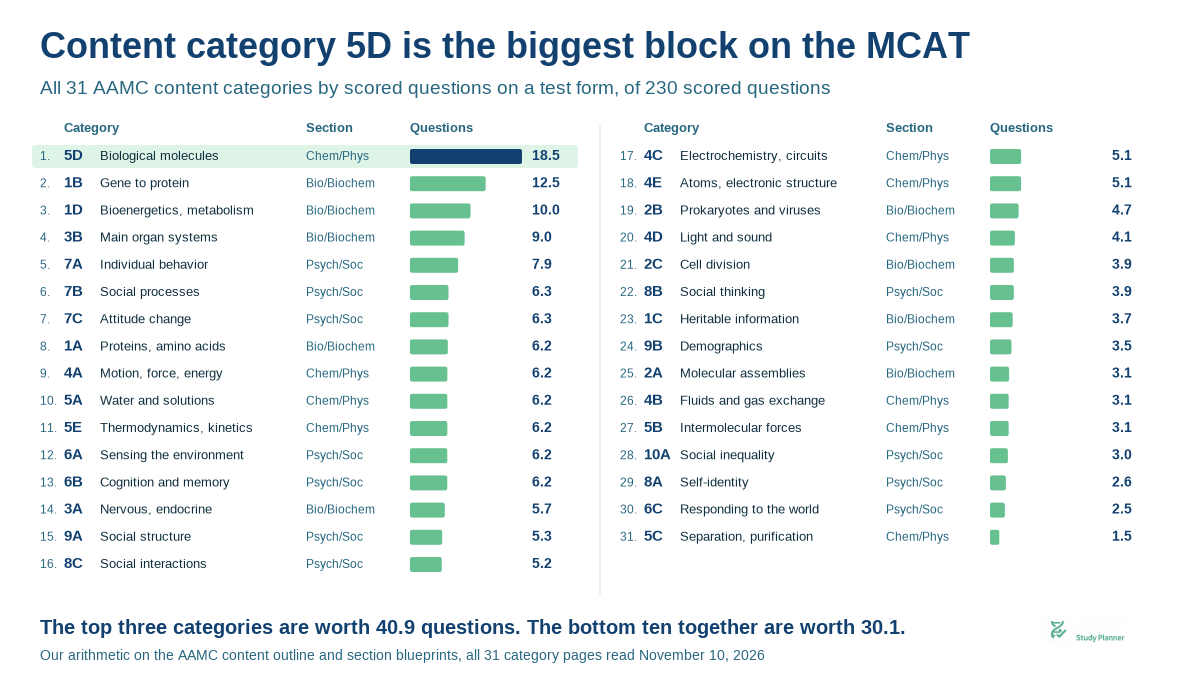
Short answer: the biggest block of content on the MCAT is AAMC content category 5D, worth about 18.5 scored questions on a test form, and it is in the Chemical and Physical Foundations section. That is 8 percent of all 230 questions and 48 percent more than the next category. We fetched all 31 AAMC content category pages and all three section blueprints on November 10, 2026, counted the 148 topic headings, and ranked every category by the questions it is actually worth.
Search for high yield MCAT topics and you get lists. Amino acids, enzyme kinetics, metabolism, the central dogma, acid-base. They are not wrong. They are just unordered, and not one of them tells you what any topic is worth.
There is a reason for that. Every list you have read is organised by school subject: biology, then biochemistry, then general chemistry, then physics. The MCAT is not built that way. It is built out of 31 content categories, and the AAMC publishes how much of each section comes from each group of them. Once you line the categories up against those published weights, the question “what is high yield” stops being an opinion.
The 30-second answer: The three science sections hold 59 questions each, CARS holds 53, and 230 questions are scored. The AAMC publishes what percentage of each section comes from each foundational concept, and the content outline divides those concepts into 31 content categories holding 148 topic headings. Rank the categories and 5D comes first at about 18.5 questions, then 1B at 12.5, 1D at 10.0, 3B at 9.0 and 7A at 7.9. Those five are a quarter of the exam. The bottom ten categories together are worth less than the top three. And the number that should drive your triage is not the total but the density: Foundational Concept 9, the sociology of social structure, buys 1.77 questions per topic heading, against 0.74 for Foundational Concept 10.
In this guide
- All 31 content categories, ranked by questions
- The biggest category on the exam is one nobody names
- How we got these numbers, and how wrong they might be
- Questions per topic studied, the number that decides your triage
- What the ranking pages get wrong
- How many hours each category deserves
- The order to study it in
- Every number on one page
All 31 Content Categories, Ranked by Questions
This is the table the ranking pages do not publish. Every figure is our arithmetic on the AAMC’s own published percentages, which we read on November 10, 2026. The method is in the next section but one, including how far off it might be.
| Rank | Category | What it covers | Section | Headings | Questions | Share of exam |
|---|---|---|---|---|---|---|
| 1 | 5D | Structure, function and reactivity of biologically relevant molecules | Chem/Phys | 12 | 18.5 | 8.0% |
| 2 | 1B | Transmission of genetic information from gene to protein | Bio/Biochem | 10 | 12.5 | 5.4% |
| 3 | 1D | Bioenergetics and fuel molecule metabolism | Bio/Biochem | 8 | 10.0 | 4.3% |
| 4 | 3B | Structure and integrative functions of the main organ systems | Bio/Biochem | 11 | 9.0 | 3.9% |
| 5 | 7A | Individual influences on behavior | Psych/Soc | 5 | 7.9 | 3.5% |
| 6 | 7B | Social processes that influence human behavior | Psych/Soc | 4 | 6.4 | 2.8% |
| 7 | 7C | Attitude and behavior change | Psych/Soc | 4 | 6.4 | 2.8% |
| 8 | 1A | Structure and function of proteins and amino acids | Bio/Biochem | 5 | 6.2 | 2.7% |
| 9 | 4A | Translational motion, forces, work, energy, equilibrium | Chem/Phys | 6 | 6.2 | 2.7% |
| 10 | 5A | Unique nature of water and its solutions | Chem/Phys | 4 | 6.2 | 2.7% |
| 11 | 5E | Chemical thermodynamics and kinetics | Chem/Phys | 4 | 6.2 | 2.7% |
| 12 | 6A | Sensing the environment | Psych/Soc | 5 | 6.2 | 2.7% |
| 13 | 6B | Making sense of the environment | Psych/Soc | 5 | 6.2 | 2.7% |
| 14 | 3A | Nervous and endocrine systems | Bio/Biochem | 7 | 5.7 | 2.5% |
| 15 | 9A | Understanding social structure | Psych/Soc | 3 | 5.3 | 2.3% |
| 16 | 8C | Social interactions | Psych/Soc | 4 | 5.2 | 2.3% |
| 17 | 4C | Electrochemistry and electrical circuits | Chem/Phys | 5 | 5.1 | 2.2% |
| 18 | 4E | Atoms, nuclear decay, electronic structure | Chem/Phys | 5 | 5.1 | 2.2% |
| 19 | 2B | Prokaryotes and viruses | Bio/Biochem | 6 | 4.7 | 2.1% |
| 20 | 4D | How light and sound interact with matter | Chem/Phys | 4 | 4.1 | 1.8% |
| 21 | 2C | Cell division, differentiation and specialization | Bio/Biochem | 5 | 3.9 | 1.7% |
| 22 | 8B | Social thinking | Psych/Soc | 3 | 3.9 | 1.7% |
| 23 | 1C | Heritable information and genetic diversity | Bio/Biochem | 3 | 3.7 | 1.6% |
| 24 | 9B | Demographic characteristics and processes | Psych/Soc | 2 | 3.5 | 1.5% |
| 25 | 2A | Assemblies of molecules, cells and groups of cells | Bio/Biochem | 4 | 3.2 | 1.4% |
| 26 | 4B | Fluids, circulation and gas exchange | Chem/Phys | 3 | 3.1 | 1.3% |
| 27 | 5B | Molecules and intermolecular interactions | Chem/Phys | 2 | 3.1 | 1.3% |
| 28 | 10A | Social inequality | Psych/Soc | 4 | 3.0 | 1.3% |
| 29 | 8A | Self-identity | Psych/Soc | 2 | 2.6 | 1.1% |
| 30 | 6C | Responding to the world | Psych/Soc | 2 | 2.5 | 1.1% |
| 31 | 5C | Separation and purification methods | Chem/Phys | 1 | 1.5 | 0.7% |
Three numbers from that table are worth saying out loud.
The top three categories are 40.9 questions. The bottom ten together are 30.1. Three categories outweigh ten.
The top five are 57.9 questions, a quarter of the exam, and they sit in 46 of the 148 topic headings.
And 5D is worth twelve times 5C. If you are triaging, that ratio is the whole argument.
CARS is absent from the table on purpose. It has 53 questions and no content categories at all, because there is nothing in it to memorise. How to study for CARS is a different problem from this one.
The Biggest Category on the Exam Is One Nobody Names
Content category 5D is called “structure, function and reactivity of biologically relevant molecules”. Here is everything in it, straight from the AAMC category page on November 10, 2026:
Nucleotides and nucleic acids. Amino acids, peptides, proteins. The three-dimensional protein structure. Non-enzymatic protein function. Lipids. Carbohydrates. Aldehydes and ketones. Alcohols. Carboxylic acids. Acid derivatives. Phenols. Polycyclic and heterocyclic aromatic compounds.
Twelve headings, more than any other category on the exam, and they are tested in Chem/Phys.
Now look at why no list names it. Half of 5D reads as biochemistry and half reads as organic chemistry, so a page organised by school subject splits it in two and files the halves in different chapters. A student studying amino acids thinks of it as biochemistry and a student studying carboxylic acids thinks of it as organic chemistry, and neither notices that the AAMC treats them as one block sitting in the section they were not expecting.
That split is also why 5D gets under-studied in exactly the wrong place. Students who have decided they are “done with orgo” stop at functional groups, and the AAMC is still asking them about phenols in a passage about protein chemistry.
Do this now: open the AAMC’s 5D page and read the twelve heading names. If more than three of them are unfamiliar, you have found the largest gap in your content review, and it is worth more than any other single fix available to you.
How We Got These Numbers, and How Wrong They Might Be
The AAMC publishes two things and stops. For each science section it publishes the percentage of questions coming from each foundational concept, and it publishes the content outline that sorts those concepts into categories and topic headings. It never says what a content category is worth.
So the model is one line. A category’s questions are its foundational concept’s published percentage, times 59 questions, times the category’s share of the topic headings in that concept.
That carries exactly one assumption: topic headings inside a foundational concept are weighted equally. It is crude, and we state it so you can discount it. It is also the only assumption here, which is worth noting, because our per-subject guides need a second one to split a shared heading between its courses and this table does not.
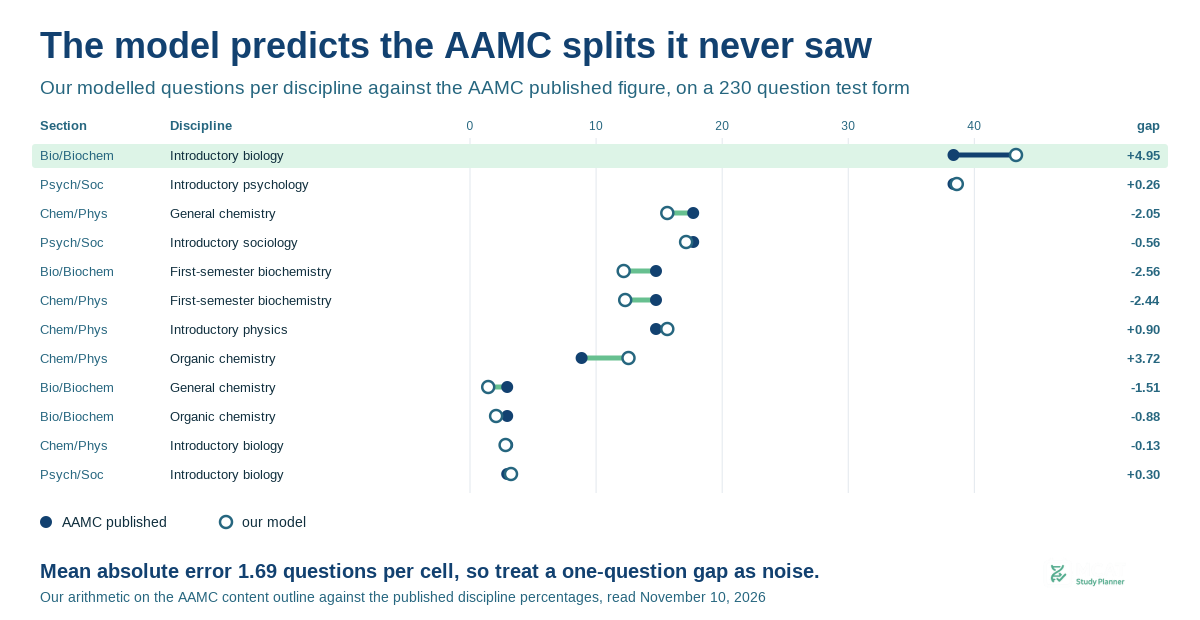
Then we checked it. The same model, run over the course tags the AAMC prints beside every heading, predicts the published discipline percentages, which it never saw. Here is how close it gets.
| Section | Discipline | AAMC publishes | Our model predicts | Gap |
|---|---|---|---|---|
| Bio/Biochem | Introductory biology | 38.35 | 43.30 | +4.95 |
| Bio/Biochem | First-semester biochemistry | 14.75 | 12.19 | -2.56 |
| Bio/Biochem | General chemistry | 2.95 | 1.44 | -1.51 |
| Bio/Biochem | Organic chemistry | 2.95 | 2.07 | -0.88 |
| Chem/Phys | General chemistry | 17.70 | 15.65 | -2.05 |
| Chem/Phys | First-semester biochemistry | 14.75 | 12.31 | -2.44 |
| Chem/Phys | Introductory physics | 14.75 | 15.65 | +0.90 |
| Chem/Phys | Organic chemistry | 8.85 | 12.57 | +3.72 |
| Chem/Phys | Introductory biology | 2.95 | 2.82 | -0.13 |
| Psych/Soc | Introductory psychology | 38.35 | 38.61 | +0.26 |
| Psych/Soc | Introductory sociology | 17.70 | 17.14 | -0.56 |
| Psych/Soc | Introductory biology | 2.95 | 3.25 | +0.30 |
Mean absolute error, 1.69 questions per cell. Psych/Soc comes out almost exact. The two worst misses are biology in Bio/Biochem and organic chemistry in Chem/Phys, both under 5 questions.
The honest reading: treat a one-question gap in the ranking as noise and a five-question gap as real. 5D beating 1B by 6 questions is a finding. 5A, 5E, 4A, 6A and 6B all landing within 0.1 of each other is not a ranking, it is a tie.
One more caveat, and it is the AAMC’s own. It describes these percentages as approximate and says the distribution varies from one form to another. This table describes the shape of a typical test, not a promise about yours.
Questions per Topic Studied, the Number That Decides Your Triage
Total questions tell you what a category is worth. They do not tell you what it costs. A category with eleven headings and one with two headings can be worth the same and take wildly different amounts of your week.
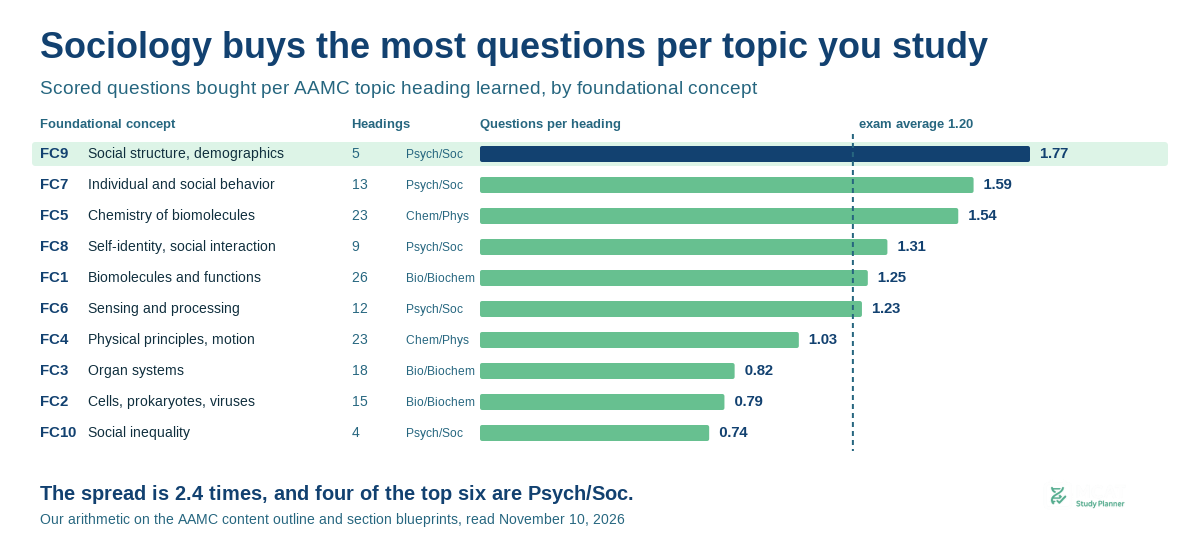
So divide. The result is the number of scored questions you buy per topic heading you learn, and it is a property of the foundational concept.
| Foundational concept | What it is | Section | Headings | Questions | Per heading |
|---|---|---|---|---|---|
| FC9 | Social structure and demographics | Psych/Soc | 5 | 8.9 | 1.77 |
| FC7 | Individual and social behavior | Psych/Soc | 13 | 20.7 | 1.59 |
| FC5 | Chemical principles of biological molecules | Chem/Phys | 23 | 35.4 | 1.54 |
| FC8 | Self-identity and social interaction | Psych/Soc | 9 | 11.8 | 1.31 |
| FC1 | Biomolecules and their functions | Bio/Biochem | 26 | 32.5 | 1.25 |
| FC6 | Sensing and processing the world | Psych/Soc | 12 | 14.8 | 1.23 |
| FC4 | Physical principles and motion | Chem/Phys | 23 | 23.6 | 1.03 |
| FC3 | Organ systems | Bio/Biochem | 18 | 14.8 | 0.82 |
| FC2 | Cells, prokaryotes and viruses | Bio/Biochem | 15 | 11.8 | 0.79 |
| FC10 | Social inequality | Psych/Soc | 4 | 3.0 | 0.74 |
The spread is 2.4 times, and the order is close to the opposite of how most people study.
Four of the top six are Psych/Soc. The section students schedule last, and most often cut when they run short, is the section where a single topic heading pays the most. That is the practical argument for studying psych and soc properly rather than skimming it in the final fortnight.
Physics sits seventh at 1.03, below the exam average of 1.20. Foundational Concept 4 is 23 topic headings for 23.6 questions: the broadest low-density lane on the test. That does not mean skip it. It means the panic it attracts is out of proportion to the points, and a reader short on time should not be spending their best hours there.
The two thinnest lanes in Bio/Biochem are organ systems and cell biology, at 0.82 and 0.79. Both are heavy reading for comparatively few questions, which is the single most common way a content review schedule quietly overruns.
What the Ranking Pages Get Wrong
We read the three article pages on page one on November 10, 2026. The rest of page one is four Reddit threads, a Scribd PDF and a YouTube video.
MedSchoolCoach is the best of them and gets closest. It converts the AAMC discipline percentages into questions per section correctly, which almost nobody does. It also says, in terms, that its tutors “tallied the number of AAMC questions related to each topic”. The tally is never published. You are asked to take the ranking on trust, and there is no ranking in the table either, only four columns of description.
Its topic list is also, in AAMC terms, mostly 5D. Amino acids, lipids, carbohydrates, protein structure, nucleotides, aldehydes and ketones, alcohols, carboxylic acids, acid derivatives, chromatography: ten entries that are one content category. The instinct is right. The category is never named, so a reader cannot see that those ten entries are a single 18.5 question block in one section.
And it contains no sociology. Not one entry. We searched the page for stratification, demographics, social institutions, functionalism, conflict theory and culture, and found zero of each. Sociology is 17.7 questions a form and the densest content on the exam per heading.
Blueprint’s complete list, dated August 6, 2024, is a bulleted topic list with no counts, no percentages and no ranking. It does include a short sociology block, which puts it ahead of the other two on that point.
Magoosh’s “The Most Commonly Tested MCAT Concepts” was last updated on July 7, 2016 and still ranks. It is the only one that uses the AAMC’s own heading names, which is a genuinely good instinct, and it has no Psych/Soc entries at all. It also lists “Separations and Purifications” among the most commonly tested concepts. That is category 5C: one topic heading, about 1.5 questions, the smallest category on the exam. Per heading it is a fine use of an evening. As a headline priority it is the last thing on the list.
The Google AI Overview on this search has the same shape as all three. It names amino acids, enzyme kinetics, metabolism, the central dogma, organ systems, acid-base, stereochemistry and the rest, in a tidy list, with no number attached to anything and no order implied beyond the sequence it happens to print them in.
How Many Hours Each Category Deserves
Rankings are only useful if they turn into time. Here is the top of the table as hours, allocated by each category’s share of the 177 science questions, against the content-review windows in our published plans.
| Category | Share | 8 weeks | 12 weeks | 16 weeks | 24 weeks |
|---|---|---|---|---|---|
| 5D | 10.4% | 4.5 to 7.2 h | 12.5 to 18.8 h | 14.1 to 23.5 h | 15.0 to 18.8 h |
| 1B | 7.1% | 3.0 to 4.9 h | 8.5 to 12.7 h | 9.5 to 15.9 h | 10.2 to 12.7 h |
| 1D | 5.6% | 2.4 to 3.9 h | 6.8 to 10.1 h | 7.6 to 12.7 h | 8.1 to 10.1 h |
| 3B | 5.1% | 2.2 to 3.5 h | 6.1 to 9.2 h | 6.9 to 11.5 h | 7.3 to 9.2 h |
| 7A | 4.5% | 1.9 to 3.1 h | 5.4 to 8.1 h | 6.1 to 10.1 h | 6.5 to 8.1 h |
| 7B | 3.6% | 1.5 to 2.5 h | 4.3 to 6.5 h | 4.8 to 8.1 h | 5.2 to 6.5 h |
| 7C | 3.6% | 1.5 to 2.5 h | 4.3 to 6.5 h | 4.8 to 8.1 h | 5.2 to 6.5 h |
| 1A | 3.5% | 1.5 to 2.4 h | 4.2 to 6.3 h | 4.8 to 7.9 h | 5.1 to 6.3 h |
The 8-week column is the warning. Four and a half hours is not enough to learn twelve topic headings in 5D, which is exactly why a compressed plan has to triage rather than review. If that is the column you are in, the ranking above is not a nice-to-have, it is the only way the plan closes.
Once you know your test date and the hours you can actually give each week, the free MCAT study schedule generator turns those two inputs into dated content blocks, so the sequencing below lands on real days rather than in a list.
The Order to Study It In
Two tables, two different instructions, and they combine cleanly.
Start with the biggest totals. 5D, 1B, 1D and 3B are 50 questions between them, 22 percent of the exam, and they carry 41 topic headings. Nothing else you do in content review moves as many points. The 10-week content review schedule is built to put blocks like these early, where you still have time to use practice questions on them.
Then spend your thin weeks on the dense lanes. When the hours get short, FC9, FC7 and FC5 are where an hour buys the most: social structure, demographics, individual behavior, social processes, attitude change, and the chemistry of biological molecules. Four of those six are Psych/Soc.
Do not front-load the low-density reading. Organ systems and cell biology, at 0.82 and 0.79 questions per heading, are where a content review schedule goes over time. MCAT biology is still the largest discipline on the exam at 44.25 questions, so this is a sequencing point, not permission to skip it.
And remember content review is a minority of the score. The AAMC publishes the same skill split on all three science sections: 35 percent Skill 1 knowledge, 45 percent Skill 2 reasoning, 10 percent each for Skills 3 and 4. Only about a third of each section rewards having learned the outline. The rest wants you to reason about an experiment you have not seen, which is what working practice questions is for and content review is not.
Do this now: take the five categories at the top of the ranking, find them in whatever resource you are using, and move them to the front of your content review. If your schedule cannot fit all 31 categories, that reordering is worth more than any resource change you could make.
Every Number on One Page
Everything above with its source. AAMC figures were read from students-residents.aamc.org on November 10, 2026. The rest is our arithmetic on them.
| Figure | Value | Source |
|---|---|---|
| Scored questions on the exam | 230 | AAMC, our arithmetic on the four section counts |
| Questions per science section | 59 | AAMC section overview pages |
| CARS questions, and content categories | 53, and none | AAMC CARS overview |
| Content categories | 31 | our count of the outline |
| Foundational concepts | 10 | AAMC |
| Tagged topic headings | 148 | our count of all 31 category pages |
| Headings with more than one course tag | 41 of 148 | our count |
| Biggest category | 5D, about 18.5 questions | our arithmetic |
| Second biggest | 1B, about 12.5 questions | our arithmetic |
| Smallest category | 5C, about 1.5 questions, one heading | our arithmetic |
| Top three categories against the bottom ten | 40.9 against 30.1 | our arithmetic |
| Top five categories | 57.9 questions, 25.2 percent of the exam | our arithmetic |
| Best return per heading | FC9, 1.77 questions | our arithmetic |
| Worst return per heading | FC10, 0.74 questions | our arithmetic |
| Exam average per heading | 1.20 questions | our arithmetic |
| Physics, FC4 | 23.6 questions over 23 headings | our arithmetic |
| Sociology on a form | about 17.7 questions | AAMC, 30 percent of Psych/Soc |
| Biochemistry on a form | about 29.5 questions | AAMC, 25 percent of two sections |
| Skill split, every science section | 35 / 45 / 10 / 10 | AAMC section overview pages |
| Model error against AAMC discipline splits | 1.69 questions mean absolute | our arithmetic |
A ranking is a starting point, not a schedule. When you have a date and a weekly hour budget, build your MCAT schedule and the categories at the top of this table land on the weeks where you still have time to do something about them. If you have not set the budget yet, how to study for the MCAT is the method this ranking plugs into, and how much general chemistry is on the MCAT covers the two Chem/Phys categories, 5A and 5E, that sit just outside the top eight.
Written by
MCAT Study Planner Team
Last updated 11/10/2026