MCAT Organic Chemistry: How Much Is Tested and How to Study
By MCAT Study Planner Team • Updated 10/2/2026
Short answer: organic chemistry is 5 percent of the Bio/Biochem section and 15 percent of the Chem/Phys section, which works out to 11.80 questions on a test form. That is the smallest of the seven disciplines the AAMC lists, and exactly 1 in 15 of every science question on the MCAT.
The ranking pages for this search mostly repeat one of those two percentages and leave it there. The AI Overview currently answers “about 5% to 15%”, which is both published numbers read aloud rather than an answer.
Two percentages are not a study decision. A question count is, and so is a count of how many topic headings the AAMC actually tags to organic chemistry. Both are published. Nobody multiplies or counts them.
The 30-second answer: 5 percent of Bio/Biochem plus 15 percent of Chem/Phys equals 11.80 questions on a 230-question exam, by our arithmetic on the AAMC’s published percentages read October 2, 2026. Three quarters of those questions sit in Chem/Phys. Only 6 of the 104 topic headings in the outline are tagged organic chemistry and nothing else, and they are spectroscopy plus five functional-group headings. Grignard, Diels-Alder, Wittig and radical reactions are named nowhere in the outline. Budget one fifteenth of your content review, which is 5.6 days on a 24-week plan.
In this guide
- 5 percent of one section, 15 percent of another
- What that works out to in questions
- Three quarters of it is in the physics section
- Where organic chemistry sits in the outline
- Six headings are organic chemistry and nothing else
- All of stereochemistry is filed under general chemistry
- The reactions the outline names, and the ones it never mentions
- Is it orgo 1 or orgo 2
- How long an organic chemistry block should be
- What the ranking pages get wrong
- Every number on one page
5 Percent of One Section, 15 Percent of Another
We read both science section overview pages on students-residents.aamc.org on October 2, 2026. Here is what the AAMC publishes for organic chemistry.
| Section | Questions | Time | Organic chemistry |
|---|---|---|---|
| Chemical and Physical Foundations of Biological Systems | 59 | 95 minutes | 15 percent |
| Biological and Biochemical Foundations of Living Systems | 59 | 95 minutes | 5 percent |
| Psychological, Social, and Biological Foundations of Behavior | 59 | 95 minutes | none listed |
| Critical Analysis and Reasoning Skills | 53 | 90 minutes | no science content |
The rest of the Chem/Phys split is general chemistry at 30 percent, first-semester biochemistry at 25 percent, introductory physics at 25 percent and introductory biology at 5 percent. The rest of the Bio/Biochem split is introductory biology at 65 percent, first-semester biochemistry at 25 percent and general chemistry at 5 percent.
One caveat the AAMC prints under both of those tables, and which applies to every number in this guide: “These percentages have been approximated to the nearest 5% and will vary from one test to another for a variety of reasons. These reasons include, but are not limited to, controlling for question difficulty, using groups of questions that depend on a single passage, and using unscored field-test questions on each test form.”
So these describe the shape of a test form, not a promise about yours.
What That Works Out to in Questions
Multiply each published percentage by its section’s question count and add across sections. This is our arithmetic on the AAMC’s numbers, under the rounding caveat above.
| Discipline | Questions on a form | Share of the 177 science questions | Where it comes from |
|---|---|---|---|
| Introductory biology | 44.25 | 25.00 percent | 65 percent of B/B, 5 percent of C/P, 5 percent of P/S |
| Introductory psychology | 38.35 | 21.67 percent | 65 percent of P/S |
| First-semester biochemistry | 29.50 | 16.67 percent | 25 percent of B/B, 25 percent of C/P |
| General chemistry | 20.65 | 11.67 percent | 5 percent of B/B, 30 percent of C/P |
| Introductory sociology | 17.70 | 10.00 percent | 30 percent of P/S |
| Introductory physics | 14.75 | 8.33 percent | 25 percent of C/P |
| Organic chemistry | 11.80 | 6.67 percent | 5 percent of B/B, 15 percent of C/P |
Organic chemistry is last. It is 2.95 questions behind introductory physics, which is the discipline premeds usually nominate as the one that matters least, and our guide to MCAT physics strategy covers how thin that section really is.
Two ratios fall straight out of that table and neither one is an approximation we rounded to.
Organic chemistry is 6.67 percent of the 177 science questions, which is exactly 1 in 15. And first-semester biochemistry at 29.50 questions is exactly 2.5 times organic chemistry. If your study plan gives orgo a week and biochem a week, the budget is off by a factor of two and a half.
Against all 230 questions on the exam, CARS included, organic chemistry is 5.13 percent. Our section-by-section MCAT timing guide carries the full question and minute counts if you want the denominators.
Three Quarters of It Is in the Physics Section
Of the 11.80 organic chemistry questions, 8.85 are in Chem/Phys and 2.95 are in Bio/Biochem. That is exactly 75 percent in the section most students think of as physics and gen chem.
This matters for when you study it, not just how long. If you have sequenced your content review so that organic chemistry lands next to biochemistry and the amino acids, three quarters of the payoff is in a different section’s prep.
Do this with your resource list: when you do an orgo review block, pair it with Chem/Phys passages rather than Bio/Biochem ones. Three quarters of the questions that block is preparing you for are in Chem/Phys, by our arithmetic on the AAMC’s published percentages.
Where Organic Chemistry Sits in the Outline
The AAMC does something useful that almost nobody uses. Every topic heading in its content outline carries a tag for the course the topic is normally learned in. In the AAMC’s words: “The abbreviations found in parentheses indicate the course(s) in which undergraduate students at many colleges and universities learn about the topics and associated subtopics.” The key defines OC as a two-semester sequence of organic chemistry.
So the outline itself says where the organic chemistry is. We read all 19 content-category pages for Foundational Concepts 1 through 5 on October 2, 2026 and counted. Of the 104 topic headings, 15 carry the OC tag, and they sit in only 6 of the 19 categories.
| Category | What it covers | Headings tagged OC | Also tagged biochemistry |
|---|---|---|---|
| 5D | Structure, function and reactivity of biologically relevant molecules | 9 of 12 | 4 of the 9 |
| 1A | Structure and function of proteins and their constituent amino acids | 2 of 5 | both |
| 1D | Principles of bioenergetics and fuel molecule metabolism | 1 of 8 | yes |
| 3A | Structure and function of the nervous and endocrine systems | 1 of 7 | yes |
| 4D | How light and sound interact with matter | 1 of 4 | no |
| 5C | Separation and purification methods | 1 of 1 | yes |
| The other 13 categories | Genetics, cells, organ systems, all of Foundational Concept 4 except 4D, bonding, solutions, thermodynamics | 0 of 67 | not applicable |
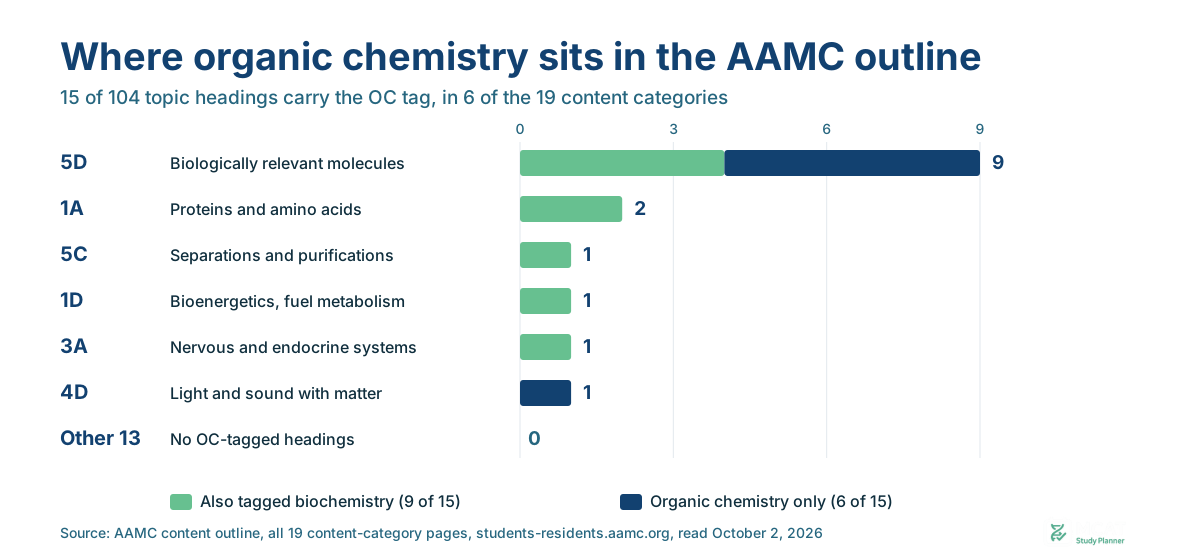
Two names are listed twice. Carbohydrates appears in 1D tagged biochemistry and organic chemistry, and again in 5D tagged organic chemistry alone. Lipids appears in 3A and 5D, tagged both ways each time. That leaves 13 distinct topic names across the 15 listings.
The AAMC is explicit about what a repeat means: “Please note topics that appear on multiple content lists will be treated differently. Questions will focus on the topics as they are described in the narrative for the content category.” Carbohydrates in 1D is written as fuel metabolism. The same heading in 5D is written as cyclic structures, anomers and the glycoside linkage.
One limit worth stating plainly. The AAMC publishes percentages down to the Foundational Concept level and no further, so this is a count of tagged topic headings, not a count of questions. If the 11.80 questions were spread evenly over the 15 headings each would be worth 0.79 questions. Treat that as a scale check, not a prediction.
Six Headings Are Organic Chemistry and Nothing Else
Here is the number that changes a study plan. Of the 15 OC-tagged headings, 9 also carry BC, first-semester biochemistry. Only 6 carry OC and no biochemistry tag at all.
| Heading | Category | What it actually contains |
|---|---|---|
| Molecular Structure and Absorption Spectra | 4D | Infrared characteristic group absorptions and the fingerprint region, ultraviolet transitions, conjugated systems, NMR equivalent protons and spin-spin splitting |
| Carbohydrates | 5D | Nomenclature, absolute configuration, cyclic structures and conformations of hexoses, epimers and anomers, hydrolysis of the glycoside linkage, keto-enol tautomerism |
| Aldehydes and Ketones | 5D | Nucleophilic addition at the C=O bond, acetal and hemiacetal, imine and enamine, hydride reagents, cyanohydrin, oxidation, enolate chemistry, aldol condensation and retro-aldol |
| Alcohols | 5D | Acidity and hydrogen bonding, oxidation, SN1 and SN2 substitution, protection of alcohols, preparation of mesylates and tosylates |
| Carboxylic Acids | 5D | Carboxyl group reactions, amide, ester and anhydride formation, reduction, decarboxylation, substitution at the 2-position |
| Acid Derivatives (Anhydrides, Amides, Esters) | 5D | Nucleophilic substitution, transesterification, hydrolysis of amides, relative reactivity, steric and electronic effects, strain in beta-lactams |
That is the whole of it. One spectroscopy heading and five functional-group headings, all but one of them in content category 5D.
The other nine headings, the ones shared with biochemistry, are amino acids, protein structure, carbohydrates as fuel, lipids twice, amino acids and peptides and proteins, separations and purifications, phenols, and polycyclic and heterocyclic aromatic compounds. You will study those while you study biochemistry whether you plan to or not, and our MCAT biochemistry guide sizes that block properly.
So the honest version of “study orgo” is: read the six headings above, and let the biochemistry block carry the other nine.
All of Stereochemistry Is Filed Under General Chemistry
This is the one place where tag-driven studying goes wrong, and it is worth knowing before you build a topic list from the outline.
Searching every subtopic line in all 19 content categories, exactly one OC tag sits inside a heading that is not itself OC-tagged. It is “Stereochemistry of covalently bonded molecules (OC)”, and it lives under the heading “Covalent Bond (GC)” in content category 5B.
Under that single subtopic the AAMC lists isomers, structural isomers, stereoisomers including diastereomers and enantiomers and cis and trans isomers, conformational isomers, polarization of light and specific rotation, absolute and relative configuration, conventions for writing R and S forms, and conventions for writing E and Z forms.
That is the entire stereochemistry syllabus, filed under a heading the AAMC tags to general chemistry. Build your orgo list from the OC headings alone and you will leave out R and S.
The Reactions the Outline Names, and the Ones It Never Mentions
Review books cover organic chemistry the way an undergraduate course does. The outline does not. We searched all 19 content-category pages on October 2, 2026 for the reaction topics that fill a typical second-semester syllabus.
| Named in the outline | Mentions across all 19 content categories |
|---|---|
| Strecker synthesis, Gabriel synthesis, aldol condensation and retro-aldol, keto-enol tautomerism, nucleophilic addition at C=O, acetal and hemiacetal, imine and enamine, hydride reagents, cyanohydrin, SN1 and SN2, transesterification, hydrolysis of amides, decarboxylation, saponification, chromatography in seven forms | present, with subtopics |
| Grignard reagents | 0 |
| Diels-Alder | 0 |
| Wittig | 0 |
| Friedel-Crafts and electrophilic aromatic substitution | 0 |
| Michael addition and Claisen | 0 |
| Markovnikov and ozonolysis | 0 |
| Alkenes, alkynes, epoxides | 0 |
| Radical reactions | 0 |
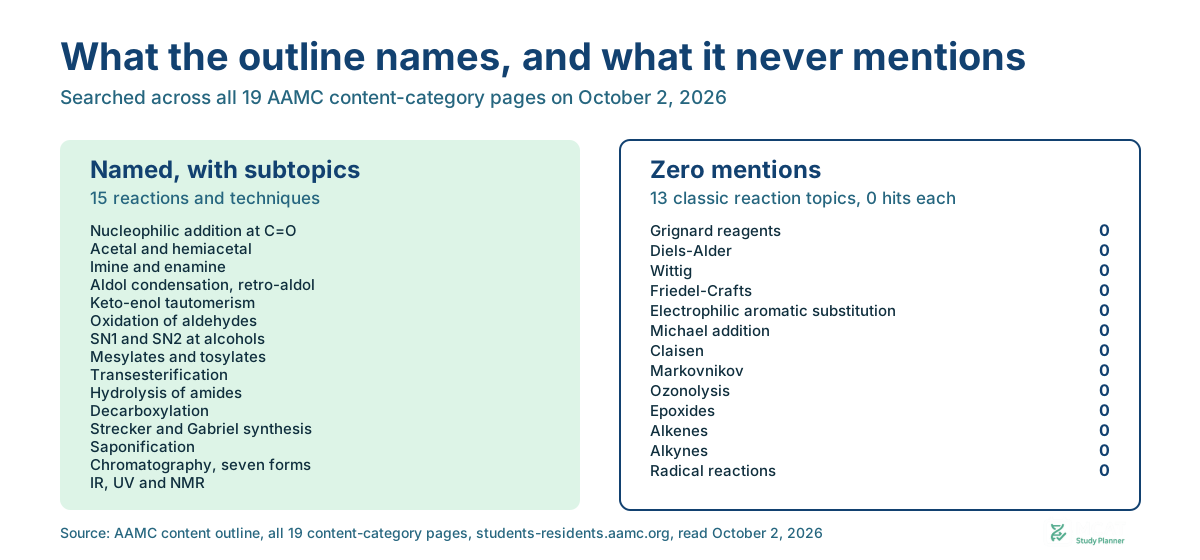
Read the pattern rather than the list. What survives is carbonyl chemistry, substitution at alcohols, acid-derivative reactivity, separations and spectroscopy. What does not survive is every reaction whose point is building a carbon skeleton.
That is also why multi-step synthesis is not on the exam in the form your orgo final used. The outline never asks you to plan a route.
Is It Orgo 1 or Orgo 2
This is the third most asked question on this search, and both of the usual answers are wrong.
The AAMC’s topic level key calls OC “a two-semester sequence of organic chemistry”, so the outline does not promise that second-semester material is excluded. Compare that with the biochemistry tag, which the same key defines as first-semester biochemistry. The AAMC drew that line for biochemistry and did not draw it for organic chemistry.
At the same time, both section overviews say the exam is designed to “test introductory-level biology, organic chemistry, and inorganic chemistry concepts”. Introductory level, two-semester sequence.
So the course number is the wrong boundary. The topic list is the boundary, and the topic list is 15 headings and 13 distinct names, with no named reaction that requires a second-semester synthesis toolkit. That is a far more useful answer than a semester number, and it is the reason the reaction audit above is the section to act on.
How Long an Organic Chemistry Block Should Be
If organic chemistry is one fifteenth of the science content, it gets one fifteenth of your content-review window. Content review covers the science sections, so the 177-question denominator is the right one. That proportional split is our assumption, stated so you can disagree with it.
Our own published plans set the windows. The 8-week MCAT plan runs content triage on days 3 to 14. The 12-week plan runs content review through day 42. The 16-week plan runs it through week 9, and the 24-week plan through week 12. Divide by 15 and convert each plan’s weekly hour band at seven days a week.
| Your plan | Content-review days | Organic chemistry days | Organic chemistry hours |
|---|---|---|---|
| 8 weeks | 12 | 0.8 | 2.9 to 4.6 |
| 12 weeks | 42 | 2.8 | 8.0 to 12.0 |
| 16 weeks | 63 | 4.2 | 9.0 to 15.0 |
| 24 weeks | 84 | 5.6 | 9.6 to 12.0 |
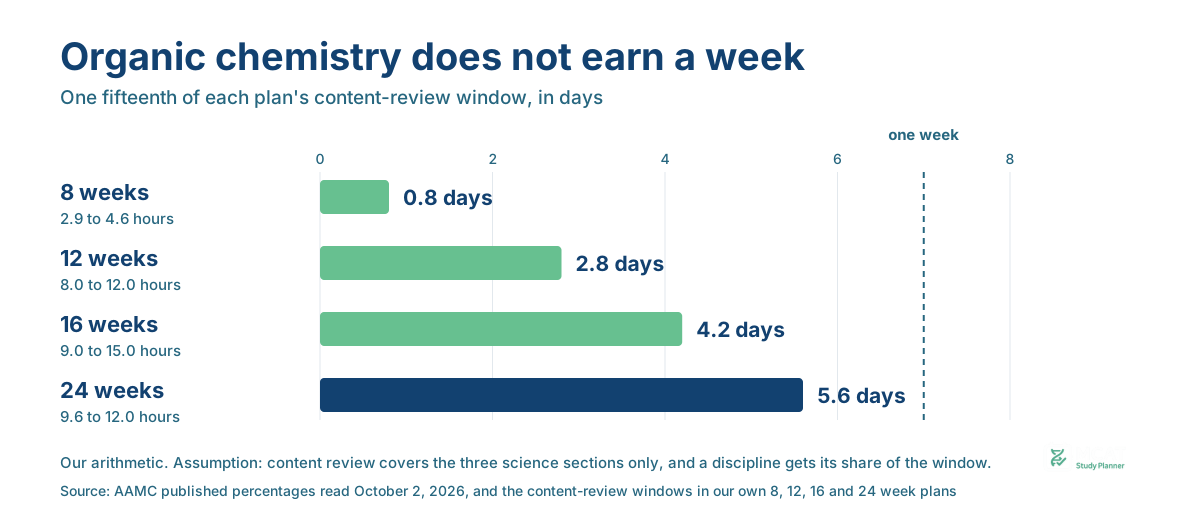
The headline is the same on every row. Organic chemistry does not earn a full week on any timeline we publish. On the longest plan it is 5.6 days and roughly 10 to 12 hours, which is enough to work the six orgo-only headings and the stereochemistry subtopic properly and nothing more.
The 8-week row, at 0.8 days, is the warning. On that timeline organic chemistry is a few hours of functional-group review inside a Chem/Phys block, not a subject you revisit.
Those are the same two inputs any schedule is built from: a test date and your honest weekly hours. Feed them into the free MCAT study schedule generator and it lays the content-review window out day by day, so you can see what one fifteenth of it is on real dates. For the order to march through the subjects in, our 10-week content review schedule sequences them by yield.
If you are turning the 13 distinct topic names into cards, the best MCAT Anki decks cover the functional-group and spectroscopy material well, and 13 names is a small enough list to keep as one deck.
What the Ranking Pages Get Wrong
We read the ranking pages on October 2, 2026. The pattern is consistent and the errors go in both directions.
Jack Westin’s guide frames the subject well. It says “MCAT orgo is about 20% of what your undergrad OChem course covered”, which matches what the tag census shows. Then its own FAQ states “Approximately 5 to 10% of Chem/Phys questions draw directly on organic chemistry content”. The AAMC publishes 15 percent for that section, on the page we read the same day.
Chemistry Steps is the longest page on the search at about 6,500 words, and its headings are an undergraduate syllabus: alkanes and cycloalkanes, alkenes, alkynes, elimination reactions, addition reactions of alkenes, radical reactions. The AAMC outline mentions none of those. It also cites only the Bio/Biochem figure: “Although percentwise only 5% of the questions are on organic chemistry”.
Shemmassian’s guide says “only 3 to 5 percent of your entire exam is likely to cover organic chemistry”. The computed figure is 5.13 percent of all 230 questions, so the range is low at both ends.
Princeton Review gets both published percentages right and is the only page on the search that does. It stops one multiplication short: no question count, no total across the two sections, no study time.
Khan Academy’s result is a course index. The page at position 1 is a Reddit thread we did not read and do not cite. Nobody on the first page counts the OC tags in the outline, and nobody turns any of this into days.
Every Number on One Page
| Figure | Value | Source |
|---|---|---|
| Organic chemistry in Chem/Phys | 15 percent of 59 questions | AAMC section overview, Oct 2, 2026 |
| Organic chemistry in Bio/Biochem | 5 percent of 59 questions | AAMC section overview, Oct 2, 2026 |
| Questions on a form | 11.80 | Our arithmetic on the two above |
| Rank among the seven disciplines | Seventh of seven | Our arithmetic |
| Behind introductory physics by | 2.95 questions | Our arithmetic |
| Share of the 177 science questions | 6.67 percent, 1 in 15 | Our arithmetic |
| Share of all 230 questions | 5.13 percent | Our arithmetic |
| Biochemistry divided by organic chemistry | Exactly 2.5 | Our arithmetic |
| Share of the orgo questions in Chem/Phys | 75 percent, 8.85 of 11.80 | Our arithmetic |
| Topic headings tagged OC | 15 of 104, in 6 of 19 categories | Our count of the AAMC outline |
| Headings in category 5D alone | 9 of the 15 | Our count of the AAMC outline |
| Headings tagged OC and not biochemistry | 6 | Our count of the AAMC outline |
| Distinct topic names | 13, with carbohydrates and lipids listed twice | Our count of the AAMC outline |
| OC subtopics under a non-OC heading | 1, all of stereochemistry, under Covalent Bond (GC) in 5B | Our count of the AAMC outline |
| Mentions of Grignard, Diels-Alder, Wittig, radicals | 0 each, across all 19 categories | Our search of the AAMC outline |
| Block length, 24-week plan | 5.6 days, 9.6 to 12.0 hours | Our arithmetic |
| Block length, 8-week plan | 0.8 days, 2.9 to 4.6 hours | Our arithmetic |
Six headings, 13 topic names, under a week of study on the longest plan. That is the whole subject, and it is smaller than almost any review book implies.
The MCAT study planner takes your test date, your weekly hours and the resources you already own, and puts a content-review window on real dates with the practice exams placed around it. The arithmetic above tells you how small the organic chemistry slice of that window is. A calendar tells you which days it lands on.
Written by
MCAT Study Planner Team
Last updated 10/2/2026