
MCAT General Chemistry: What Is Tested and How to Study It
By MCAT Study Planner Team • Updated 10/14/2026
Short answer: general chemistry is about 20.65 questions on an MCAT test form. That is 30 percent of the Chemical and Physical Foundations section plus another 5 percent of the Biological and Biochemical Foundations section, and it makes general chemistry the largest single discipline in the section most students call the physics section. We read every science page of the published content outline on October 14, 2026 to get those numbers.
Search this topic and you will be told general chemistry is “roughly 30 percent of Chem/Phys, about 18 questions”. That is true as far as it goes, and it stops two steps early.
It counts general chemistry in one section and misses the questions sitting in the biology section. It leaves “high yield” as an opinion, because nobody has worked out what the AAMC’s own topic list is worth. And it hands you an equation list, half of which the AAMC never actually names.
The 30-second answer: The AAMC targets general chemistry at 30 percent of Chem/Phys and 5 percent of Bio/Biochem. At 59 questions a section that is 20.65 questions, 11.67 percent of the 177 science questions and 8.98 percent of all 230. It is the biggest discipline target in Chem/Phys, ahead of biochemistry and physics at 25 percent each and double organic chemistry at 15 percent. Of the 105 topic headings in the 19 science content categories, 17 carry the AAMC’s (GC) tag, in 8 categories. Two of them, 5A and 4E, are worth 9.87 questions between them. Give general chemistry about 11.67 percent of your content-review window, which is 1.4 days on an 8-week plan and 7.35 days on a 16-week plan.
In this guide
- General chemistry is the biggest discipline in that section
- What that works out to in questions
- The questions hiding in the biology section
- Every general chemistry topic the AAMC actually lists
- Which content categories carry the points
- Electrochemistry is on the exam twice
- The equations the AAMC names, and four it does not
- How long a general chemistry block should be
- How to study the two categories that carry half the points
- What the ranking pages get wrong
- Every number on one page
General Chemistry Is the Biggest Discipline in That Section
We read all four section overview pages on students-residents.aamc.org on October 14, 2026. Here is the full discipline split the AAMC publishes for the Chemical and Physical Foundations section.
| Discipline | AAMC target | Questions on a form |
|---|---|---|
| General chemistry | 30 percent | 17.70 |
| First-semester biochemistry | 25 percent | 14.75 |
| Introductory physics | 25 percent | 14.75 |
| Organic chemistry | 15 percent | 8.85 |
| Introductory biology | 5 percent | 2.95 |
Almost everyone calls this the physics section. By the AAMC’s own targets it holds more general chemistry than physics, and twice as much general chemistry as organic chemistry.
Add biochemistry and organic chemistry to general chemistry and 70 percent of the section is chemistry of one kind or another. Physics is the quarter that is left. If you are budgeting that section by subject, how to study MCAT physics is the quarter, not the half you may have assumed, and that article carries the physics equation list so this one does not repeat it.
One caveat the AAMC prints under every one of those tables, and which applies to every number in this guide: “These percentages have been approximated to the nearest 5% and will vary from one test to another for a variety of reasons. These reasons include, but are not limited to, controlling for question difficulty, using groups of questions that depend on a single passage, and using unscored field-test questions on each test form.”
These describe the shape of a test form, not a promise about yours.
What That Works Out to in Questions
The AAMC publishes percentages. Percentages do not tell you how many questions to practise. Multiply each target by the section’s published question count and you get something you can plan against.
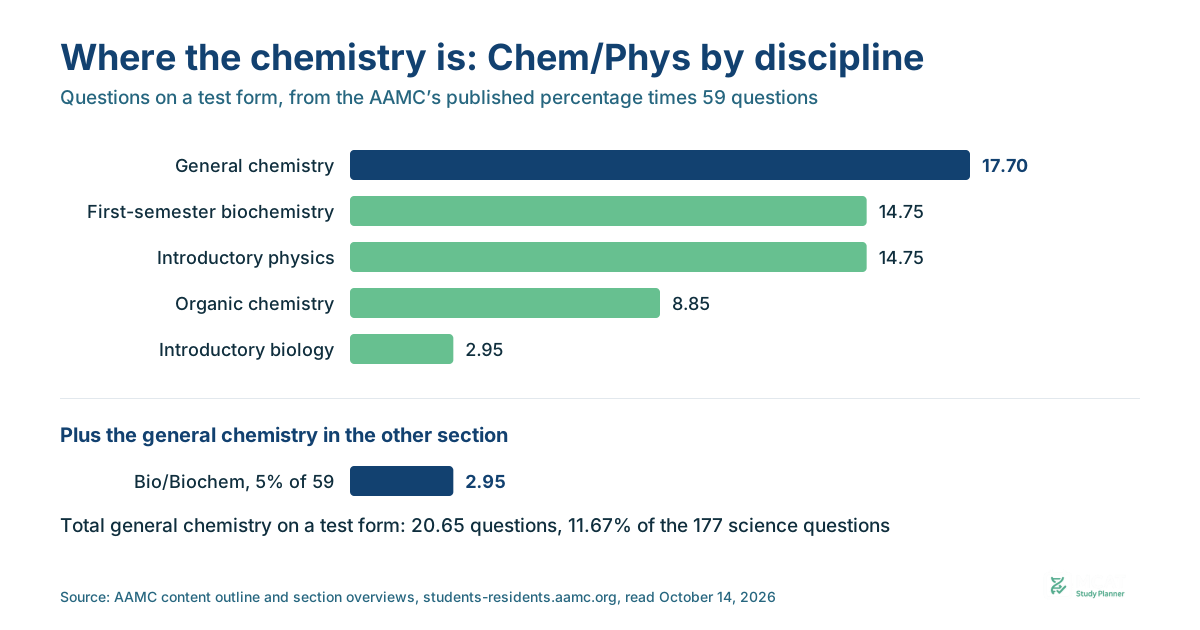
General chemistry lands in two sections, so the total is a sum of two numbers:
| Where | AAMC target | Section questions | General chemistry |
|---|---|---|---|
| Chemical and Physical Foundations | 30 percent | 59 | 17.70 |
| Biological and Biochemical Foundations | 5 percent | 59 | 2.95 |
| Total on a test form | 20.65 |
That is our arithmetic on the AAMC’s published numbers, not a figure the AAMC prints. It puts general chemistry fourth of the seven disciplines on the exam, behind introductory biology at 44.25, introductory psychology at 38.35 and first-semester biochemistry at 29.50, and ahead of sociology, physics and organic chemistry.
In share terms, 20.65 questions is 11.67 percent of the 177 questions in the three science sections, and 8.98 percent of all 230 questions once CARS is included. Roughly one question in eleven on your whole exam is general chemistry.
The Questions Hiding in the Biology Section
The 2.95 questions in the Biological and Biochemical Foundations section are the ones every ranking page drops, and they are not rounding noise. On a 118 to 132 section scale, three questions is worth more than a point.
The AAMC’s discipline split for that section, read October 14, 2026, is introductory biology 65 percent, first-semester biochemistry 25 percent, general chemistry 5 percent and organic chemistry 5 percent. The general chemistry is real and it sits in exactly two places in the outline.
| Content category | The general chemistry heading | Roughly worth |
|---|---|---|
| 3A, the nervous and endocrine systems | Electrochemistry (GC) | 1.67 questions |
| 1D, bioenergetics and fuel metabolism | Principles of Bioenergetics (BC, GC) | 1.28 questions |
Both are chemistry asked in a biological frame. 1D is thermodynamics applied to ATP, where the outline lists free energy, the equilibrium constant, Le Chatelier’s Principle and “Phosphoryl group transfers and ATP”. We mapped that overlap in detail in the biochemistry content map.
3A is the one worth knowing about, and it gets its own section below.
Every General Chemistry Topic the AAMC Actually Lists
The content outline tags every topic heading with the course it is learned in. The AAMC’s own key: “The abbreviations found in parentheses indicate the course(s) in which undergraduate students at many colleges and universities learn about the topics and associated subtopics”, with “GC = two-semester sequence of general chemistry”.
So there is no need to guess what counts as general chemistry. The AAMC has already labelled it. We fetched all 19 science content category pages on October 14, 2026 and counted.
Of the 105 topic headings in those categories, 17 carry the (GC) tag. They sit in 8 categories and are absent from the other 11.
| Category | What it covers | GC headings |
|---|---|---|
| 4E | Atomic nucleus, electronic structure, periodic table, stoichiometry | 5 of 5 |
| 5A | Acid and base equilibria, ions in solution, solubility, titration | 4 of 4 |
| 5B | Covalent bond, intermolecular forces | 2 of 2 |
| 5E | Thermochemistry, kinetics and equilibrium | 2 of 4 |
| 4B | Gas phase | 1 of 3 |
| 4C | Electrochemistry | 1 of 5 |
| 3A | Electrochemistry | 1 of 7 |
| 1D | Principles of bioenergetics | 1 of 8 |
Three of those categories are entirely general chemistry: 4E, 5A and 5B have no other discipline in them at all.
The absences are just as useful. Content category 5D is the largest on the exam at 12 topic headings, and not one of them is general chemistry. Every heading there is organic chemistry or biochemistry, which is why the organic chemistry content map and this guide barely overlap. Categories 4A, 4D and 5C are pure physics and organic too.
Do this now: open your review book’s general chemistry chapter list and strike anything that is not in the eight categories above. The AAMC’s tags are the list. Most books carry gas laws, colligative properties and nuclear chemistry at the same depth as acid and base equilibria, which is worth nine times as much.
Which Content Categories Carry the Points
The AAMC publishes percentages per foundational concept, never per content category. So we modelled it, the same way we did for MCAT biology.
Give every topic heading inside a foundational concept an equal share of that concept’s published percentage, then split each heading’s weight evenly across the courses tagged on it. Two assumptions are doing the work there, and both are rough: headings are not really equally weighted, and a shared heading does not really split evenly.
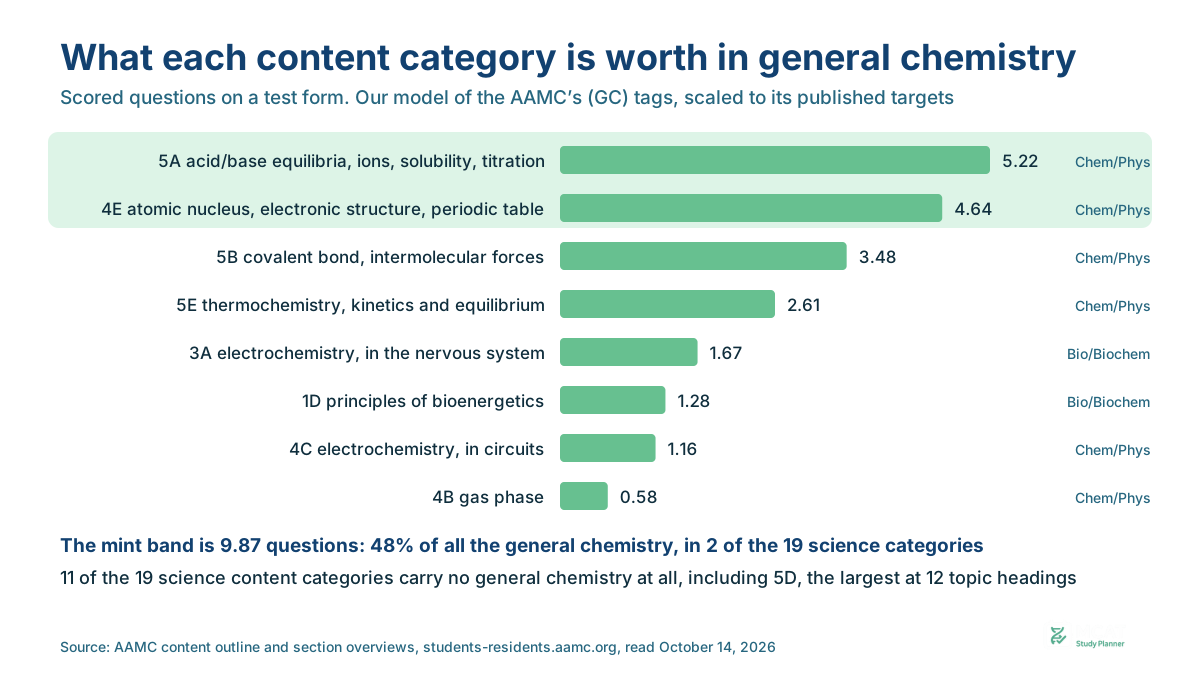
The check is whether the model reproduces numbers the AAMC does publish. Run on the general chemistry tags it returns 26.52 percent of Chem/Phys against a published 30, and 2.45 percent of Bio/Biochem against a published 5. Close enough to rank categories, not close enough to replace the AAMC’s own figures, so the table below is scaled so each section sums to the AAMC target.
| Category | Section | General chemistry questions |
|---|---|---|
| 5A acid and base equilibria, ions, solubility, titration | Chem/Phys | 5.22 |
| 4E atomic nucleus, electronic structure, periodic table, stoichiometry | Chem/Phys | 4.64 |
| 5B covalent bond, intermolecular forces | Chem/Phys | 3.48 |
| 5E thermochemistry, kinetics and equilibrium | Chem/Phys | 2.61 |
| 3A electrochemistry, in the nervous system | Bio/Biochem | 1.67 |
| 1D principles of bioenergetics | Bio/Biochem | 1.28 |
| 4C electrochemistry, in circuits | Chem/Phys | 1.16 |
| 4B gas phase | Chem/Phys | 0.58 |
| Total | 20.65 |
5A and 4E together are 9.87 questions, 48 percent of all the general chemistry on the exam, out of 31 content categories. The bottom four categories together are worth less than 5A on its own.
Gas phase is the surprise at the bottom. Boyle, Charles and the ideal gas law take up a full chapter in every review book and are worth about 0.58 questions.
Electrochemistry Is on the Exam Twice
This is the oddity in the outline, and no ranking page mentions it.
”Electrochemistry (GC)” appears as a topic heading in two different content categories, in two different sections, with completely different subtopics under each.
| 4C, in Chem/Phys | 3A, in Bio/Biochem | |
|---|---|---|
| Subtopics listed | 11 | 1 |
| What is there | Electrolytic cells, anode and cathode, electrolyte, Faraday’s Law, electron flow, galvanic cells, half-reactions, reduction potentials, cell potential, concentration cell, batteries | ”Concentration cell: direction of electron flow, Nernst equation” |
| Worth | 1.16 questions | 1.67 questions |
So the Nernst equation appears exactly once in the entire science content outline, and it is on the biology side of the exam, not the chemistry side. The Chem/Phys electrochemistry entry names Faraday’s Law and never mentions Nernst.
The Nernst equation is also one of the three places the AAMC’s logarithm requirement cashes out, alongside pH and the Arrhenius equation. Our guide to MCAT math without a calculator quotes all seven of the AAMC’s mathematical requirements and maps each one to the content categories that produce it.
The AAMC prints a note on this across the outline: “Please note topics that appear on multiple content lists will be treated differently. Questions will focus on the topics as they are described in the narrative for the content category.”
Read in context, that is a planning instruction. The 3A version of electrochemistry is about membrane potentials and nerve cells, and it is worth more than the circuits version. If you are reviewing electrochemistry as a circuits topic only, you are studying the smaller half.
The Equations the AAMC Names, and Four It Does Not
There is no equation sheet on the MCAT. Both science section overview pages say the same thing, read October 14, 2026: “During the actual exam, you will have access to the periodic table while answering questions in this section of the exam.” A periodic table, and nothing else.
Which makes it worth knowing exactly which equations the AAMC names. We searched all 19 science content category pages for each one.
| Named in the outline | Where |
|---|---|
| Ideal Gas Law, PV = nRT | 4B |
| Boyle’s Law, Charles’ Law, Avogadro’s Law | 4B |
| Arrhenius Equation | 5E |
| Hess’ Law of Heat Summation | 5E |
| Law of Mass Action | 5E |
| Le Chatelier’s Principle | 5E and 1D |
| Faraday’s Law | 4C |
| Nernst equation | 3A |
And the ones that are not there at all:
| Not named anywhere in the science outline | What the outline says instead |
|---|---|
| Henderson-Hasselbalch equation | 5A lists “Equilibrium constants Ka and Kb: pKa, pKb”, “Buffers” and “Influence on titration curves” |
| Gibbs free energy | 5E lists “Free energy: G” and “Spontaneous reactions and standard delta G” |
| Raoult’s Law | nothing |
| Graham’s Law | nothing |
Be careful how you read that table. Buffer chemistry is tested, clearly and repeatedly, and 5A is the single most valuable general chemistry category on the exam. The point is narrower: the AAMC describes that chemistry in terms of pKa, buffers and titration curves, and the named equation every prep equation sheet leads with is not in the published outline. Same for free energy, which the outline calls “Free energy: G”.
If a resource is selling you a memorised formula sheet as the core of general chemistry, the AAMC’s own document does not support that framing.
How Long a General Chemistry Block Should Be
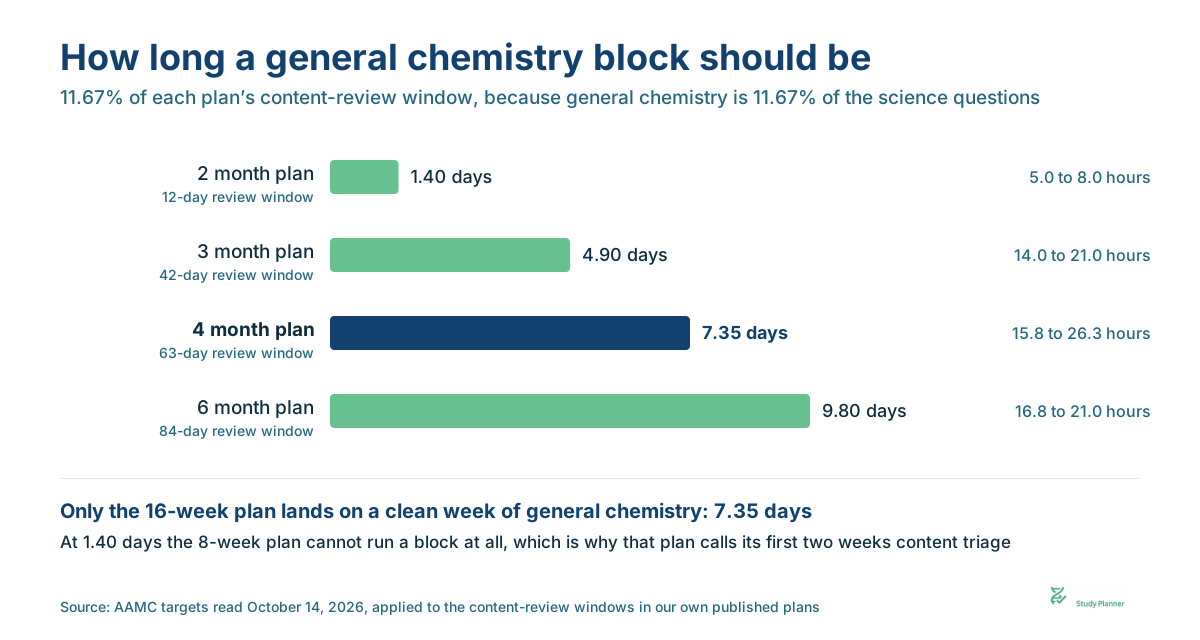
General chemistry is 11.67 percent of the science questions, so it gets about 11.67 percent of your content-review window. Here is that applied to the four plans we publish, using each plan’s own review window and weekly hours.
| Plan | Content-review window | General chemistry block | Hours |
|---|---|---|---|
| 2 month, 8 weeks | 12 days | 1.40 days | 5.0 to 8.0 |
| 3 month, 12 weeks | 42 days | 4.90 days | 14.0 to 21.0 |
| 4 month, 16 weeks | 63 days | 7.35 days | 15.8 to 26.3 |
| 6 month, 24 weeks | 84 days | 9.80 days | 16.8 to 21.0 |
On the 16-week plan the block is 7.35 days, which is where “one week of gen chem” comes from. It is the only one of the four that lands on a clean week.
The 8-week plan cannot really afford a block at all, which is consistent with that plan calling its first two weeks content triage rather than content review. At 1.4 days you are not reviewing general chemistry, you are checking whether 5A and 4E are weak and fixing only those.
Slotting that block against a real test date is what the free MCAT study schedule generator does: it takes your date, your hours a week and your resources and puts the subject blocks on actual days. The 10-week content review schedule shows the same idea laid out by hand if you would rather build it yourself.
How to Study the Two Categories That Carry Half the Points
5A and 4E are 9.87 of the 20.65 questions. They deserve a different treatment from the rest.
5A, acid and base equilibria. Four topic headings, all general chemistry: acid and base equilibria, ions in solutions, solubility, titration. The outline goes deep here in a way it does not elsewhere, listing Bronsted-Lowry definitions, Kw, conjugate pairs, weak acid and base dissociation, hydrolysis of salts, Ka and Kb, pKa and pKb, buffers, Ksp, the common ion effect, solubility and pH, indicators, neutralisation and redox titration. Work titration curves until you can read one without calculating. This is where the biochemistry overlap pays too, since 5A’s acid and base headings are tagged (GC, BC).
4E, atomic structure and stoichiometry. Five topic headings, all general chemistry. The periodic table gets two of its own: classification of elements by electronic structure, and variation of chemical properties with group and row. Given that the AAMC hands you a periodic table on test day and devotes two topic headings to reading it, periodic trends are the highest-return memorisation on this list.
For the rest, review proportional to the table above. Thermochemistry and kinetics at 2.61 questions is worth real time. Gas phase at 0.58 is worth an afternoon, not a chapter.
Then practise by category rather than by chapter. Our comparison of every question bank covers which banks let you filter to acid and base or stoichiometry specifically, which is the only way to turn this table into a study session.
What the Ranking Pages Get Wrong
We read the two real articles on this search result on October 14, 2026. The rest of the first page is four YouTube videos, a forum thread and a pirated textbook scan.
BeMo publishes one number in the body, “approximately 30%”, and only in its FAQ. Its list of 16 “chemistry subject areas” is actually the AAMC’s Foundational Concept 4 and 5 content category titles, four of which are pure physics: translational motion and forces, fluids, magnetism and electrical circuits, and how light and sound interact with matter. Presented as chemistry.
King of the Curve runs about 600 words with no numbers at all, lists “Gibbs free energy” as a high-yield topic in the AAMC’s own subject area, and closes with an FAQ about test anxiety, motivation and exercise.
Neither counts the general chemistry in the biology section. Neither ranks the content categories. Neither notices that the outline does not name Henderson-Hasselbalch, or that electrochemistry is split across two sections.
The AI summary at the top of the page has the same gaps: it stops at “about 18 questions” and leads its topic list with the Henderson-Hasselbalch equation and Gibbs free energy, neither of which appears in the AAMC outline.
Every Number on One Page
| Item | Value | Source |
|---|---|---|
| General chemistry in Chem/Phys | 30 percent, 17.70 questions | AAMC section overview, read 2026-10-14 |
| General chemistry in Bio/Biochem | 5 percent, 2.95 questions | AAMC section overview, read 2026-10-14 |
| Total on a test form | 20.65 questions | our arithmetic |
| Share of the 177 science questions | 11.67 percent | our arithmetic |
| Share of all 230 questions | 8.98 percent | our arithmetic |
| Rank among the seven disciplines | 4th | our arithmetic |
| Chem/Phys is chemistry | 70 percent, gen chem plus biochem plus organic | AAMC targets |
| GC-tagged topic headings | 17 of 105, in 8 of 19 science categories | AAMC content outline |
| Categories that are pure general chemistry | 4E, 5A, 5B | AAMC content outline |
| Largest category with no general chemistry | 5D, 12 headings | AAMC content outline |
| Most valuable category | 5A, 5.22 questions | our arithmetic |
| Top two categories combined | 9.87 questions, 48 percent | our arithmetic |
| Equations named in the outline | 9, including PV = nRT, Arrhenius, Hess, Nernst | AAMC content outline |
| Named equations absent from the outline | Henderson-Hasselbalch, Gibbs, Raoult, Graham | AAMC content outline |
| What you are given on test day | the periodic table, no equation sheet | AAMC section overviews |
| Block on a 16-week plan | 7.35 days, 15.8 to 26.3 hours | our arithmetic |
Once you know general chemistry is a week of review and where that week should go, the scheduling is the easy part. Build your MCAT schedule around your test date and the block lands where it belongs.
Written by
MCAT Study Planner Team
Last updated 10/14/2026