
MCAT Math Without a Calculator: What Is Actually Tested
By MCAT Study Planner Team • Updated 10/20/2026
Short answer: you cannot use a calculator on the MCAT, and the AAMC answers the harder question too. It publishes a seven-item list of the mathematical concepts and techniques the exam requires, plus four things it rules out or hands you. All of it was read on students-residents.aamc.org on October 20, 2026.
The calculator half of this question is settled in one page of the MCAT Essentials, and Google’s AI Overview answers it correctly.
The skill half is where the search goes wrong. The AI Overview lists five skill categories and names no primary source for any of them. Two of the five contradict what the AAMC actually publishes. The list it is paraphrasing exists, is free, and sits one click off the content outline.
The 30-second answer: No calculator. Six items are permitted at your desk and four of them are handed to you. The AAMC names seven mathematical requirements: scales and slopes, significant digits and estimates, metric units and dimensional analysis, probability and ratio and square roots, Algebra II-level logs and scientific notation, basic trigonometry, and vector addition. It also rules out calculus and dot and cross products, provides the periodic table, and provides metric-to-English conversion factors when they are needed. You get 96.6 seconds a question in the science sections, which is why the skill to drill is estimation, not computation. Fifteen minutes a day through your content block covers it.
In this guide
- Can you use a calculator on the MCAT
- The seven things the AAMC says the math is
- Four things the AAMC says you do not need
- Where each operation actually comes from
- The trigonometry is smaller than you think
- You have 96.6 seconds a question
- The 15 minute drill block, placed by week
- What the ranking pages get wrong
- The whole thing on one page
Can You Use a Calculator on the MCAT? The Policy, Not the Rumour
No, and the cleanest source is not a prep company. It is the MCAT Essentials chapter on storage of personal belongings, which publishes a closed list.
You may bring two personal items into the testing room: eyeglasses, subject to inspection, and your MCAT-accepted ID. The test center then provides four more: earplugs, a storage key, a noteboard booklet and a fine-point marker. The chapter closes the list with one sentence: “No other items are permitted unless previously approved by the AAMC.”
That is six items. A calculator is not among them, and nothing on the list is electronic.
The testing room agreement makes the same point from the other direction. You confirm that “You will not access any written materials, electronic devices, cell phones, or other unauthorized items at any point during today’s MCAT administration which includes any scheduled or unscheduled breaks.” The breaks clause matters. There is no point in the day when a device is available to you.
What you get instead is paper. The noteboard chapter specifies a booklet of “nine 14-by-8.5-inch wet-erase pages”, which must stay on your desk and in one piece, and which a test administrator will swap for a fresh one if you raise your hand. You may not write on it while your exam is paused or in break mode. Our test day checklist from 520+ scorers covers how to set that booklet up before the first passage.
The Seven Things the AAMC Says the Math Is
This is the page almost nobody cites. It lives on the Scientific Inquiry and Reasoning Skills branch rather than under “What’s on the MCAT”, which is probably why it gets missed.
It opens by scoping itself: “questions on the natural, behavioral, and social sciences sections will ask you to use certain mathematical concepts and techniques.” Three sections, not four. CARS carries no math requirement.
Then it lists seven, and here they are in the AAMC’s own words, read October 20, 2026.
- ”Recognize and interpret linear, semilog, and log-log scales and calculate slopes from data found in figures, graphs, and tables"
- "Demonstrate a general understanding of significant digits and the use of reasonable numerical estimates in performing measurements and calculations"
- "Use metric units, including converting units within the metric system and between metric and English units (conversion factors will be provided when needed), and dimensional analysis (using units to balance equations)"
- "Perform arithmetic calculations involving the following: probability, proportion, ratio, percentage, and square-root estimations"
- "Demonstrate a general understanding (Algebra II-level) of exponentials and logarithms (natural and base 10), scientific notation, and solving simultaneous equations"
- "Demonstrate a general understanding of the following trigonometric concepts: definitions of basic (sine, cosine, tangent) and inverse (sin-1, cos-1, tan-1) functions; sin and cos values of 0 degrees, 90 degrees, and 180 degrees; relationships between the lengths of sides of right triangles containing angles of 30, 45, and 60 degrees"
- "Demonstrate a general understanding of vector addition and subtraction and the right-hand rule (knowledge of dot and cross products is not required)“
Read bullet 4 again. “Square-root estimations” is named by the exam’s own writer, and it is the single operation we have never seen on a prep company’s tip list.
Four Things the AAMC Says You Do Not Need
The same page closes with a sentence worth more than most of the advice written about it: “Note also that an understanding of calculus is not required, and a periodic table will be provided during the exam.”
Add the parenthetical inside bullet 7, and the one inside bullet 3, and you have four separate pieces of work the AAMC has taken off your plate.
| What you can skip | Where the AAMC says so |
|---|---|
| Calculus | ”an understanding of calculus is not required” |
| Dot and cross products | ”(knowledge of dot and cross products is not required)“ |
| Metric to English conversion factors | ”(conversion factors will be provided when needed)“ |
| The periodic table | ”a periodic table will be provided during the exam” |
The periodic table one has a boundary. The sentence “During the actual exam, you will have access to the periodic table while answering questions in this section of the exam” appears on the Chem/Phys section overview and on the Bio/Biochem section overview. It does not appear in the body of the Psych/Soc or CARS overviews.
Do this now: open your equation sheet and delete every metric-to-English conversion on it. Feet to metres, pounds to kilograms, gallons to litres. The AAMC provides those factors when a question needs them. Keep the metric-to-metric prefixes, because those you still convert yourself.
Where Each Operation Actually Comes From
A list of operations is not a study plan. What makes it one is knowing which content produces each operation, so the drill sits inside the review you are already doing.
We mapped each of the seven requirements onto the AAMC content outline entries that generate it. Every entry below is quoted from a content category page read on October 20, 2026.
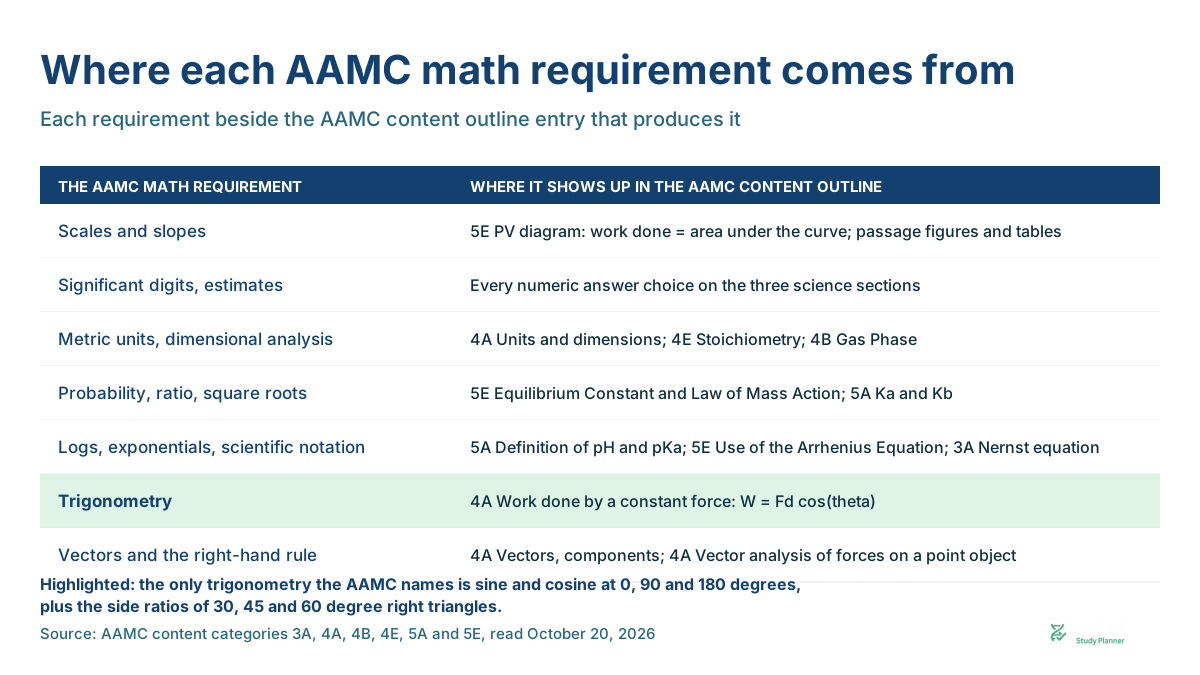
| AAMC requirement | Outline entries that produce it |
|---|---|
| Scales and slopes | 5E “PV diagram: work done = area under or enclosed by curve”; passage figures and tables |
| Significant digits and estimates | Every numeric answer choice on the three science sections |
| Metric units, dimensional analysis | 4A “Units and dimensions”; 4E Stoichiometry; 4B Gas Phase |
| Probability, ratio, square roots | 5E “Equilibrium Constant” and “Law of Mass Action”; 5A “Equilibrium constants Ka and Kb: pKa, pKb” |
| Logs, exponentials, scientific notation | 5A “Definition of pH”; 5E “Use of the Arrhenius Equation”; 3A “Nernst equation” |
| Trigonometry | 4A “Work done by a constant force: W = Fd cos(theta)“ |
| Vectors, right-hand rule | 4A “Vectors, components”; 4A “Vector analysis of forces acting on a point object” |
Two things follow from that table.
The first is that the log work is chemistry work. pH, pKa, the Arrhenius equation and the Nernst equation are all general chemistry entries, and general chemistry is 30 percent of the Chem/Phys section, the largest discipline target in it. Our guide to which general chemistry categories carry the points has the full split and the equation list. The four log values worth memorising are already on our MCAT physics strategy page: log(1) = 0, log(10) = 1, log(2) is about 0.3 and log(5) is about 0.7.
The second is that the trigonometry work is one equation deep.
The Trigonometry Is Smaller Than You Think
Google’s AI Overview for this search describes the requirement as “Estimating sine, cosine, and tangent values for common angles without a calculator (e.g., using simplified decimal approximations).”
That is not what the AAMC asks for. Bullet 6 names values for exactly three angles, 0, 90 and 180 degrees, where sine and cosine are 0 and 1 and nothing needs estimating. For 30, 45 and 60 degrees it asks for something different: “relationships between the lengths of sides of right triangles”. Side ratios, not trig values.
In the content outline, the place this cashes out is 4A, “Work done by a constant force: W = Fd cos(theta)“. An inclined plane, a force at an angle, a component resolved. If you know that cos(0) is 1 and cos(90) is 0, you can sanity-check most of those answers before touching the arithmetic.
Learning the decimal value of sin(37 degrees) is not on the AAMC’s list. Learning that the side ratio of a 30-60-90 triangle is 1 to the square root of 3 to 2 is.
You Have 96.6 Seconds a Question
Here is why estimation beats computation, and the arithmetic is ours.
The AAMC blueprint gives Chem/Phys 59 questions in 95 minutes. That is 5,700 seconds across 59 questions, or 96.6 seconds each. Bio/Biochem and Psych/Soc are the same shape. CARS gets 5,400 seconds across 53 questions, or 101.9 seconds. The assumption in all four figures is an even split across questions, which nobody actually runs.
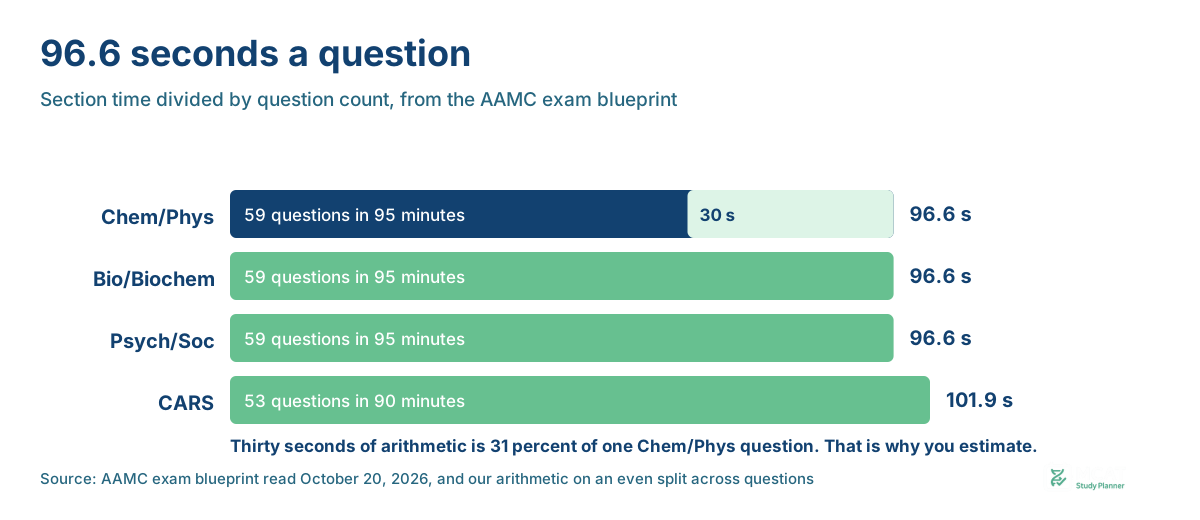
Ninety-six point six seconds has to cover reading the stem, retrieving the relevant equation, setting it up, doing the arithmetic and checking the answer choices. Spend 30 seconds on the arithmetic and you have used 31 percent of the question on the part that carries no content marks.
That is the whole argument for estimation, and it is a timing argument rather than a mathematical one. Our section-by-section MCAT timing guide has the passage-level budgets that sit underneath these per-question numbers.
One more number, and we are labelling it carefully. General chemistry at 30 percent and introductory physics at 25 percent together account for 55 percent of the Chem/Phys section, which is 32.45 of its 59 questions. Those are the two disciplines whose AAMC outline entries name equations. That is exposure, not a count of calculation questions. The AAMC does not publish how many questions require arithmetic, and we are not going to invent a figure for it.
The 15 Minute Drill Block, Placed by Week
Every page on this search says to practise mental math. None of them says when, for how long, or what it displaces. So here is the block, placed inside the four dated plans we already publish.
The rule has three parts. Fifteen minutes every day through your plan’s content block, because that is when you are meeting the equations for the first time. Fifteen minutes three days a week once your scored full lengths start, because by then the drilling happens inside the exams. Nothing in test week.
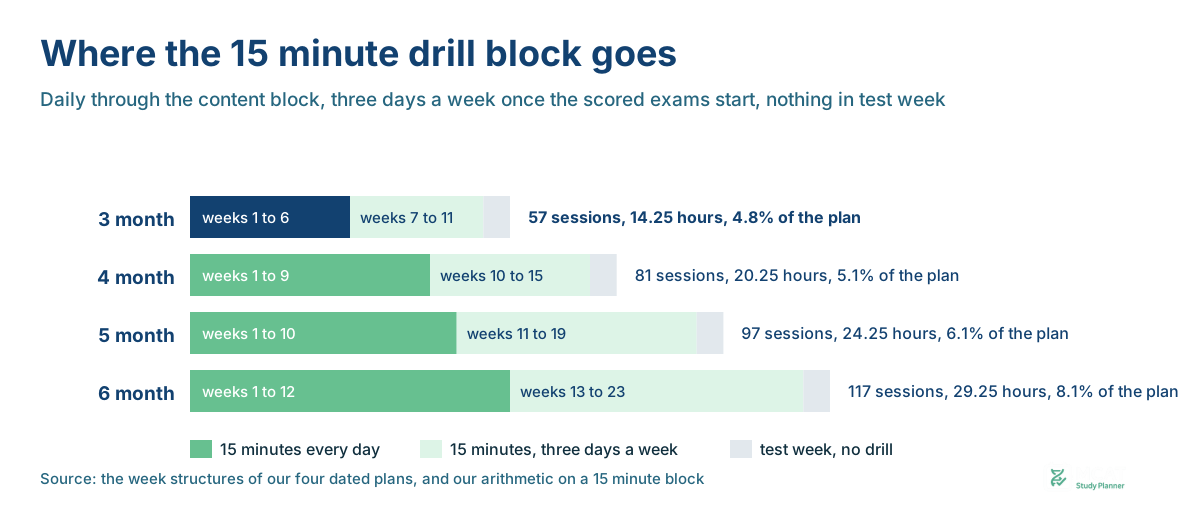
| Plan | Daily block | Then three a week | Sessions | Hours | Share of that plan |
|---|---|---|---|---|---|
| 3 month | weeks 1 to 6 | weeks 7 to 11 | 57 | 14.25 | 4.8 percent of 300 hours |
| 4 month | weeks 1 to 9 | weeks 10 to 15 | 81 | 20.25 | 5.1 percent of 400 hours |
| 5 month | weeks 1 to 10 | weeks 11 to 19 | 97 | 24.25 | 6.1 percent of 400 hours |
| 6 month | weeks 1 to 12 | weeks 13 to 23 | 117 | 29.25 | 8.1 percent of 360 hours |
The week boundaries come from each plan’s own published structure. The session counts and hours are our arithmetic on a 15 minute block, and the percentages are against each plan’s own budget at the weekly hours that plan recommends. The totals they are a share of come from our analysis of 43 real reports.
Under five percent of a three-month plan is a cheap insurance policy on 32 questions’ worth of exposure. If you want those blocks landing on actual dates rather than week numbers, the free MCAT study schedule generator takes your test date and your weekly hours and places them for you.
What goes in the 15 minutes, in rough order of payoff:
- Powers of 10 and scientific notation, multiplying and dividing without writing anything down
- The four log values, then pH and pKa questions until they are reflexive
- Percentage and ratio arithmetic against the answer choices rather than to completion
- Square-root estimation, which bullet 4 names and almost nobody drills
- Metric prefix conversions, which stay yours because only the English ones are provided
Use real stems rather than drill sheets. Our guide to where to find official MCAT practice questions covers the banks worth running these on.
The habit that matters most: read the four answer choices before you start calculating. If they are an order of magnitude apart, you do not need the second significant digit. The AAMC asks for “reasonable numerical estimates” in bullet 2 for exactly this reason.
What the Ranking Pages Get Wrong
We pulled the live results for “mcat math” on October 20, 2026. Position 3 is Blueprint’s no-calculator post. Positions 4, 6, 7, 9, 10, 11, 13 and 14 are a Reddit thread, a Quizlet set, four YouTube videos, a Pinterest pin and an iOS app. Position 8 is a paid course.
Blueprint’s page, by Brian McGrew, dated October 10, 2024, covers units, choosing equations, and three calculation errors: sign mistakes on negative numbers, dividing by a number less than 1, and distribution errors when rearranging. It is reasonable advice and it is well written. It cites no AAMC page anywhere, lists nothing about what is tested, and never mentions logarithms, scientific notation or trigonometry. Its worked conversion example is 1 foot to 0.3 metres, which is precisely the kind of factor the exam supplies.
The AI Overview is the bigger problem, because it is the answer most people will see. Two of its five skill categories misstate the source. It tells you to learn “Metric prefixes (from femto- to giga-)” without mentioning that cross-system conversion factors are provided. It tells you to estimate “sine, cosine, and tangent values for common angles” when the AAMC names values at only three angles and side ratios at the other three. It cites kaptest.com, YouTube and Reddit, and no primary source.
None of this is hidden. The list is published, free, and dated. It just sits on a branch of the AAMC site that the SERP has not found.
The Whole Thing on One Page
| Item | Where it stands |
|---|---|
| Calculator | Not permitted. Six items allowed, four provided at the test center |
| What you get instead | A noteboard booklet of nine 14-by-8.5-inch wet-erase pages and a fine-point marker |
| Sections with a math requirement | Chem/Phys, Bio/Biochem, Psych/Soc. Not CARS |
| Number of AAMC requirements | Seven |
| Explicitly not required | Calculus; dot and cross products |
| Provided to you | The periodic table (Chem/Phys and Bio/Biochem); metric-to-English conversion factors when needed |
| Trigonometry actually named | sin and cos at 0, 90, 180 degrees; side ratios of 30, 45, 60 degree right triangles |
| Algebra ceiling | Algebra II-level |
| Seconds per science question | 96.6, our arithmetic on 59 questions in 95 minutes |
| Cost of a 30 second calculation | 31 percent of one question |
| Drill block | 15 minutes daily through content review, three days a week through the exam block |
| Cost on a 12 week plan | 57 sessions, 14.25 hours, 4.8 percent of the budget |
| Everything above verified | students-residents.aamc.org, read October 20, 2026 |
The list has been sitting there the whole time. Print the seven bullets, cross off the four things you do not need, and give the rest 15 minutes a day until your first scored full length. To put those blocks on dated days alongside your content review and your exams, build your MCAT schedule around your test date and the hours you can actually hold.
Written by
MCAT Study Planner Team
Last updated 10/20/2026