
MCAT Biology: What Is Tested and How to Study It
By MCAT Study Planner Team • Updated 10/12/2026
Short answer: biology is about 44.25 questions on an MCAT test form, which is a quarter of the science content and the largest single discipline on the exam. It is also the only subject the AAMC lists in all three science sections. We read every page of the published content outline on October 12, 2026 to get those numbers.
Every page that ranks for this search tells you biology is 65 percent of the Bio/Biochem section. That is true and it is the wrong frame.
It counts biology once, in the section named after it, and misses the 5.9 questions sitting in Chem/Phys and Psych/Soc. It gives you a percentage of a section rather than a number of questions. And it leaves “high yield” as an opinion, because nobody has worked out what the AAMC’s own topic list is actually worth.
The 30-second answer: The AAMC targets introductory biology at 65 percent of Bio/Biochem, 5 percent of Chem/Phys and 5 percent of Psych/Soc. At 59 questions a section that is 44.25 questions, exactly 25.00 percent of the 177 science questions and 19.2 percent of all 230. Biology is the only discipline named in all three science sections and the only one present in all nine Bio/Biochem content categories. Of the 31 content categories, 14 carry biology and 17 carry none. Two categories, gene-to-protein and the organ systems, are worth about 18.5 questions between them. Give biology a quarter of your content-review window, which is 3 days on an 8-week plan and 21 days on a 24-week plan.
In this guide
- Biology is the only subject in all three science sections
- What that works out to in questions
- Where the biology actually sits in the outline
- Which content categories are worth the most
- Seventeen content categories have no biology at all
- Only 35 percent of the section is knowledge
- How long a biology block should be
- The order to study it in
- What the ranking pages get wrong
- Every number on one page
Biology Is the Only Subject in All Three Science Sections
We read all four section overview pages on students-residents.aamc.org on October 12, 2026. Here is the introductory biology target the AAMC publishes for each one.
| Section | Questions | Time | Introductory biology |
|---|---|---|---|
| Biological and Biochemical Foundations of Living Systems | 59 | 95 minutes | 65 percent |
| Chemical and Physical Foundations of Biological Systems | 59 | 95 minutes | 5 percent |
| Psychological, Social, and Biological Foundations of Behavior | 59 | 95 minutes | 5 percent |
| Critical Analysis and Reasoning Skills | 53 | 90 minutes | no science content |
No other discipline appears in all three. First-semester biochemistry is listed in two sections, general chemistry in two, organic chemistry in two, introductory physics in one, and psychology and sociology in one each. Biology is the only one that follows you everywhere.
The Psych/Soc page carries a footnote that almost nobody quotes. In the AAMC’s words: “Please note that about 5% of this test section will include psychology questions that are biologically relevant. This is in addition to the discipline target of 5% for introductory biology specified for this section.”
So roughly a tenth of Psych/Soc is biology or biologically framed psychology, not the 5 percent the discipline table shows on its own. If you want the rest of that section mapped the same way, we did it in the AAMC skill weighting.
One caveat the AAMC prints under every one of those tables, and which applies to every number in this guide: “These percentages have been approximated to the nearest 5% and will vary from one test to another for a variety of reasons. These reasons include, but are not limited to, controlling for question difficulty, using groups of questions that depend on a single passage, and using unscored field-test questions on each test form.”
These are the shape of a test form, not a promise about yours.
What That Works Out to in Questions
Percentages of a section are hard to compare. Questions are not. Multiply each published discipline target by that section’s published question count and add across sections. This table is our arithmetic on the AAMC’s numbers, nothing more.
| Discipline | Questions on a form | Share of the 177 science questions |
|---|---|---|
| Introductory biology | 44.25 | 25.00 percent |
| Introductory psychology | 38.35 | 21.67 percent |
| First-semester biochemistry | 29.50 | 16.67 percent |
| General chemistry | 20.65 | 11.67 percent |
| Introductory sociology | 17.70 | 10.00 percent |
| Introductory physics | 14.75 | 8.33 percent |
| Organic chemistry | 11.80 | 6.67 percent |
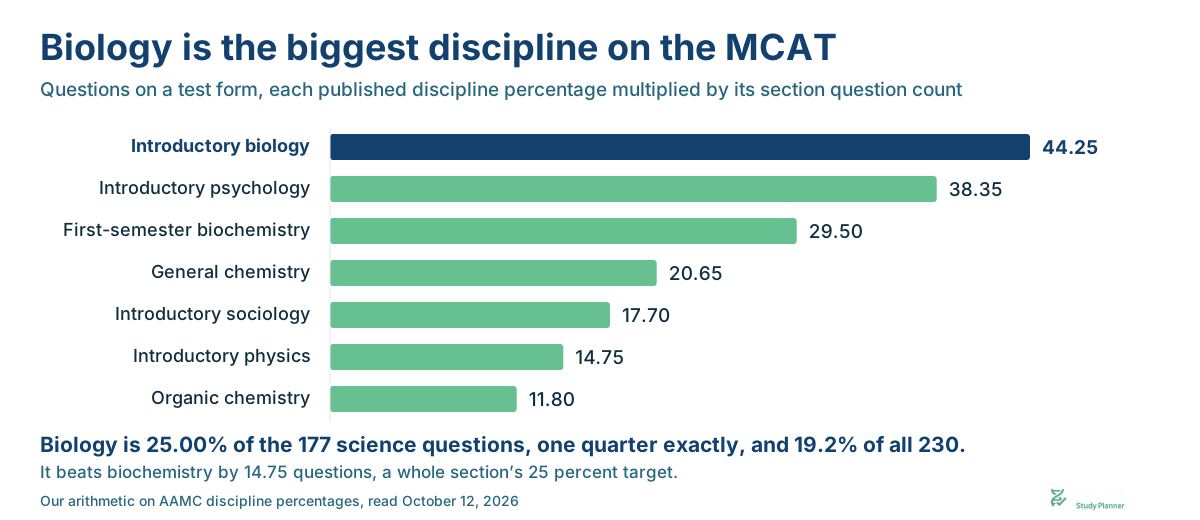
Biology lands at 44.25, which is 25.00 percent of the 177 science questions. Exactly one quarter, which falls out of the AAMC’s own rounded percentages rather than being tidied up by us.
A few comparisons worth holding onto. Biology beats biochemistry by 14.75 questions, which is a whole section’s 25 percent target. It is three times introductory physics and 3.75 times organic chemistry. Against all 230 questions on the exam, CARS included, biology is 19.2 percent.
And 5.90 of those 44.25 sit outside Bio/Biochem: 2.95 in Chem/Phys and 2.95 in Psych/Soc. That is more than a scored question on each of those sections than most study plans account for.
Where the Biology Actually Sits in the Outline
The AAMC’s content outline tags every topic heading with the course it is learned in. The key is printed on every content category page: “The abbreviations found in parentheses indicate the course(s) in which undergraduate students at many colleges and universities learn about the topics and associated subtopics.”
Its code for biology is BIO, and the definition is worth reading twice: “BIO = two-semester sequence of introductory biology”. Compare that to “BC = first-semester biochemistry” and “PSY: one semester of introductory psychology”. Biology is the heaviest coursework assumption the outline makes.
We fetched all 31 content category pages on October 12, 2026 and counted the tagged headings. The published outline carries 148 topic headings across 10 foundational concepts. 58 of them are tagged BIO.
| Content category | Section | Biology headings |
|---|---|---|
| 1A Proteins and amino acids | Bio/Biochem | 4 of 5 |
| 1B Gene to protein | Bio/Biochem | 10 of 10 |
| 1C Heritable information | Bio/Biochem | 3 of 3 |
| 1D Bioenergetics and fuel metabolism | Bio/Biochem | 4 of 8 |
| 2A Assemblies of molecules and cells | Bio/Biochem | 4 of 4 |
| 2B Prokaryotes and viruses | Bio/Biochem | 6 of 6 |
| 2C Cell division and differentiation | Bio/Biochem | 4 of 5 |
| 3A Nervous and endocrine systems | Bio/Biochem | 4 of 7 |
| 3B Organ systems | Bio/Biochem | 11 of 11 |
| 4B Fluids, circulation and gas exchange | Chem/Phys | 1 of 3 |
| 4C Electrochemistry and circuits | Chem/Phys | 1 of 5 |
| 5D Biologically relevant molecules | Chem/Phys | 1 of 12 |
| 6A Sensing the environment | Psych/Soc | 4 of 5 |
| 7A Individual influences on behavior | Psych/Soc | 1 of 5 |
Biology is in all nine Bio/Biochem content categories. No other discipline manages that: biochemistry reaches six of the nine, organic chemistry three, general chemistry two, and physics none at all.
Four of those categories are biology end to end. 1B, 1C, 2A and 2B have no heading tagged with anything else, and 3B is eleven organ systems with no other course named.
42 of the 58 headings carry BIO as their only tag. The other 16 are shared, mostly with biochemistry in 1A, 1D, 2A and 5D, and with psychology across all five headings in 6A and 7A. Those shared ones are the cheapest questions on the exam, because one evening of study is earning points in two sections.
Three topic names appear in two different categories: Reproductive System in 2C and again in 3B, Circulatory System in 3B and again in 4B, and the nerve cell, listed as “Nerve Cell” in 3A and as “Specialized Cell - Nerve Cell” in 4C. The AAMC warns what that means: “Please note topics that appear on multiple content lists will be treated differently. Questions will focus on the topics as they are described in the narrative for the content category.” The circulatory system in 4B is a fluids problem, not a physiology one.
Which Content Categories Are Worth the Most
The AAMC publishes percentages down to the foundational concept and stops. It never says what a content category is worth. So we worked it out, and then checked the working against the AAMC’s own published numbers before trusting it.
The method has two assumptions, both of them crude and both stated here so you can discount them. First, topic headings inside a foundational concept are weighted equally. Second, a heading tagged with two courses splits evenly between them.
Run that over all 148 headings and it should reproduce the AAMC’s published discipline splits. It nearly does.
| Section | What our model returns | What the AAMC publishes |
|---|---|---|
| Psych/Soc | psychology 65, sociology 29, biology 6 | 65, 30, 5 |
| Chem/Phys | gen chem 27, physics 25, organic 21, biochem 21, biology 5 | 30, 25, 15, 25, 5 |
| Bio/Biochem | biology 73, biochem 21, organic 4, gen chem 2 | 65, 25, 5, 5 |
Psych/Soc comes back within a point on all three disciplines. Chem/Phys is exact on physics and on biology. Bio/Biochem overweights biology by 8 points. Good enough to rank categories, not good enough to replace the AAMC’s own figures, so the table below is scaled to make each section total the published biology target.
| Content category | Section | Scored biology questions |
|---|---|---|
| 1B Gene to protein | Bio/Biochem | 10.5 |
| 3B Organ systems | Bio/Biochem | 8.0 |
| 2B Prokaryotes and viruses | Bio/Biochem | 4.2 |
| 1C Heritable information | Bio/Biochem | 3.3 |
| 3A Nervous and endocrine systems | Bio/Biochem | 2.9 |
| 2C Cell division and differentiation | Bio/Biochem | 2.8 |
| 2A Assemblies of molecules and cells | Bio/Biochem | 2.4 |
| 6A Sensing the environment | Psych/Soc | 2.2 |
| 1D Bioenergetics and fuel metabolism | Bio/Biochem | 2.2 |
| 1A Proteins and amino acids | Bio/Biochem | 2.0 |
| 4B Fluids, circulation and gas exchange | Chem/Phys | 1.1 |
| 4C Electrochemistry and circuits | Chem/Phys | 1.1 |
| 5D Biologically relevant molecules | Chem/Phys | 0.8 |
| 7A Individual influences on behavior | Psych/Soc | 0.7 |
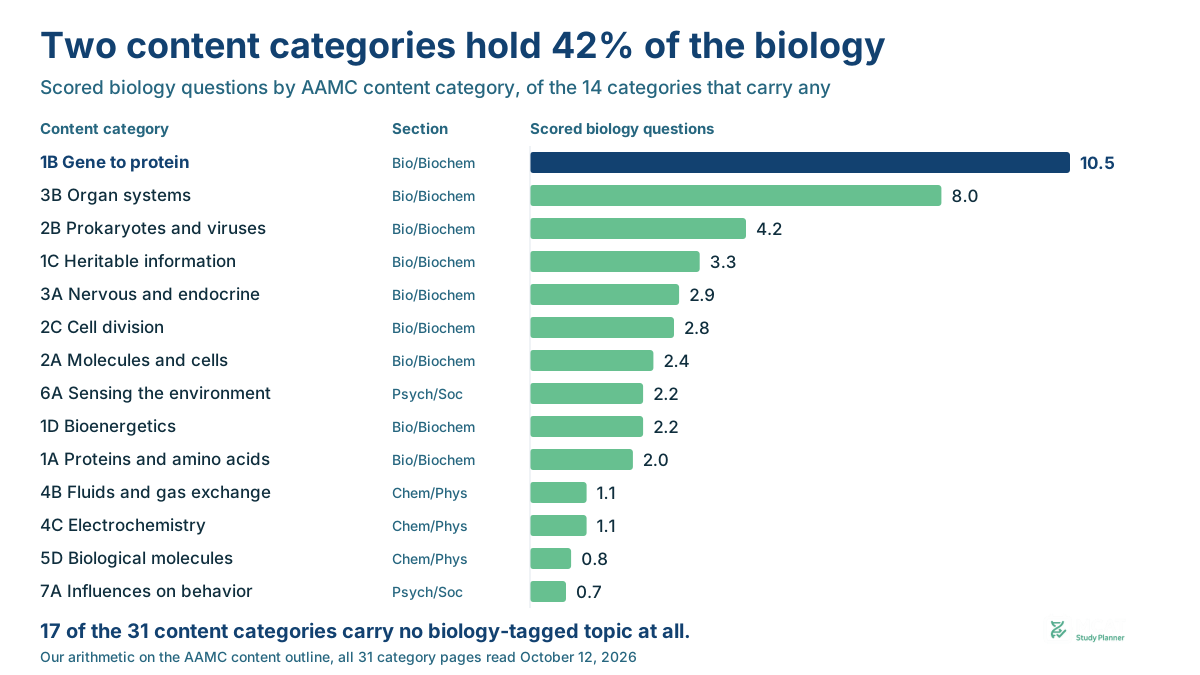
1B and 3B together are 18.5 questions. That is 42 percent of all the biology on a form, from two of the 31 content categories, and more than the other twelve biology-bearing categories put together.
That result disagrees with the one article ranking for this search, which calls amino acids and enzymes “arguably the single highest-yield category in all of Bio/Biochem”. Category 1A ranks tenth here, at about 2.0 questions. It is high-yield for biochemistry, where 1A is five of five tagged headings. It is not where the biology is.
Seventeen Content Categories Have No Biology At All
The outline has 31 content categories. Biology appears in 14. These 17 carry no biology-tagged heading whatsoever: 4A, 4D, 4E, 5A, 5B, 5C, 5E, 6B, 6C, 7B, 7C, 8A, 8B, 8C, 9A, 9B and 10A.
That is the whole of foundational concepts 8, 9 and 10, which is self-identity, social thinking, social interactions, social structure, demographics and social inequality. It is also translational motion and forces, light and sound, atomic structure, the properties of water, intermolecular interactions, separations, and thermodynamics and kinetics.
Do this now: open the AAMC content outline and mark the nine Bio/Biochem categories plus 4B, 4C, 5D, 6A and 7A. That is your biology. Everything else in those 31 categories belongs to another discipline’s study block, and reviewing it as biology is how a two-week block turns into five.
Only 35 Percent of the Section Is Knowledge
Here is the number that decides how you study, and it is the same for all three science sections. The AAMC publishes the scientific inquiry and reasoning skill split as Skill 1 at 35 percent, Skill 2 at 45 percent, Skill 3 at 10 percent and Skill 4 at 10 percent.
Skill 1 is knowledge of scientific concepts and principles. Skill 2 is scientific reasoning and problem solving. Skills 3 and 4 are research design and data analysis.
So the part of Bio/Biochem that rewards having learned the outline is 35 percent. Twenty of the 59 questions, by our arithmetic. The other 39 want you to reason about an experiment you have never seen.
This is why a biology block built entirely out of content review underperforms. The 58 topic headings are the entry fee, not the score. Once you can state what is in 1B and 3B, the gains come from working practice questions and reading the data in the passage, not from another pass through the chapter.
The 42 biology-only headings are the ones worth putting on cards, and the best MCAT Anki decks already map to the AAMC categories, so you can load 1B and 3B first rather than starting at deck position one.
How Long a Biology Block Should Be
If biology is one quarter of the science content, it gets one quarter of your content-review window. Content review covers only the three science sections, so the 177-question denominator is the right one.
Our own published plans set the windows. The 8-week MCAT plan runs content triage on days 3 to 14. The 12-week plan runs content review through day 42. The 16-week plan runs it through week 9, and the 24-week plan through week 12. Divide by four and convert each plan’s weekly hour band at seven days a week.
| Your plan | Content-review days | Biology days | Biology hours |
|---|---|---|---|
| 8 weeks | 12 | 3.0 | 10.7 to 17.1 |
| 12 weeks | 42 | 10.5 | 30.0 to 45.0 |
| 16 weeks | 63 | 15.8 | 33.8 to 56.2 |
| 24 weeks | 84 | 21.0 | 36.0 to 45.0 |
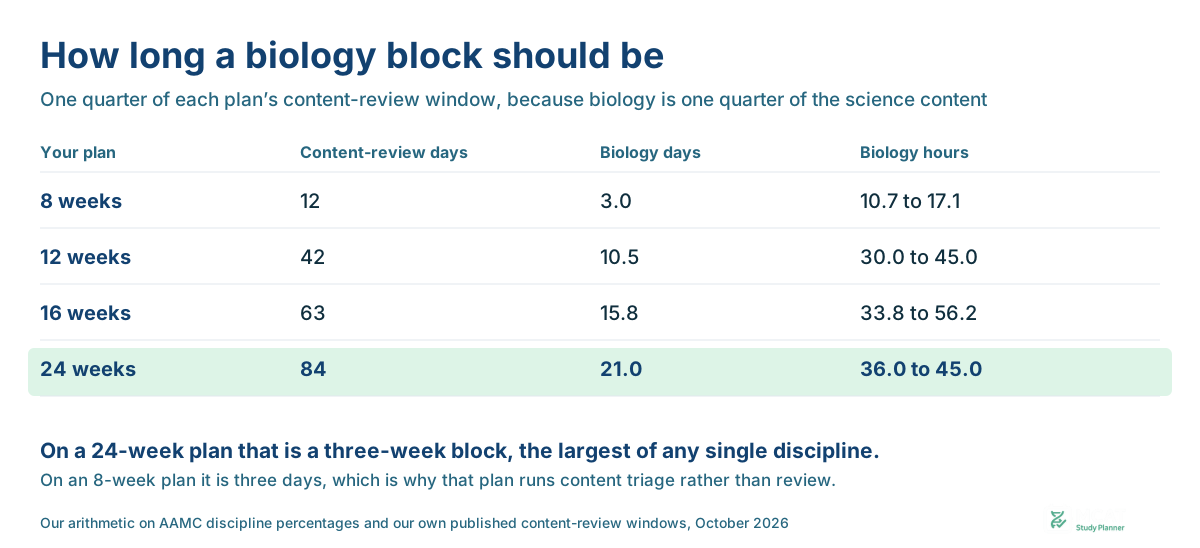
On the two longer plans this is a two to three week biology block, and it is the largest single-discipline block in the whole schedule. Biochemistry gets about two weeks on the same 24-week plan. Biology gets three.
The 8-week row is the warning. Three days and 11 to 17 hours does not cover 58 topic headings, which is exactly why that plan schedules triage rather than review. If your date forces that row, spend the three days on 1B and 3B and let the rest arrive through practice questions.
Those are the same two inputs any schedule is built from. Feed your test date and your honest weekly hours into the free MCAT study schedule generator and it lays the content-review window out day by day, so you can put a real three-week block on real dates instead of a rule of thumb.
If you want the hour budget those bands come from, our analysis of 43 real reports has the totals.
The Order to Study It In
The ranking above is the order. Four blocks, heaviest first.
- 1B and 1C, then 3B. Gene to protein, heritable information and the organ systems. 21.8 questions between them, just under half the biology on the exam. 1B and 1C are one continuous story, from DNA structure through replication, transcription, translation and gene control to recombinant DNA, then Mendelian inheritance and meiosis. 3B is eleven systems and the only honest way through it is one system a day.
- 2A, 2B and 2C. Cell structure, prokaryotes and viruses, and cell division and development. 9.4 questions, and the fastest returns in the set because 2B is six headings that are entirely biology and almost entirely recall.
- 3A and 1D. The nervous and endocrine systems, and fuel metabolism. 5.1 questions of biology, but both categories are shared with other disciplines, so the real return is higher than the biology column shows. 1D is where biology and biochemistry overlap most, and our biochemistry guide treats it as a biochemistry category worth 8 of 8 tagged headings.
- 1A, 6A, 7A, 4B, 4C and 5D. The scattered 7.8. 6A and 7A are the ones to prioritize here, because sensory processing, vision, hearing and the biological bases of behavior are tagged for both biology and psychology, so they count twice.
Slot that order into the 10-week content review schedule and the biology block has a shape instead of a reading list.
What the Ranking Pages Get Wrong
The search results for this term are unusually thin. Of the ten organic results we pulled on October 12, 2026, two are YouTube videos, one is a Spotify show, one is a Quizlet flashcard set, one is a university library guide, one is a question-of-the-day tool and one is a paid tutorial course at $19.99 a month. Exactly one is an article making an argument.
That article contains no numbers at all. Its FAQ says biology-specific content “makes up roughly half of that section”, where the AAMC publishes 65 percent for the same section on its own page. It names six high-yield categories in an order that puts amino acids and enzymes first, which our ranking puts tenth.
None of the ten count biology outside Bio/Biochem, so the 5.9 questions in Chem/Phys and Psych/Soc appear nowhere.
The AI Overview sitting above those results is more specific and partly unsourced. It gives the 65 percent, the 59 questions and the 95 minutes, all of which match the AAMC. It then states a passage structure: 10 experimental and research passages carrying 44 questions, plus 15 standalone discrete questions. We could not find that split on any AAMC page. The Bio/Biochem section overview publishes only “59 (note that questions are a combination of passage-based and discrete questions)”, and the broader prepare and taking-the-exam pages give no passage count either. Treat the 10 and the 44 as unverified.
Every Number on One Page
Everything above, with its source. The AAMC figures were read from students-residents.aamc.org on October 12, 2026. The rest is our arithmetic on them.
| Figure | Value | Where it comes from |
|---|---|---|
| Biology in Bio/Biochem | 65 percent of 59 | AAMC section overview |
| Biology in Chem/Phys | 5 percent of 59 | AAMC section overview |
| Biology in Psych/Soc | 5 percent of 59, plus a 5 percent footnote | AAMC section overview |
| Biology questions on a form | 44.25 | our arithmetic |
| Share of the science sections | 25.00 percent | 44.25 of 177 |
| Share of the whole exam | 19.2 percent | 44.25 of 230 |
| Rank among the seven disciplines | first | our arithmetic |
| Topic headings tagged BIO | 58 of 148 | our count of all 31 category pages |
| Categories carrying biology | 14 of 31 | same count |
| Bio/Biochem categories carrying biology | 9 of 9 | same count |
| Biggest category | 1B, about 10.5 questions | our arithmetic |
| Second biggest | 3B, about 8.0 questions | our arithmetic |
| Knowledge share of the section | 35 percent | AAMC skill split |
| Biology block, 24-week plan | 21.0 days, 36 to 45 hours | our arithmetic |
| Biology block, 8-week plan | 3.0 days, 10.7 to 17.1 hours | our arithmetic |
The two numbers to act on are the quarter and the ranking. A quarter of your content-review window belongs to biology, and inside it the gene-to-protein and organ-system categories are worth more than everything else combined.
Build your MCAT schedule with your real test date and the hours you actually have, and the block lands on dates you can keep.
Written by
MCAT Study Planner Team
Last updated 10/12/2026