
How to Review MCAT Practice Tests (A 4-Hour System)
By MCAT Study Planner Team • Updated 11/6/2026
Short answer: budget four hours, split into four timed blocks, and accept that it covers about 37 questions. That is 16 percent of a 230-question exam, so unless you scored roughly 84 percent or better, the job is triage and not “review everything”.
Every guide on this search tells you to review every question, tag every error and look for patterns. None of them tells you how long any of that takes.
That omission is the whole problem. A review with no clock attached is a review you abandon at hour six with the Psych/Soc section untouched.
The 30-second answer: review the day after the exam, never the same day. Give it four hours: 20 minutes on the score, 25 on timing, 150 on the error log, 45 on patterns. The error-log block holds about 37 questions at 4 minutes each, so sort your misses before you start. Tag each one to the AAMC’s own skill list rather than a tag list you invented, because the AAMC publishes a percentage weight for each skill and that weight tells you which fix is worth the most points.
In this guide
- Why “review everything” is not advice
- The four-hour protocol, block by block
- What four hours actually holds
- Tag every miss to the AAMC’s skill list, not your own
- The error log, as a table you copy
- The content-review instinct chases the smaller number
- The two skills almost nobody drills
- CARS gets its own three tags
- What to do with the log before the next exam
- The whole protocol on one page
Why “Review Everything” Is Not Advice
We read the three most substantial guides on this search on November 6, 2026. Here is every time figure the three of them publish between them.
| Page | Structure it gives | Time figures it gives |
|---|---|---|
| Blueprint, “How to Review MCAT Full Lengths” | Six stages, from light wrong-answer review up to breaking down every passage | None, for any stage |
| Sketchy, “How to Review MCAT Practice Test Results Like a Pro” | Four questions to ask yourself, then write the patterns down by hand | Review “the day after you take them, or two days after at the absolute most” |
| Jack Westin, “How to Review for the MCAT” | A four-column tracker and nine error tags | ”Early in prep, review time often equals or exceeds test time” |
Blueprint’s page is the honest one. It says outright that you will not always have “an empty hours-long block of time”, then lays out six stages ending in reading every passage of the exam again, and never says how long one stage runs.
Jack Westin’s page gives the one quantitative rule on the SERP, so it is worth doing the arithmetic on it. MCAT testing time is 6 hours 15 minutes, or 375 minutes, over 230 questions, per the AAMC’s exam structure. Review for as long as you tested and you are spending 375 divided by 230, which is 1.6 minutes a question. That is our arithmetic on the AAMC’s own counts, and it is exactly the rate you had while the clock was running. A rule that tells you to review at test speed is not a review plan.
Google’s AI Overview for this search does better on the deadline and no better on the budget. It says to finish within 1 to 2 days and to expect “a full day to several days”, which spans a factor of five.
Here is the number those pages leave out. Reviewing all 230 questions at 4 minutes each, which is what it takes to read the explanation, reconstruct your own reasoning and write a log row, is 920 minutes. That is 15 hours 20 minutes. Nobody does that, which is why nearly everyone quietly abandons the review somewhere in the third section.
The Four-Hour Protocol, Block by Block
Four hours, four blocks, a timer on each. The budget is ours, not an AAMC recommendation, and the point of publishing it as minutes is that you can tell when you are over.
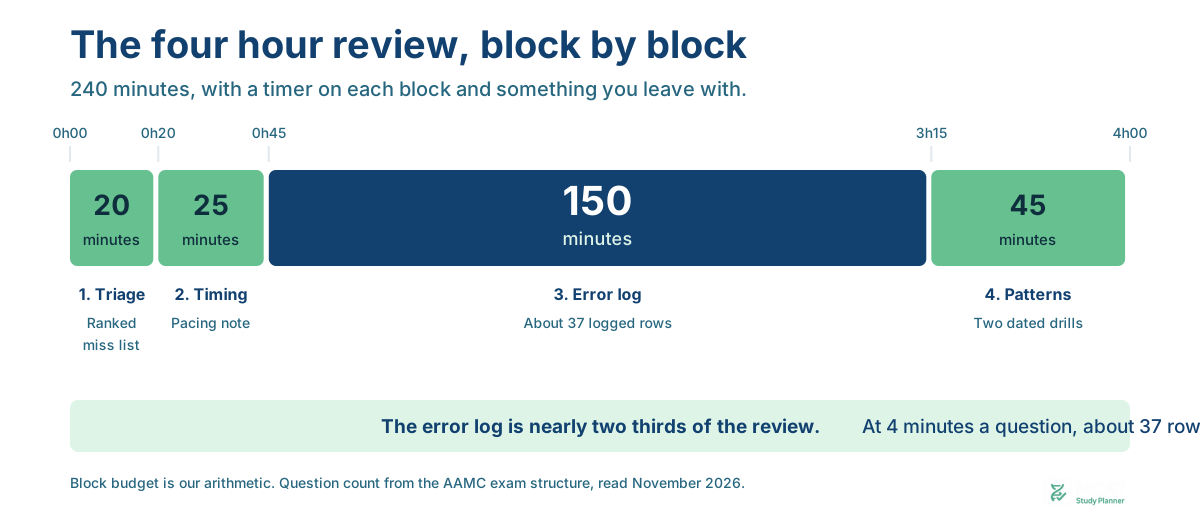
| Block | Minutes | What you do | What you leave with |
|---|---|---|---|
| 1. Score read and triage | 20 | Section scores, then sort the miss list. Rank every missed question by whether the topic recurs. Mark the ones you will log | A ranked miss list, cut to fit block 3 |
| 2. Timing audit | 25 | For each section, note where you ran out of clock and which passage you rushed. Compare against the section clocks | A per-section pacing note |
| 3. The error log | 150 | Work the ranked list. One row per question, six columns, the AAMC skill tag on every row | About 37 completed rows |
| 4. Pattern pass and scheduling | 45 | Count rows by skill tag. Pick the top two. Put the drills on specific days | Two dated drill blocks |
Block 1 is the one people skip, and skipping it is what makes the review run long. You cannot triage a list you have not ranked, and at the end of block 3 the timer stops whether you are finished or not.
Do this the day after the exam. Sketchy puts it at the day after, “or two days after at the absolute most”, and that matches the AI Overview. The same day does not work: an MCAT sitting runs about 7 hours 30 minutes door to door, and you cannot honestly reconstruct your own reasoning on that much fatigue.
Do this now: open the calendar and put a four-hour block on the day after your next full length, before you take it. A review you schedule after the fact competes with whatever was already there and loses. If your exam dates are not on a calendar yet, the free MCAT study schedule generator places the full lengths and the review blocks together from your test date and your hours a week.
What Four Hours Actually Holds
The error-log block is 150 minutes. Divide by your working rate per question and that is your capacity. This is our arithmetic, and the 4-minute figure is an assumption we are stating rather than a measurement.
| Minutes per question | Questions the 150-minute block covers | Share of a 230-question exam |
|---|---|---|
| 3 | 50 | 21.7% |
| 4 | 37 | 16.1% |
| 5 | 30 | 13.0% |
| 6 | 25 | 10.9% |
Now put that against the miss list. The MCAT is 230 questions, per the AAMC. At 4 minutes each, here is what your score implies.
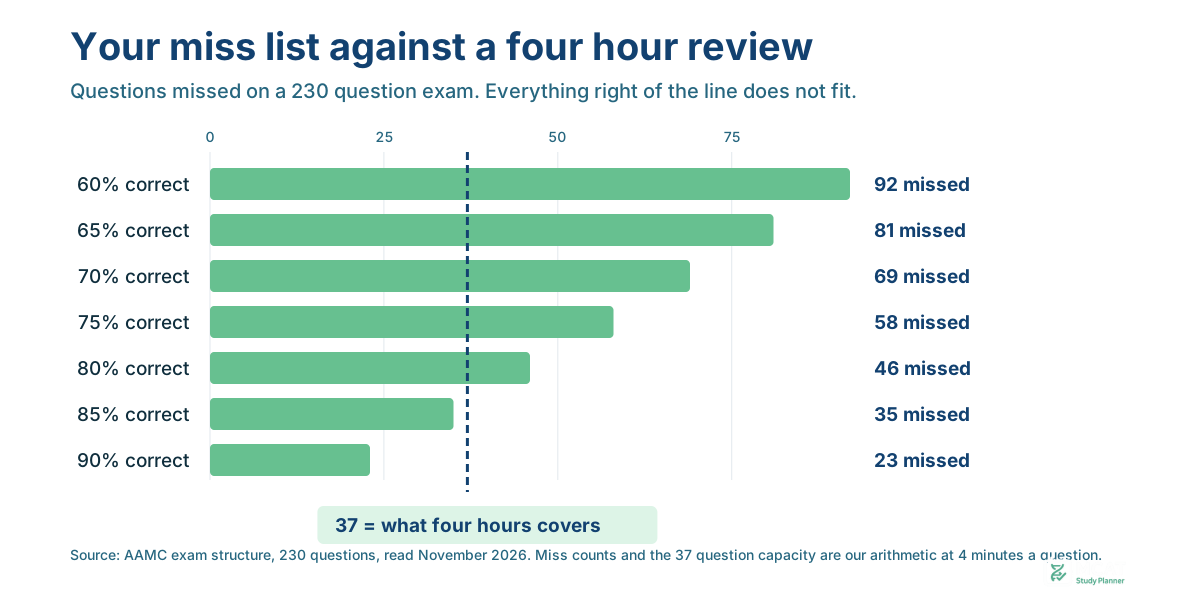
| Percent correct | Questions missed | Minutes to log them all | Fits the 150-minute block? |
|---|---|---|---|
| 60% | 92 | 368 | No, 2.5 blocks |
| 65% | 81 | 324 | No |
| 70% | 69 | 276 | No |
| 75% | 58 | 232 | No |
| 80% | 46 | 184 | No, just over |
| 85% | 35 | 140 | Yes |
| 90% | 23 | 92 | Yes, with room |
The break-even is 37.5 questions, which is 16.3 percent of 230. So the whole miss list fits inside a four-hour review only if you scored about 84 percent or better.
Below that, triage is not laziness. It is the only thing the clock allows. Rank the misses in block 1 by whether the underlying topic will appear again, log the top 37, and leave the rest.
One adjustment. Every guide on this search, correctly, tells you to review questions you guessed or flagged and got right. Those come out of the same 37. If you flag 10 percent of the exam that is 23 more questions and about 92 more minutes, so either extend the block or drop 23 low-value misses to make room.
Tag Every Miss to the AAMC’s Skill List, Not Your Own
Every page we read builds a private tag list. Blueprint uses knowledge, reasoning, reading comprehension and attention to detail. Jack Westin uses nine tags. Sketchy uses three.
The problem with a private list is that no tag on it has a weight. You end the review with eleven rows tagged “reasoning” and nothing telling you what eleven is worth.
The AAMC publishes the real list, and it publishes a percentage next to each entry. Each of the three science sections draws on four Scientific Inquiry and Reasoning Skills in the same proportions, which we read on the AAMC’s section-overview pages on November 6, 2026.
| AAMC skill | Share of each science section | Questions across the exam |
|---|---|---|
| Skill 1, Knowledge of Scientific Concepts and Principles | 35% | about 62 |
| Skill 2, Scientific Reasoning and Problem-solving | 45% | about 80 |
| Skill 3, Reasoning about the Design and Execution of Research | 10% | about 18 |
| Skill 4, Data-based Statistical Reasoning | 10% | about 18 |
The question counts are our arithmetic. The three science sections are 59 questions each, so 177 together, and applying the published percentages gives the right column. The AAMC notes on each of those pages that the percentages are “approximated to the nearest 5% and will vary by test from one test to another”, so read these as about, not exactly. Rounding to whole questions is also why the column sums to 178 rather than 177.
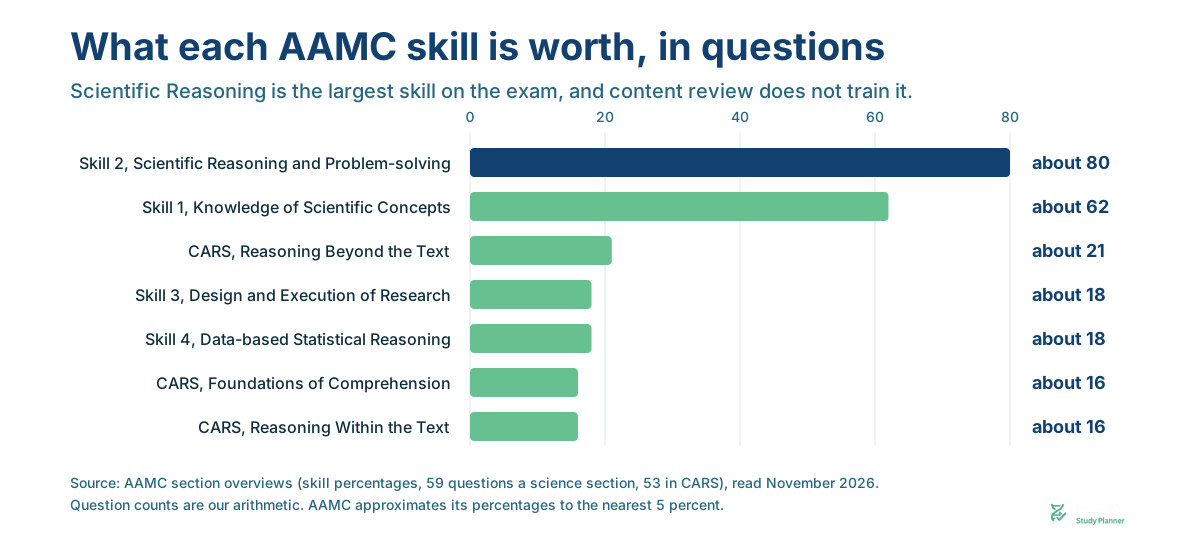
Now a tag carries a number. Nine rows tagged Skill 4 means nine of the roughly 18 statistical-reasoning questions on the exam, which is half of them, and that is a sentence you can act on.
The Error Log, as a Table You Copy
Six columns. Copy this into a sheet or a notebook, one row per question, and keep the same file across every full length so the counts accumulate.
| Q | Section | AAMC skill | What I did | What the test wanted | Fix, one drill |
|---|---|---|---|---|---|
| 14 | C/P | Skill 2, Scientific Reasoning | Picked the equation by matching units | Recognize the system was at equilibrium before choosing | 10 equilibrium-vs-kinetics stems, Thursday |
| 31 | B/B | Skill 4, Data-based Statistical Reasoning | Read the error bars as a significance claim | Overlapping intervals do not settle significance | Figure-reading set, 20 minutes Friday |
| 52 | CARS | Reasoning Beyond the Text | Chose the answer the passage supports | Apply the author’s argument to a new case | 3 passages, Beyond-the-Text questions only, Saturday |
Three rules make the log worth the 4 minutes.
Write what you actually did, in your own words, before you read the explanation. A row that says “careless” records nothing. A row that says “picked the equation by matching units” names a habit you can drill.
Give every row exactly one skill tag. Most misses have two plausible tags; pick the earliest failure in the chain, because that is the one the drill has to fix.
Every row ends in a drill with a day on it. A fix with no date is a fix that does not happen, and block 4 exists to put those dates on the calendar. This is the step where the MCAT study planner earns its keep, since the drill blocks have to land in a week that already has content review and the next exam in it.
The Content-Review Instinct Chases the Smaller Number
Here is what the weights change. After a bad full length, almost everyone goes back to content review.
Content review trains Skill 1, Knowledge of Scientific Concepts and Principles. That is 35 percent of each science section, or about 62 questions across the exam.
Skill 2, Scientific Reasoning and Problem-solving, is 45 percent, or about 80 questions. It is the largest single skill on the test by 18 questions, and rereading a review book does not train it. Working problems backward from the answer choices and reconstructing why the trap option was built does.
So the default response to a disappointing score points at the smaller of the two numbers. That is not an argument against content review, which you need when the log genuinely says Skill 1. It is an argument for letting the log decide, because the log is the only thing that knows which of the two you are short on.
If your log comes back Skill 1 heavy, the fix is a content block, and our 10-week content review schedule is built for that. If it comes back Skill 2 heavy, more passages is the fix, not more pages.
The Two Skills Almost Nobody Drills
Skills 3 and 4 are 10 percent of each science section each. Together that is about 36 questions on a full exam, our arithmetic on the AAMC’s published weights.
Thirty-six questions is almost 16 percent of the test. It is more than the roughly 21 questions that CARS Reasoning Beyond the Text is worth, and Reasoning Beyond the Text gets written about constantly.
Skill 3 is Reasoning about the Design and Execution of Research. Skill 4 is Data-based Statistical Reasoning. Neither is in a content review book in any depth, and neither improves from flashcards.
They do improve from a specific drill, and the log is how you find out whether you need it. Take the figures out of the passages you just missed, cover the question, and write down what each figure can and cannot establish on its own: the axes, the scale, the control against the treatment, and what the error bars do and do not say. Twenty minutes of that beats an hour of rereading the chapter.
CARS Gets Its Own Three Tags
CARS does not use the Scientific Inquiry skills. The AAMC publishes a separate three-skill breakdown for it, which we read on the CARS section-overview page on November 6, 2026.
| CARS skill | Share of the section | Questions, of 53 |
|---|---|---|
| Foundations of Comprehension | 30% | about 16 |
| Reasoning Within the Text | 30% | about 16 |
| Reasoning Beyond the Text | 40% | about 21 |
The question counts are our arithmetic on the AAMC’s 53-question count and its published percentages, rounded, and the same “approximated to the nearest 5%” footnote applies.
Reasoning Beyond the Text is the largest of the three at about 21 questions, and it is the one that asks you to take the author’s argument somewhere the passage never goes. If your CARS rows cluster there, drilling comprehension will not move the score. The AAMC also publishes the passage split, 50 percent humanities and 50 percent social sciences, which is worth a column in the log if you suspect one of the two is costing you.
Our CARS strategy guide goes deeper on what each of the three skills asks for.
What to Do With the Log Before the Next Exam
Block 4 is 45 minutes and it is the block that converts the review into a score change.
Count the rows by skill tag. Take the top two tags only. Three or more and you are back to studying everything, which is what the review was supposed to stop.
For each of the two, write one drill with a date and a length. Not “review stats”, but “20 figure-reading questions, Friday, 30 minutes”. A drill without a length does not fit on a calendar.
Then check the drills against your next full length. Our full-length calendar puts the six official scored exams in the final weeks, and a drill scheduled after the next exam fixes nothing it was meant to catch. If the drill cannot land before the next sitting, move the sitting or cut the drill.
A note on the exams themselves. The AAMC sells six scored practice exams and gives away an Unscored Sample Test, and the ones with full explanations are the only ones this protocol fully works on, since block 3 depends on reading the testmaker’s reasoning. Our comparison of every full length covers which ones carry explanations and what each costs.
Last thing, and it belongs in block 2 rather than block 3. Your timing audit from the first full lengths is the raw material for your test-day pacing plan, so keep those notes next to the MCAT test day tips checklist rather than throwing them away with the score report. The per-section clocks are in our MCAT time breakdown if you want to compute your own per-passage pace.
The Whole Protocol on One Page
| Step | Time | Rule |
|---|---|---|
| When | Day after the exam, 2 days at the outside | Never the same day. A sitting runs about 7 hours 30 minutes |
| Block 1, triage | 20 min | Rank the misses. Cut the list to about 37 |
| Block 2, timing | 25 min | Note where the clock ran out, per section |
| Block 3, error log | 150 min | Six columns, one AAMC skill tag per row, about 4 minutes a question |
| Block 4, patterns | 45 min | Top two tags only. One dated drill each |
| Capacity | 37 questions | 16% of a 230-question exam. Everything fits only above about 84% correct |
| Tags, science | Skills 1 to 4 | Worth about 62, 80, 18 and 18 questions |
| Tags, CARS | 3 skills | Worth about 16, 16 and 21 questions |
Four hours covers 16 percent of the exam. That sounds small until you compare it against the alternative, which is 15 hours 20 minutes you will not spend and a review you abandon in the third section.
Once the drills have dates, the rest is scheduling, and that is what the free MCAT study schedule generator does with your test date and your hours a week: it places the full lengths, the four-hour reviews and the drill blocks in the same calendar so the fixes land before the next exam instead of after it.
Written by
MCAT Study Planner Team
Last updated 11/6/2026