
How to Use UWorld for the MCAT (Questions Per Day)
By MCAT Study Planner Team • Updated 9/30/2026
Short answer: UWorld’s own QBank page says 25 questions a day is a sustainable target, and it prints the assumption behind that number: a 3,000 question bank over about 120 study days. There is no universal per-day number. There is a bank size, a count of study days you have left, and division.
Almost every page on this search gives one figure for everybody. The Google AI Overview says 40 to 60 a day. Older advice says 90 or 100.
Those numbers were all correct once, against a bank that no longer exists. And none of them multiply the per-day count by the time a question plus its explanation actually takes, which is the number that decides whether your plan is possible.
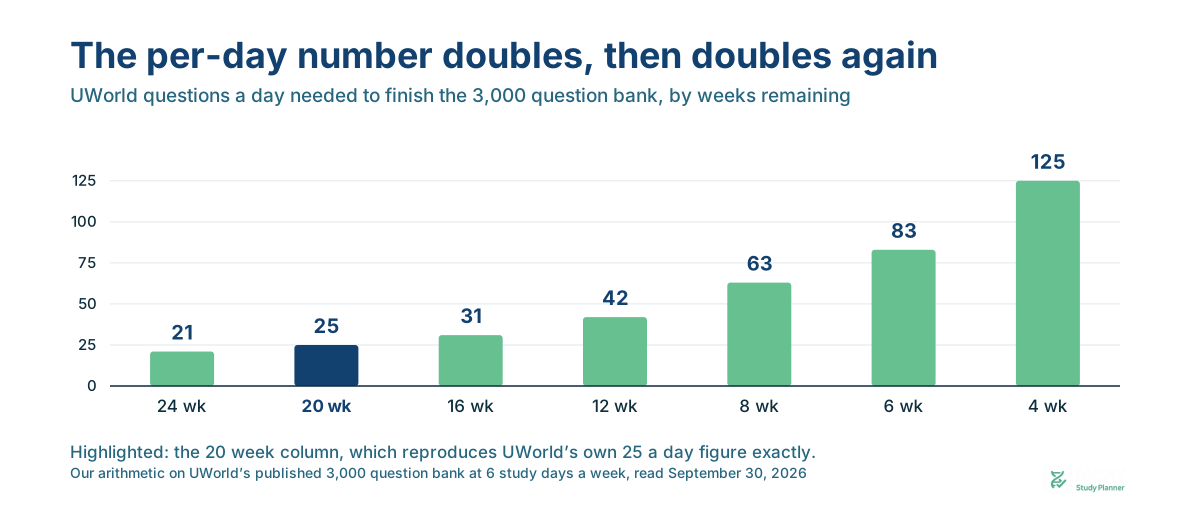
The 30-second answer: UWorld’s QBank listed 3,000+ questions on September 30, 2026. Count your study days, divide, and check the hours. At 6 study days a week that is 21 questions a day with 24 weeks left, 31 with 16 weeks, 63 with 8 weeks and 125 with 4 weeks, by our arithmetic. Anything past about 40 a day costs more than 2.5 hours of UWorld alone on a study day, before content review, before AAMC material, before full lengths. If the whole bank does not fit your timeline, stop trying to finish it and filter it by your weakest content instead.
In this guide
- UWorld’s own answer is 25 a day, and it is a 20-week answer
- How many questions a day, by weeks left
- The number that actually decides this is hours
- Why the per-day advice you will read is too high
- If the bank does not fit, pick which 40 percent
- When to open UWorld
- What your percent correct does and does not mean
- What UWorld is not
- Every number on one page
UWorld’s Own Answer Is 25 a Day, and It Is a 20-Week Answer
We read UWorld’s MCAT QBank page on September 30, 2026. Buried in its FAQ is the only per-day arithmetic anyone on this search actually shows:
“As a general guide, if you have a 6-month plan (approx. 120 study days) and our QBank has 3,000 questions, an average of 25 questions per day is a sustainable target.”
That is a good answer. It is also a conditional one, and the condition matters more than the number.
Notice what UWorld calls a six-month plan. It is 120 study days. At 6 study days a week, 120 study days is 20 weeks, not 26. So the 25-a-day figure is a 20-week number wearing a six-month label. A reader with a genuine 26-week runway needs fewer than 25 a day. A reader with 10 weeks needs far more.
UWorld adds one sentence that most summaries drop: “You will also need to allocate time to take and review the UWorld full length practice exams.” The QBank ships with 2 of them. That time is not in the 25.
How Many Questions a Day, by Weeks Left
Here is the same division UWorld did, run across every timeline instead of one. The bank is 3,000 questions, which is the figure on UWorld’s product page as of September 30, 2026. We assume 6 study days a week and one rest day. This table is our arithmetic, not UWorld’s.
| Weeks until test day | Study days at 6 a week | Questions a day to finish 3,000 |
|---|---|---|
| 24 | 144 | 21 |
| 20 | 120 | 25 |
| 16 | 96 | 31 |
| 12 | 72 | 42 |
| 8 | 48 | 63 |
| 6 | 36 | 83 |
| 4 | 24 | 125 |
The 20-week row reproduces UWorld’s own number exactly, which is a useful check that the assumptions line up.
The rows below it are the interesting ones. Between 16 weeks and 8 weeks the required pace doubles. Between 8 weeks and 4 weeks it doubles again. Finishing the bank is not a slightly harder goal on a short timeline. It is a different activity.
Your two inputs here are the same two the planner asks for, a test date and the days you can actually study, so if you want the calendar rather than the table you can build your MCAT schedule and let it place the blocks. The hours per week by timeline in our step-by-step plan shows where the rest of the week goes.
The Number That Actually Decides This Is Hours
A question count is not a time budget. Convert it and the short timelines stop being ambitious and start being impossible.
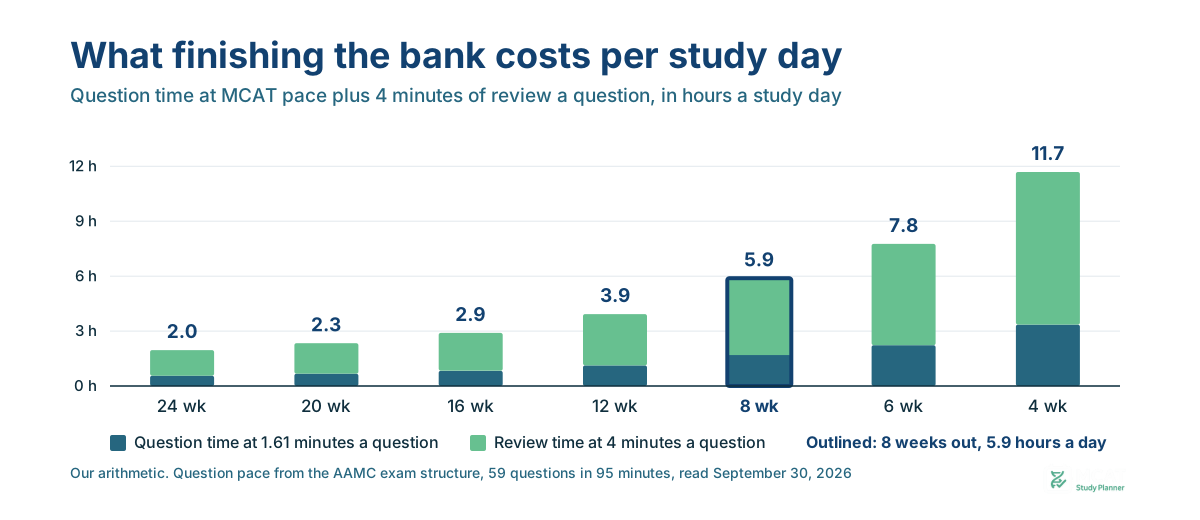
Two ingredients. The AAMC publishes the pace: its Chem/Phys and Bio/Biochem sections are each 59 questions in 95 minutes, and Psych/Soc is the same, read from the AAMC exam-structure chapter on September 30, 2026. That is 1.61 minutes a question at test pace.
Review is the other ingredient, and nobody publishes a number for it because it depends on you. We use two, and we state them rather than hiding them. Light review is 2 minutes a question, meaning you read the explanation on the ones you missed. Deep review is 4 minutes a question, meaning you read every explanation including the ones you got right, which is exactly what the AI Overview on this search tells you to do.
| Weeks left | Questions a day | Hours a day, light review | Hours a day, deep review |
|---|---|---|---|
| 24 | 21 | 1.3 | 2.0 |
| 20 | 25 | 1.5 | 2.3 |
| 16 | 31 | 1.9 | 2.9 |
| 12 | 42 | 2.5 | 3.9 |
| 8 | 63 | 3.8 | 5.9 |
| 6 | 83 | 5.0 | 7.8 |
| 4 | 125 | 7.5 | 11.7 |
Read the 8-week row again. Finishing the bank with deep review costs 5.9 hours on every study day, which is 35.4 hours a week of UWorld and nothing else. No content review. No AAMC question packs. No full lengths, which cost about 7 hours 30 minutes of seated time each per the AAMC.
Against our analysis of 43 real reports, where the median total was 475 hours across an entire prep, a 35-hour UWorld week is not a sustainable slice of a study plan. It is the study plan.
Do this now: count your actual study days between today and test day, not your calendar days. Divide 3,000 by that number. If the answer is above 40, you are not going to finish the bank, and planning as though you will is what breaks the rest of the schedule.
Why the Per-Day Advice You Will Read Is Too High
The advice is not wrong. It is old, and the bank grew underneath it.
We read five Student Doctor Network threads directly on September 30, 2026. Put in order, they date the bank:
| Source read | Date | Bank size stated |
|---|---|---|
| SDN thread 1284582 | October 2017 | ”all 1,100 World questions” |
| SDN thread 1292467 | December 2017 | ”about 1000 questions right now” |
| SDN thread 1472230 | November 2022 | ”approximately 2,000 questions” |
| UWorld MCAT QBank page | September 2026 | 3,000+ |
Now run the old advice against the new bank. In the October 2017 thread a poster writes that at about 90 questions a day “you could finish all the questions within the 15 day free trial.” That was true: 1,100 questions at 90 a day is 12.2 study days. The same 90 a day against 3,000 questions takes 33.3 study days, and the free trial is now 7 days and 100 questions with no credit card, per UWorld’s page on September 30, 2026.
In the November 2022 thread a poster writes: “There are approximately 2,000 questions, which is approximately three weeks if you do 100 problems per day.” Also true at the time, 20 study days. Against 3,000 it is 30 study days, five weeks at 6 days a week.
The bank is roughly 2.7 times its late-2017 size and 1.5 times its late-2022 size. Every per-day figure inherited from that era understates the job by the same factor.
The Google AI Overview for this search recommends 40 to 60 questions a day. By our arithmetic, 40 a day clears 3,000 questions in 75 study days, which is 12.5 weeks, and 60 a day clears it in 50 study days, or 8.3 weeks. So that range is an 8-to-12-week prescription being handed to everyone, including the student who has six months and should be doing 21 a day.
If the Bank Does Not Fit, Pick Which 40 Percent
Flip the question. Instead of asking what pace finishes the bank, ask what a sustainable pace actually reaches.
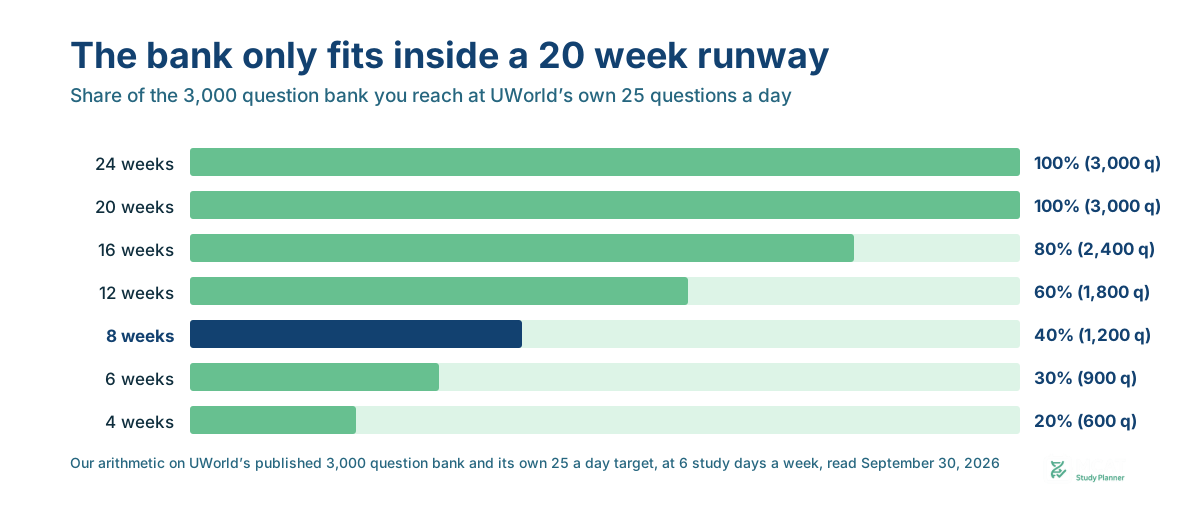
Hold UWorld’s own 25 a day steady and vary the runway. This is our arithmetic on UWorld’s published figures.
| Weeks left | Questions at 25 a day | Share of the 3,000 bank |
|---|---|---|
| 24 | 3,000 (bank runs out with 24 days spare) | 100 percent |
| 20 | 3,000 | 100 percent |
| 16 | 2,400 | 80 percent |
| 12 | 1,800 | 60 percent |
| 8 | 1,200 | 40 percent |
| 6 | 900 | 30 percent |
| 4 | 600 | 20 percent |
The bank only fits inside a 20-week runway at a sustainable pace. Below that, you are choosing a subset whether you admit it or not, and the students who do badly here are the ones who choose it by accident, working front to back and running out of time in whatever happens to be last.
Choose it on purpose. In the February 2020 SDN thread we read, a poster points out that you can build your own quizzes inside UWorld by topic, “it even allows you to break it down to specific topics within gen chem, physics, etc.” That filter is the whole strategy on a short timeline. Spend your 1,200 questions on the content categories where your diagnostic or your last full length was weakest, not on the ones you already pass.
If the subscription itself is the constraint rather than the calendar, our free MCAT prep compilation covers what to use instead.
When to Open UWorld
Earlier than the schedules imply. The February 2020 SDN thread is blunt about this. One reply: “A common mistake students make across MCAT and board studying is waiting too long to open UWorld. UW is as much a total learning system as it is question bank.” Another: “You can start UWorld very early as well. You don’t need to do a ton of content before, but realize that you won’t get many questions right.”
That is not universal advice in the thread. A different poster in the same discussion argues for UWorld after book passages and before AAMC material, and the November 2022 thread puts UWorld after content review, then 2 to 4 weeks of AAMC material at the end. Both orders appear among people who scored well.
What reconciles them is the topic filter. Starting early does not mean random questions across content you have not seen. It means running the questions for the unit you just reviewed, which is why the custom-quiz feature matters more than the start date. Our 10-week content review schedule shows where those blocks sit against the review calendar.
One practical note from the same thread, from a poster who credits “diligently doing 30ish UWorld questions a day + reviewing why I got questions wrong”: the reviewing is named in the same breath as the count. Nobody in any thread we read credits the count alone.
What Your Percent Correct Does and Does Not Mean
The most common question on this search after the per-day one is whether 60 percent is good. UWorld answers it on its own page, read September 30, 2026: “Consistently scoring 60% or higher indicates a strong grasp of the material.”
Read the sentence next to it too. “QBank performance is a great learning and diagnostic tool, but full-length practice exams are the most accurate predictors of a scaled score.” UWorld is telling you its own percentage is not a score prediction, and it says your percent correct “should trend upward”, which frames it as a trend line rather than a number with a meaning on any given day.
A student testimonial printed on the same page says the QBank “is typically more challenging than actual MCAT test questions attributing to a higher score as a result.” That is a student’s words published by UWorld, not a UWorld measurement, and there is no published study behind it. Treat it as a reason not to panic at a low percentage, not as a conversion factor.
If you want a scaled number, that comes from full lengths. Our comparison of every full length compared covers what each one predicts, and the full-length calendar covers where they go.
What UWorld Is Not
It is not AAMC material, and the SDN threads are consistent on this in a way the marketing pages are not. From the January 2018 thread: UWorld questions are “definitely nowhere close to AAMC, but good for content review. Explanations are great so it’s good for checking what you need to study.”
That is the right job description. UWorld’s strength on every thread we read is the explanation, not the question. Plan the time accordingly: the review column in the hours table above is not overhead on the real work, it is the real work.
It is also not a full-length substitute. The QBank ships with 2 practice exams. The AAMC sells its own, and the pacing you need on test day comes from those, at 1.61 minutes a question in the science sections.
Do this now: set your block size to 59, the real section length per the AAMC, once you are past the first few weeks. A 59 question block plus its review is one whole study session, and it is the unit your test day is actually built from.
Every Number on One Page
| Item | Figure | Where it comes from |
|---|---|---|
| UWorld MCAT QBank size | 3,000+ questions, 2 practice exams | UWorld product page, September 30, 2026 |
| UWorld’s recommended pace | 25 a day over about 120 study days | UWorld QBank FAQ, September 30, 2026 |
| Free trial | 7 days, 100 questions, no credit card | UWorld QBank page, September 30, 2026 |
| Also included | 4,000 flashcard quiz questions, 450 concept check questions | UWorld QBank page, September 30, 2026 |
| MCAT science section | 59 questions in 95 minutes | AAMC exam structure, September 30, 2026 |
| Test pace per question | 1.61 minutes | Our arithmetic on the AAMC figure |
| Questions a day at 24 weeks | 21 | Our arithmetic, 6 study days a week |
| Questions a day at 16 weeks | 31 | Our arithmetic |
| Questions a day at 8 weeks | 63 | Our arithmetic |
| Questions a day at 4 weeks | 125 | Our arithmetic |
| Cost of the 8-week pace | 3.8 to 5.9 hours a study day | Our arithmetic at 2 or 4 minutes review a question |
| Bank reached at 25 a day, 8 weeks out | 1,200 questions, 40 percent | Our arithmetic |
| Bank size, late 2017 | about 1,000 to 1,100 | SDN threads 1284582 and 1292467, read September 30, 2026 |
| Bank size, late 2022 | about 2,000 | SDN thread 1472230, read September 30, 2026 |
| Good QBank percentage | 60 percent or higher | UWorld QBank FAQ, September 30, 2026 |
The per-day number is the easy part once you know your study days. If you would rather not count them by hand, the free MCAT study schedule generator takes your test date and your available hours and places the question blocks, the content review and the full lengths in one calendar.
Written by
MCAT Study Planner Team
Last updated 9/30/2026