The MCAT Noteboard: Nine Pages for 230 Questions
By MCAT Study Planner Team • Updated 10/24/2026
Short answer: you get nine wet-erase pages, each 14 inches by 8.5 inches, plus a cover page you may not write on, and a fine point marker. That is it for the whole exam. Across 230 questions it works out at one page every 25.6 questions, or one page every 41.7 minutes of scored testing time. Every figure here was read on students-residents.aamc.org on October 24, 2026.
Most pages about the noteboard stop at the description. The useful question is not what it looks like, it is whether nine pages is enough.
Nobody does that arithmetic, so here it is, along with what the exchange actually costs you and what the practice booklets on sale do and do not tell you.
The 30-second answer: Nine graph-lined wet-erase pages at 14 by 8.5 inches, a cover page you cannot use, and a fine point marker. Nine pages across 230 questions is 25.6 questions a page and 4.66 square inches a question. You can ask for another booklet, but it is an exchange: the administrator takes the old one, equations and all. You may not erase, tear, or use it during a break. A practice booklet costs $21.99, and the same page size costs $13.12 if you build it yourself.
In this guide
- What the AAMC actually hands you
- Nine pages across 230 questions
- The five things you may not do with it
- What the exchange actually costs you
- Every practice booklet on sale
- The marker, and the brand nobody can source
- Where the noteboard fits in your plan
- The whole spec on one page
What the AAMC Actually Hands You
The Noteboard Booklets chapter of the MCAT Essentials for Testing Year 2027 puts it in one sentence: “You will be provided with a noteboard booklet for note taking during the exam. It contains nine 14-by-8.5-inch wet-erase pages.”
The Pearson VUE sheet the AAMC publishes alongside it adds the detail that chapter leaves out. The booklet is white and laminated. There is a cover page before those nine, and the sheet says plainly that it “can’t be used for notes”. The nine pages behind it are graph-lined. You get the booklet and a fine point marker before you begin, and you may not touch either until the administrator starts your exam.
Fourteen by eight and a half inches is US legal size, turned portrait. It is noticeably taller than the letter paper you have been drafting on all year, which is one of the few things actually worth rehearsing.
One wrinkle is worth naming, because the two AAMC documents are not perfectly aligned. The Essentials says nine pages. The Pearson sheet carries a callout telling you to “take notes front and back”. Every figure in this article is computed on nine writable pages, which is the number the AAMC states in prose. If the backs of your booklet take writing, you have more room than the arithmetic below assumes, not less.
Nine Pages Across 230 Questions
Here is the number nobody publishes. The AAMC’s own Exam Overview table gives the exam 230 scored questions: 59 in Chem/Phys, 53 in CARS, 59 in Bio/Biochem and 59 in Psych/Soc. The four sections run 95, 90, 95 and 95 minutes, which is 375 minutes of scored testing time.
Put the two documents together and nine pages is 25.6 questions per page, or one page every 41.7 minutes. Both are our arithmetic, and both assume you spread the booklet evenly across the day, which nobody actually does.
The area figure is the one that lands. Each page is 119 square inches, so the booklet holds 1,071 square inches in total. Divided by 230 questions that is 4.66 square inches per question, a square about 2.2 inches on a side. That is the real budget, and it is smaller than the booklet looks when it is sitting closed on the desk.
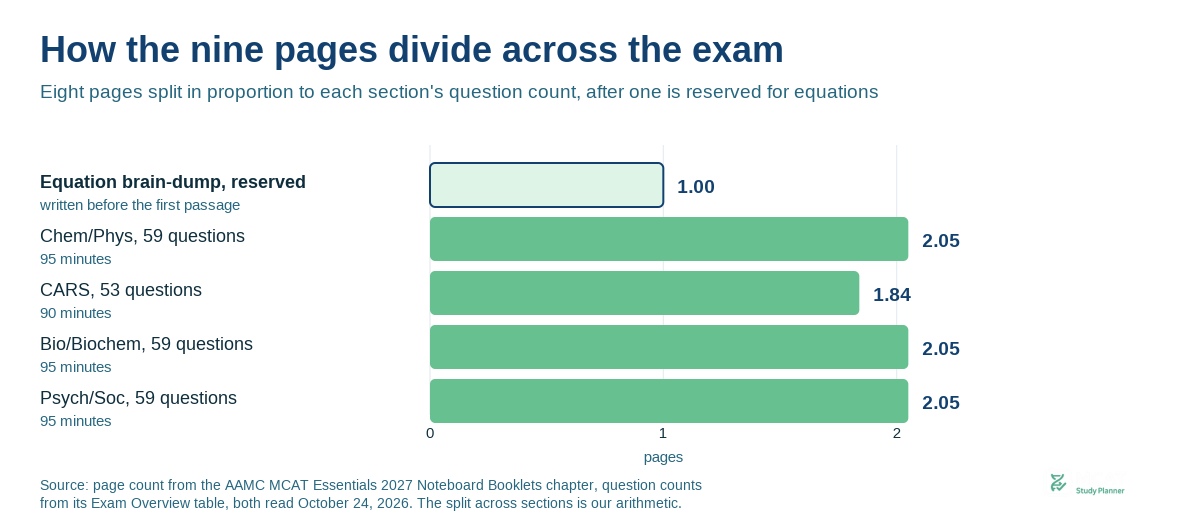
Now subtract the page almost everyone spends before the first passage. If page one goes to an equation brain-dump, the remaining eight pages carry 230 questions at 28.75 questions per page. Split those eight in proportion to each section’s question count and you get the allocation below.
| Use | Pages | Questions covered |
|---|---|---|
| Equation brain-dump, before section one | 1.00 | None |
| Chem/Phys | 2.05 | 59 |
| CARS | 1.84 | 53 |
| Bio/Biochem | 2.05 | 59 |
| Psych/Soc | 2.05 | 59 |
Proportional allocation is our arithmetic and it is deliberately naive. In practice CARS consumes far less than 1.84 pages and Chem/Phys consumes more than 2.05, so treat the CARS row as the reserve you borrow against. Our section-by-section MCAT timing guide has the per-question seconds these page counts are paced against.
The Five Things You May Not Do With It
The Essentials chapter lists the restrictions explicitly. Four are prohibitions and one is a condition, and at least one of them surprises people every year.
- You may not rip, tear or separate the booklet. It stays in one piece and it stays on your desk.
- You may not conceal or remove it, in whole or in part, from the exam room. That includes during breaks and at the end of the exam. The Pearson sheet calls removing it an act of misconduct.
- You may not wipe or erase any of your notes from the booklet. This is the one worth reading twice. Everyone knows the booklet is wet erase and therefore hard to erase mid-exam. Fewer people know that erasing is separately prohibited. It is a rule, not a property of the marker.
- You may not write on it while your exam is paused or in break mode.
- You may not use it on returning from a break before the next section begins. The AAMC’s wording is that you must end your break before you may use the noteboard, which rules out the common plan of re-dumping your equations during the 30-minute mid-exam break.
Point five is the one that breaks a popular strategy. If you were planning to rewrite your Bio/Biochem equations during the long break, you cannot. You write them once the section is running, on the clock.
For completeness on the wider rules: notes, test prep pages and review books may not come into the test centre with you at all, and while they can sit in your locker you may not access them on any break. That is from the AAMC’s Testing Center Regulations and Procedures page, read the same day. Our test day checklist from 520+ scorers covers the rest of the check-in sequence.
What the Exchange Actually Costs You
Every article about the noteboard tells you that you can get another one. Almost none of them quotes the sentence.
The AAMC’s wording is: “If you require an additional noteboard booklet during the exam, please raise your hand to alert the test administrator, who will exchange your original booklet for a new one.”
Exchange. Not supplement, not add. The administrator takes the booklet you have been writing in and gives you a clean one.
That turns the equation brain-dump on page one from a safety net into a liability. If you fill the booklet in Psych/Soc and swap it, the amino acid chart you wrote at 8:10 in the morning leaves the desk with it, and you may not rewrite it during a break. You would have to spend scored section time reconstructing it.
Do this on your next full length: count the pages you actually fill. If you are past five by the end of Bio/Biochem, you are writing too much, and the fix is to practise shorter working now rather than to plan on an exchange. If you genuinely need the swap, do it at a section boundary, after you have copied anything you still need onto the new booklet’s first page.
Every Practice Booklet on Sale
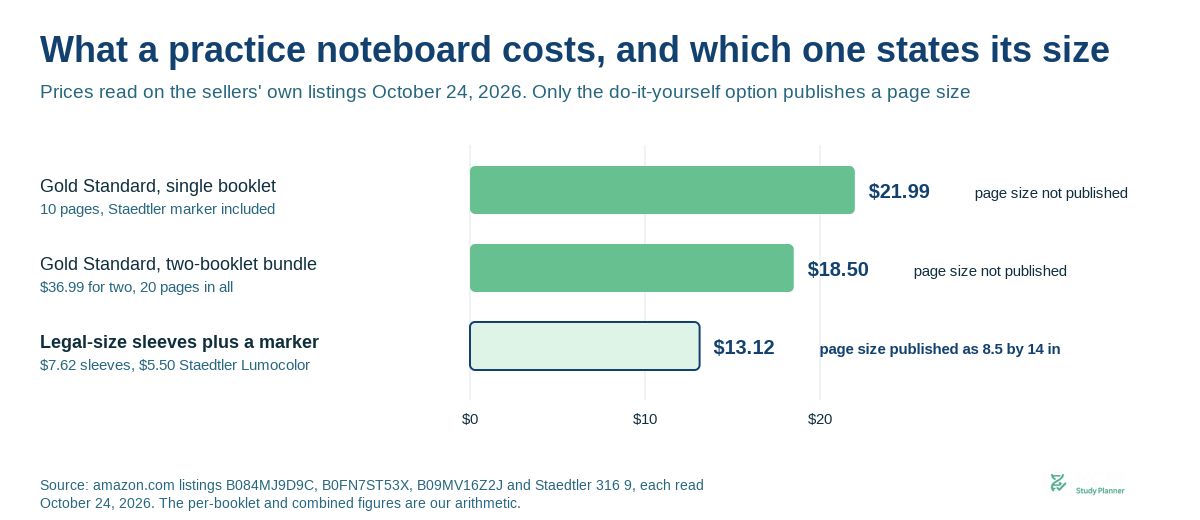
There is one real product family here, and the search results are mostly resellers of it. Prices below were read on each listing on October 24, 2026.
| Option | What you get | Price | Page size published |
|---|---|---|---|
| Gold Standard, single booklet | 10 pages, Staedtler marker included | $21.99 | No |
| Gold Standard, two-booklet bundle | 20 pages in all, markers included | $36.99, or $18.50 each | No |
| Legal sheet protectors plus a marker | 8.5 by 14 inch sleeves, one marker | $13.12 | Yes |
The single Gold Standard booklet is published by MCAT-prep.com, first edition dated January 1, 2020, spiral-bound, 10 pages, 5.9 ounces, rated 4.6 out of 5 from 290 ratings. Ten pages is the right shape: a cover plus nine, exactly like the real thing. The two-booklet bundle is published by Ruveneco Inc at 20 pages in total, 9.5 ounces, rated 5.0 out of 5 from a single rating, with other new and used copies from $35.14.
Here is the finding that matters, and it is a gap rather than a number. Neither listing publishes a page size anywhere. We checked both pages in full for a dimensions field and for any inch measurement at all, and there is none. The AAMC publishes an exact page size twice over. The products sold to simulate it publish none, so the one specification a buyer would want to verify before paying cannot be verified.
That is also why the cheapest option in the table is the only one with a “yes” in the last column. An 8.5 by 14 inch legal sheet protector states its size because stationery always does: $7.62 for a Samsill pack, or $11.92 for the Avery heavyweight equivalent. Add a single Staedtler Lumocolor non-permanent fine point marker at $5.50 and you have the exact page dimensions for $13.12. What you do not get is the AAMC’s laminated wet-erase surface, and none of the sheet-protector listings claims wet-erase compatibility, so that is the trade.
Our honest read: the booklet is worth buying if you will otherwise never rehearse the constraint, and skippable if you are disciplined enough to cap yourself at nine legal-size pages on every full length. The thing being bought is the limit, not the plastic.
The Marker, and the Brand Nobody Can Source
You will see the test-day marker described as a Staedtler Lumocolor in a lot of places. Both AAMC documents say something less specific.
The Essentials and the Pearson VUE sheet each call it a “fine point marker” and name no manufacturer. The Staedtler attribution appears to come from the practice product, whose Amazon title literally includes “with Staedtler Marker”. That is a real fact about the practice booklet and not a fact about test day.
Practically it changes little, since a fine-point wet-erase marker is a fine-point wet-erase marker. It matters for a different reason: if you are rehearsing with a specific pen because you read that it is the official one, you are rehearsing a detail nobody has sourced. Rehearse the nib width instead. Fine point writing is smaller than you write by default, which is part of why nine pages goes further than it sounds.
Where the Noteboard Fits in Your Plan
The noteboard is not a study topic. It is a constraint you either practise under or meet for the first time on test day, and the only place it belongs is inside your practice exams.
Use it on every scored full length rather than on question blocks. The constraint is cumulative across a seven and a half hour day, which is exactly what the six official practice exams reproduce and what a 59-question block does not. Our guide to every full length compared covers which exams to spend on those rehearsals.
The arithmetic habit matters more than the paper. Working inside 4.66 square inches a question means estimating rather than computing, which is a skill with its own drill block: MCAT math without a calculator sets out what the AAMC actually requires and how to practise it to speed.
If you have not yet mapped where those full lengths sit, the inputs are the ones you already know: your test date, the hours you have each week and the resources you own. Feed them into the free MCAT study schedule generator and the practice exams land on real dates, which is the only way the booklet rehearsal happens more than once.
The Whole Spec on One Page
| Item | What the AAMC publishes |
|---|---|
| Pages | Nine graph-lined wet-erase pages, plus a cover page you may not write on |
| Page size | 14 inches by 8.5 inches, US legal, portrait |
| Writing tool | A fine point marker, no brand named |
| When you get it | Before the exam, but you may not use it until the administrator starts you |
| Running out | Raise your hand for an exchange; the original booklet goes back |
| Erasing | Prohibited, and the surface is wet erase |
| Tearing or separating | Prohibited |
| Removing it from the room | Prohibited, including during breaks and at the end |
| Using it during a break | Prohibited; you must end the break first |
| Questions it has to cover | 230, across 375 minutes of scored testing |
| Our arithmetic | 25.6 questions a page, 41.7 minutes a page, 4.66 square inches a question |
Everything in the left-hand column comes from the Noteboard Booklets chapter of the MCAT Essentials for Testing Year 2027, the Pearson VUE test-day sheet, and the Exam Overview table, all read on students-residents.aamc.org on October 24, 2026. The last row is ours, computed from the two figures above it.
Nine pages is enough. It is enough because the exam was built around it, and because most of what people write down on test day is reflex rather than need. The examinees who run out are not the ones with more to calculate, they are the ones who never counted. Build the count into your personalized study plan and you will know your own number long before test day.
Written by
MCAT Study Planner Team
Last updated 10/24/2026