Best MCAT Flashcards: Card Counts and Prices Compared
By MCAT Study Planner Team • Updated 10/22/2026
Short answer: the free options are the best buy. Magoosh gives you about 230 cards at no cost and Anki is free on everything except iOS, where it is $24.99 once. Among products you pay for, Kaplan’s 1,000-card set at $34.34 is the cheapest per card, and the 4,000 UWorld cards everyone recommends require a $1,199 course. All prices read on each seller’s own page on October 22, 2026.
Every ranking page on this search treats card count as the quality signal. None of them puts a price next to one.
That matters more than it sounds, because the single most recommended product on the search is quietly the most expensive, and the single most searched one does not exist.
The 30-second answer: Start with Anki, free, or Magoosh’s 230 cards, also free. If you want a printed deck, Kaplan’s 1,000 cards at $34.34 costs $34.34 per thousand and nothing else comes close. UWorld’s 4,000 flashcards are not in the $339 QBank; they come with the Comprehensive Prep Course from $1,199, which is $299.75 per thousand cards. The AAMC sells no flashcards at all. And measure a deck in hours, not cards: 4,000 cards is about 53.3 hours of reviewing, which is 11.2 percent of a 475-hour study budget.
In this guide
- Every product, priced and counted
- The 4,000 UWorld cards are not in the QBank
- The AAMC does not sell flashcards
- What is actually free and what is a trial
- The printed decks, and how old they are
- Count the hours, not the cards
- Where flashcards go in your week
- Every product on one page
Every Product, Priced and Counted
Each figure below was read on the seller’s own page or its own store listing on October 22, 2026. Where a seller publishes no card count, the table says so rather than guessing.
| Product | What it is | Cards | Price | Spaced repetition |
|---|---|---|---|---|
| Anki plus a community deck | Software | Your deck’s size | Free, $24.99 once on iOS | Yes, it is the original |
| Magoosh MCAT Flashcards | Web and app | About 230 | Free | Adaptive review, not stated as spaced repetition |
| StudyStack MCAT | User-generated sets | 10 to about 120 a set | Free | Varies by set |
| Kaplan MCAT Flashcards | Printed box | 1,000 | $34.34 | No |
| Test Prep Books Practice Question Study Cards | Printed box | Not published | $47.99 | No |
| Test Prep Books MCAT Prep Study Cards | Printed box | Not published | $59.99 | No |
| Mometrix MCAT Prep Study Cards | Printed box | 1,400 plus | $89.99 | No |
| Princeton Review Essential MCAT | Printed box plus online | Not published in the listing | $98.87 | No |
| MedSchoolBro MCAT Flashcard Set | Printed, illustrated | 477 | $119.00, or $57.00 a subject | No, despite the copy |
| Barron’s MCAT Flash Cards | Printed box | Not published | $176.09 | No |
| King of the Curve | App | Not published | $750 on its own banner | Yes |
| UWorld MCAT Flashcards | Inside a course | 4,000 plus | Comprehensive Prep Course from $1,199 | Yes |
Divide price by cards and the ranking inverts. The products at the top of every recommendation list are the ones that cost the most per card.
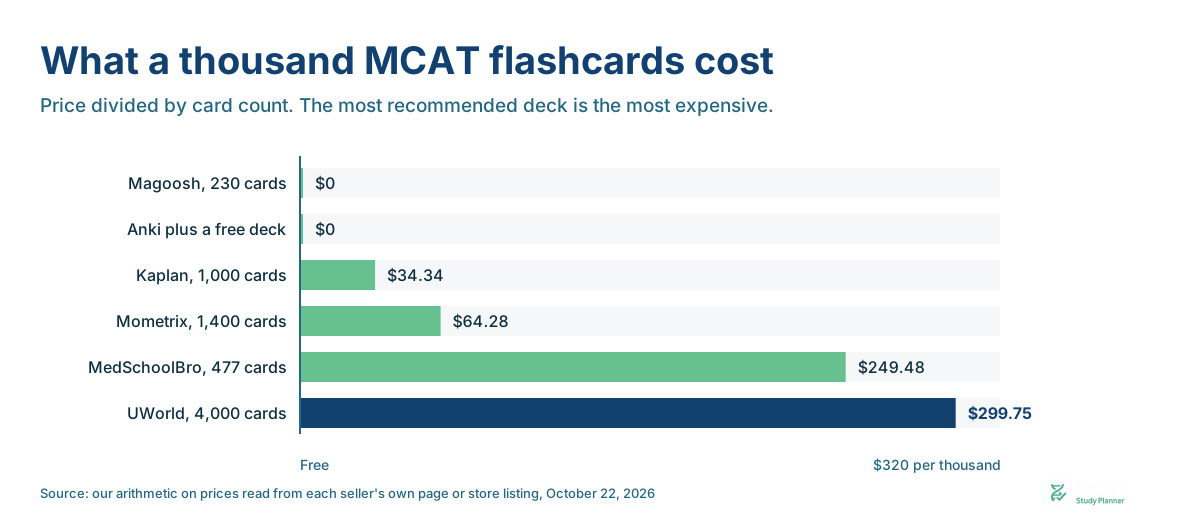
Those per-thousand figures are our arithmetic: the price divided by the card count, times a thousand. Kaplan’s 1,000 cards at $34.34 give $34.34 per thousand. MedSchoolBro’s 477 cards at $119.00 give $249.48. The UWorld figure is $1,199 divided by 4,000, which is $299.75, and it carries a caveat the next section explains.
The 4,000 UWorld Cards Are Not in the QBank
This is the one thing worth knowing before you spend anything.
Google’s AI Overview for this search recommends “UWorld MCAT Flashcards (4,000+ AAMC-aligned cards with spaced repetition)” and names no price. Most readers will assume those cards come with the UWorld product they have heard of, the QBank.
They do not. UWorld’s own flashcards page, read October 22, 2026, says it plainly: “UWorld’s 4,000+ MCAT Flashcards available in the Comprehensive Prep Course are designed by experts”. Its UWorld versus Anki comparison table makes the same point in the Time to Value row, which reads “Instant access for Comprehensive Prep Course users, no setup or searching for high quality decks”.
The Comprehensive Prep Course starts at $1,199, read the same day on UWorld’s question bank page. The tiers below it are the Core Prep Course from $599 and the QBank from $339.
What the $339 QBank does include is a different feature with a similar name. UWorld’s own feature list describes it as a “Flashcard Tool With Spaced-Repetition” that lets you “Create your own flashcards from existing UWorld content”. That is a blank deck and a scheduler, not 4,000 written cards.
A separate line in the same list, “4,000 Flashcard Quiz Questions”, is described as “adaptive end-of-lesson quizzes”, which is lesson material rather than a deck you study from.
Do this now: if you were planning to buy the UWorld QBank for its flashcards, stop and reread what you are buying. The QBank gives you a tool to write your own cards. If what you want is the 4,000 pre-written ones, the cheapest route is the $1,199 course, and a free Anki deck plus our MCAT Anki settings gets you spaced repetition for nothing.
UWorld does run a 7-day free trial, so you can confirm which tier holds what before paying.
The AAMC Does Not Sell Flashcards
About 4,800 searches a month go to “aamc flashcards mcat” in our own keyword data. The AAMC store answers them by holding positions 1 and 10 on that search for a product it does not sell.
We read the AAMC store’s full MCAT Prep catalogue on October 22, 2026. The word flashcard does not appear on it once.
What the AAMC does sell is question material: the MCAT Official Prep Online-Only Bundle at $336.15, two Section Banks, the CARS Question Bank, the subject question packs and practice exams two through six. Our guide to every question bank compared prices that line end to end.
So if a product is advertised to you as official AAMC flashcards, it is somebody else’s deck written from AAMC content. That is not necessarily bad, but it is not official, and nobody is selling you the AAMC’s own cards because there are none.
What Is Actually Free and What Is a Trial
The SERP uses the word free loosely. Here is the split, all of it read on October 22, 2026.
Genuinely free. Magoosh publishes “around 230 of the most common and challenging concepts” as free online flashcards on web, iPhone and Android. The App Store listing that ranks fifth on this search, “MCAT Prep: MCAT Flashcards”, is the same product by the same publisher, listed Free, holding 4.8 from 755 ratings. StudyStack’s MCAT page is free and user-generated, with sets running from 10 to about 120 cards and no curation.
Free with one fee. Anki is free on desktop, web and Android. The iOS app, AnkiMobile Flashcards by Anki Software, LLC, costs $24.99 once. That is the entire cost of the Anki route, and it buys the best scheduler in the category. Our comparison of the best MCAT Anki decks covers which community deck to load into it.
Free as in trial. King of the Curve offers “TRY FREE” on a product its own site banner prices at “$750 (reg. $1,000)“. UWorld’s free trial runs 7 days. Neither is a free flashcard product; both are paid products with a door held open.
For everything else on this site that costs nothing, our compilation of free MCAT resources is the wider list.
The Printed Decks, and How Old They Are
Physical sets have one real advantage, which is that a screen is not involved, and one real disadvantage, which is that cardboard cannot schedule anything.
Worth noting when you read product copy: MedSchoolBro’s page says its printed cards reinforce understanding “through spaced repetition”. A printed deck does not know what you got wrong yesterday. With paper, you are the algorithm.
The other thing the listings do not advertise is their age.
| Printed set | Published | Price | Cards |
|---|---|---|---|
| Barron’s MCAT Flash Cards | January 1, 2010 | $176.09 | Not published |
| Princeton Review Essential MCAT: Flashcards + Online | December 8, 2015 | $98.87 | Not published in the listing |
| Kaplan MCAT Flashcards + App | August 5, 2014 | $39.70 | Not published |
| Kaplan MCAT Flashcards: 1000 Cards | July 7, 2020 | $34.34, list $49.99 | 1,000 |
| Test Prep Books MCAT Prep Study Cards 2026-2027 | October 26, 2021 | $59.99, list $77.99 | Not published |
| Mometrix MCAT Prep 2026-2027 Study Cards | July 26, 2024 | $89.99, list $121.99 | 1,400 plus |
| Test Prep Books Practice Question Study Cards 2026-2027 | January 2, 2025 | $47.99 | Not published |
| MedSchoolBro MCAT Flashcard Set | Not published | $119.00, list $171.00 | 477 |
Two things fall out of that table.
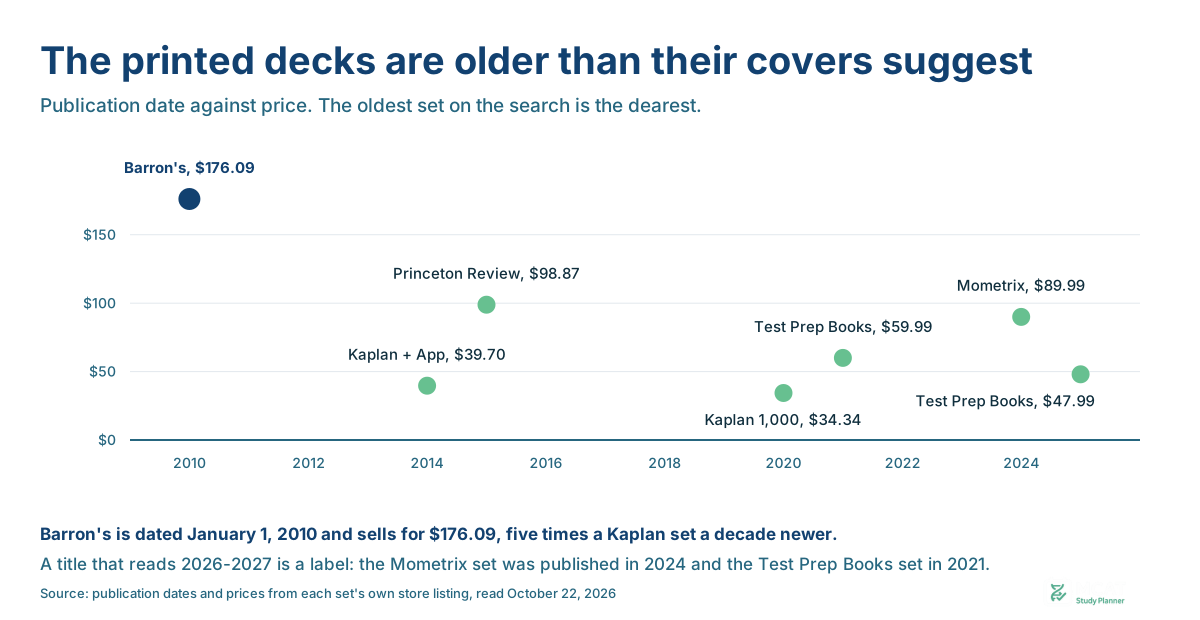
The most expensive printed deck on the search is the oldest. Barron’s is dated January 1, 2010 and sells for $176.09, which is five times the price of a Kaplan set a decade newer. A price like that usually means a book is out of print rather than in demand.
And a title that says 2026-2027 is a label, not a publication date. The Mometrix set was published in July 2024 and the Test Prep Books set in October 2021. The MCAT content outline has not moved underneath them, so this is less damaging than it sounds, but you are not buying anything written this year.
MedSchoolBro’s is the one printed set that publishes an exact count, and it is specific: 123 cards for chemistry, physics and organic chemistry, 160 for psychology and sociology, 194 for biology and biochemistry, double-sided, 477 in all. At $119.00 for the bundle or $57.00 a subject, it is the most expensive per card of any printed set here, and it is also the only one built around custom illustrations.
Count the Hours, Not the Cards
Every page on this search ranks decks by size. Size is the cost, not the benefit.
We publish the arithmetic for this in our MCAT Anki settings guide: on a typical MCAT timeline each card takes about six review touches, at about eight seconds a card. Thirty new cards a day settles near 180 reviews a day, or about 24 minutes.
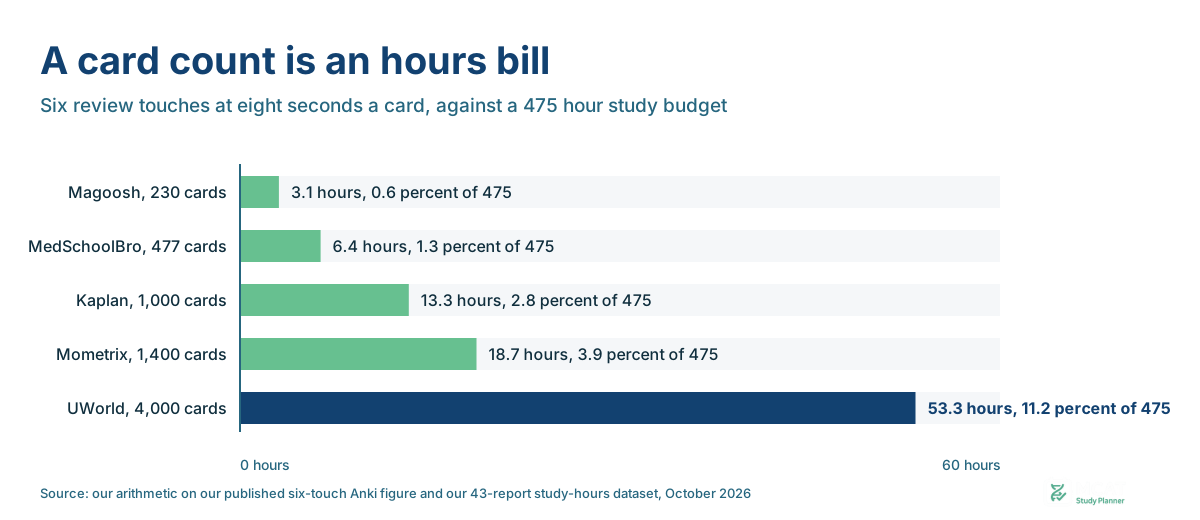
Apply that to each deck and a card count becomes an hours figure. This is our arithmetic, not a vendor’s: cards times six touches times eight seconds. It describes software that schedules cards, so for printed decks treat it as the equivalent workload rather than a schedule anything will enforce.
| Deck | Cards | Hours to work through | Share of a 475-hour budget |
|---|---|---|---|
| Magoosh | 230 | 3.1 | 0.6 percent |
| MedSchoolBro | 477 | 6.4 | 1.3 percent |
| Kaplan | 1,000 | 13.3 | 2.8 percent |
| Mometrix | 1,400 | 18.7 | 3.9 percent |
| UWorld | 4,000 | 53.3 | 11.2 percent |
The 475 hours is the median in our own dataset of 43 real study-time reports, which our guide to how many hours to study for the MCAT breaks down by score band.
Read the last row again. The 4,000-card deck that every list recommends costs 53.3 hours of reviewing, which is more than a ninth of a median study budget, before you have answered a single practice question.
That is the argument for a small deck you finish over a large deck you abandon. It is the same finding we reached when we counted question banks by hours rather than questions.
Where Flashcards Go in Your Week
Flashcards are a retention tool, not a learning tool. They work after you have understood something, which means they belong beside content review rather than instead of it.
Our 10-week content review schedule places the card session immediately after the content session, while the material is still fresh, and keeps it to a fixed daily block rather than letting it expand.
The cap matters more than the placement. At 30 new cards a day the review load settles near 24 minutes. Push it to 75 or 100 new cards a day and the deck alone becomes a 1.5 to 2 hour daily commitment, which is the single most common way a study week quietly breaks.
If you are building the week around a test date, hours a week and the resources you have actually bought, our free MCAT study schedule generator takes those three inputs and places the card block for you rather than leaving you to guess.
Once you are running cards daily, the workflow questions matter more than the product choice. Our guide to using Anki for the MCAT covers the daily routine, and the Anki settings guide covers the one setting that decides whether your review load stays survivable.
Every Product on One Page
Prices and counts read on each seller’s own page or store listing on October 22, 2026. Per-thousand and hours figures are our arithmetic, described above.
| Product | Cards | Price | Per 1,000 cards | Hours |
|---|---|---|---|---|
| Anki plus a free deck | Your deck’s size | Free, $24.99 on iOS | About $0 | Depends on the deck |
| Magoosh | About 230 | Free | $0 | 3.1 |
| StudyStack | 10 to 120 a set | Free | $0 | Under 1 a set |
| Kaplan | 1,000 | $34.34 | $34.34 | 13.3 |
| Mometrix | 1,400 plus | $89.99 | $64.28 | 18.7 |
| MedSchoolBro | 477 | $119.00 | $249.48 | 6.4 |
| UWorld, via the $1,199 course | 4,000 plus | $1,199.00 | $299.75 | 53.3 |
| AAMC | None sold | Not applicable | Not applicable | Not applicable |
The verdict is the same one the arithmetic keeps producing. Use Anki with a free community deck, add Magoosh’s 230 cards if you want something polished on your phone, and spend the money you saved on practice questions instead. If you want paper, Kaplan’s set is the only one that is not expensive per card.
When you know which deck you are running, put it in the calendar rather than in a list of intentions. Our MCAT study planner builds the daily card block into a schedule that already knows your test date.
Written by
MCAT Study Planner Team
Last updated 10/22/2026